
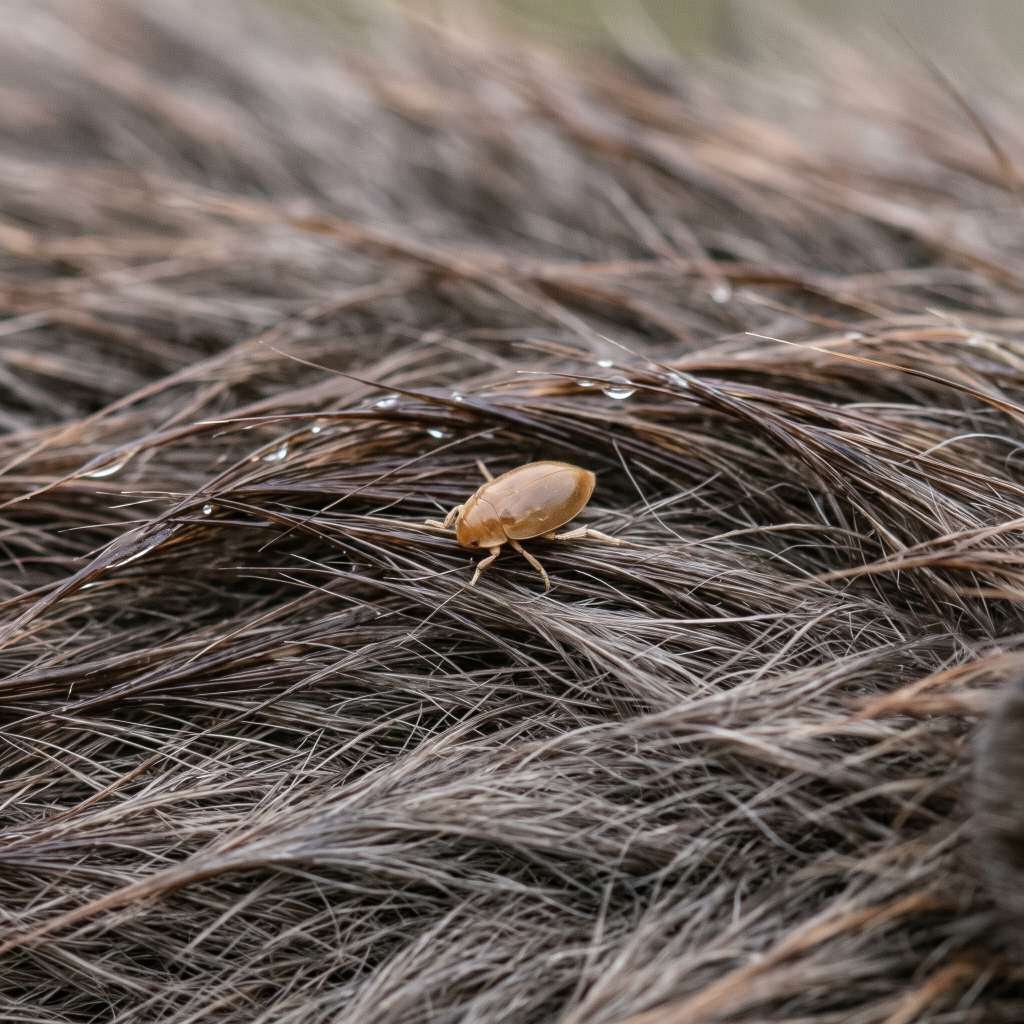
Skin a beaver, and tiny eyeless beetles may come pouring out of its fur. The beaver beetle lives nowhere else, and for over a century scientists called it a parasite. It lives on both North American beavers and Eurasian beavers.
Outside beavers, it has been found only once, on a North American river otter in California in 1998, and that was probably an accident.
It was first described in 1869, from specimens collected from American beavers at the Rotterdam zoo in the Netherlands. Its body made no sense to the scientists who looked at it. One placed it in a brand-new order of insects of its own, and it was also classified as a flea, in a new family. Only in 1872 did the American entomologist John LeConte recognize it as a beetle.
Its flat body slides between the hairs, and its legs are built for clinging and moving through thick, wet fur. Both the adults and the larvae live on the beaver. The larvae go through three growth stages without leaving the host. The only time the beetle gets off is to pupate, which it does in a small chamber of earth at the top of the beaver's lodge or burrow. Then the new adult climbs back on.
Some beavers carry almost none. Others have been found with as many as 192 adult beetles. In one study of 45 beavers, more than 60 percent had them. When a beaver dies, the beetles leave the cooling body and go looking for a new host.
Earlier researchers thought the beetle ate the beaver's skin, along with skin secretions and fluid from wounds. Even so, beavers never seemed bothered by it, and there was no sign they used the special grooming claws on their hind feet to get rid of the beetles.
In 2022, a team of German and Polish researchers took a closer look. They used modern imaging to map the adult beetle's body inside and out, including the muscles that work its mouthparts. They found the mouthparts can't damage the beaver's skin. The beetle seems to live only on liquid food, possibly with tiny bits of shed skin floating in it. Brushes on its mouthparts appear to pull that liquid up into the mouth, the same way water creeps up a paper towel.
Since it can't harm the beaver, the researchers concluded the beaver beetle is a commensal, not a parasite. That means it lives on the beaver and benefits from it without hurting it. No one has shown that the beaver gets anything back.
The beetle follows wherever beavers go. Beavers disappeared from Britain centuries ago, and the beetle went with them. In 2012, it was reported again, apparently established on beavers living wild in Scotland, the first record of the species in Britain.
Image is for illustration purposes only.
Source: Yavorskaya, Jałoszyński & Beutel, Journal of Morphology (2023) / Peck, Insecta Mundi (2006) / Duff et al., The Coleopterist (2012) / Ohio State Trappers Association