
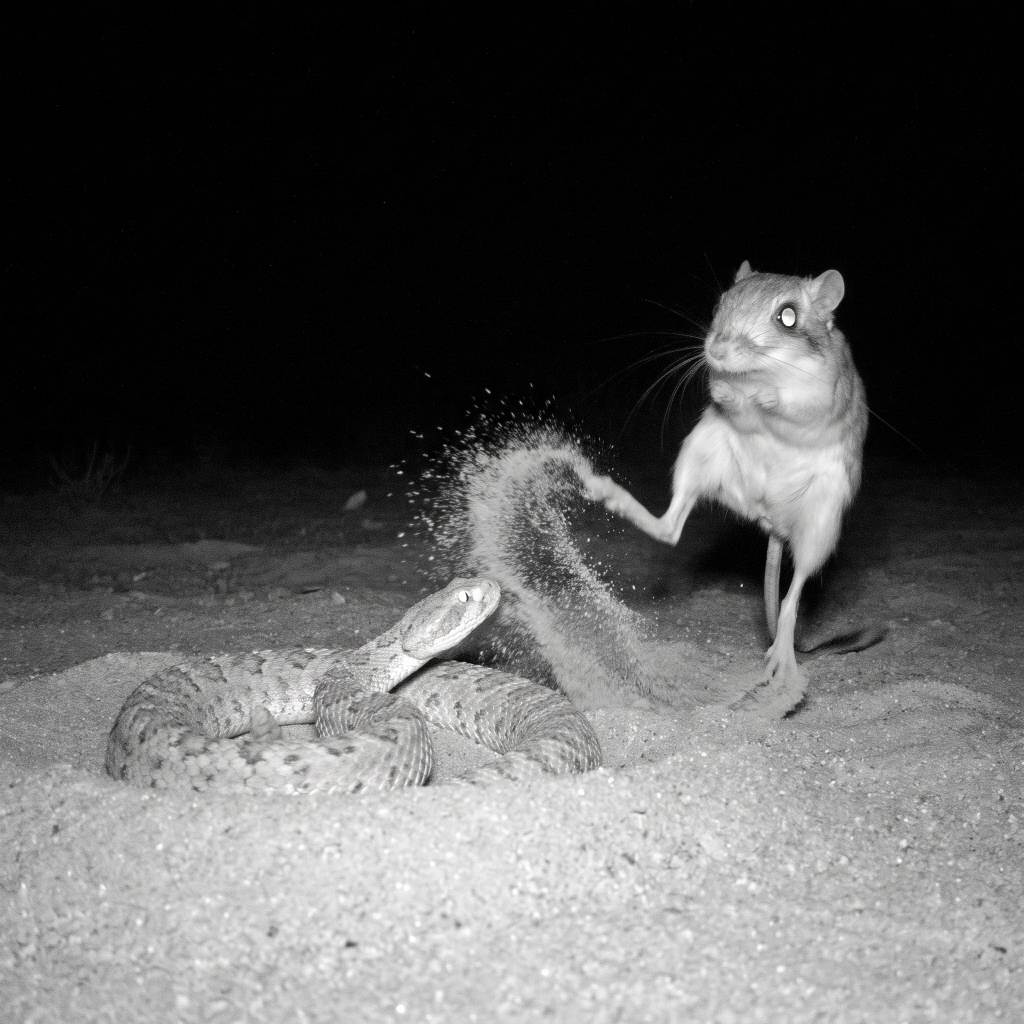
When a desert kangaroo rat discovers a sidewinder rattlesnake coiled in ambush near its burrow, the five-ounce rodent does not run away and hide, instead marching straight up to the venomous predator and kicking clouds of sand into its face until the snake gives up and slithers off to hunt somewhere else.
For a sit-and-wait ambush hunter like a sidewinder, everything depends on staying invisible in the sand until a meal hops within striking range. Once a desert kangaroo rat spots a coiled snake in the dark, however, the element of surprise is ruined, and the rodent shifts immediately from potential meal to relentless nuisance.
In a 2019 field study published in the journal Ethology, researchers recorded encounters between desert kangaroo rats and sidewinder rattlesnakes in the southwestern desert to figure out which part of the rodent's defensive display actually drove the snakes away. During these standoffs, the rats drummed their oversized hind feet on the ground, jumped, and spun around to use their back legs like miniature snowplows, blasting rapid-fire volleys of loose sand directly onto the coiled reptile.
When the researchers broke down the video data, foot-drumming and jumping alone did not make the rattlesnakes budge. The physical sand kicking was the decisive factor: the more sand a kangaroo rat kicked onto a sidewinder, the sooner the snake uncoiled, abandoned its ambush site, and left the area.
Earlier comparative experiments published in Animal Behaviour showed that this aggressive eviction tactic is a specialized trait of the desert kangaroo rat rather than a habit shared by every rodent in its family. When researchers placed both desert kangaroo rats and closely related giant kangaroo rats near live snakes and artificial snake decoys, the desert kangaroo rats told the real predators apart from the fakes, approached the live snakes, and pelted them with sand, while the giant kangaroo rats did not perform the sand-kicking behavior at all.
Harassing a lethal predator at point-blank range works because a desert kangaroo rat carries an extraordinary set of physical insurances into the dark. Its skull is dominated by cavernous middle-ear chambers called auditory bullae that amplify the faint, low-frequency rustle of a snake's scales shifting against the dirt, or the sudden whisper of a strike launching through the air.
In 2017 field experiments using a spring-powered cork to simulate a rattlesnake strike at a bait station, researchers found that kangaroo rats that had encountered a real rattlesnake at that exact spot earlier in the evening returned with their hair-trigger reflexes measurably heightened. Compared to rats that had not seen a snake recently, the primed rodents reacted faster, launched faster, and leaped at a steeper vertical angle to clear the strike zone, with roughly one-third of them initiating their jump within just 8 to 17 milliseconds of the simulator firing.
Because those razor-sharp reflexes depend so heavily on the rat's oversized ears, earlier California laboratory experiments also tested what happens when human noise enters the desert. After desert kangaroo rats were exposed to recorded dune-buggy engine noise at 95 decibels for roughly eight and a half minutes, their hearing sensitivity dropped noticeably, and ten minutes later, both of the two rats tested in a behavioral follow-up failed to kick sand when researchers played the sound of a crawling sidewinder.
Out on a quiet dune, however, a sidewinder facing a desert kangaroo rat is dealing with a neighbor that hears its slightest movement, reacts in thousandths of a second if it strikes, and will stand inches from its fangs shoveling dirt into its eyes and heat-sensing pits until the snake finally packs up and moves along.
Image is for illustration purposes only.
Source: Whitford, M. D., Freymiller, G. A., & Clark, R. W. (2019), Functional Ecology & National Park Service Mojave National Preserve Research / Randall, J. A., & Matocq, M. D. (1997), Animal Behaviour / Brattstrom, B. H., & Bondello, M. C. (1983), U.S. Bureau of Land Management California Desert Report