
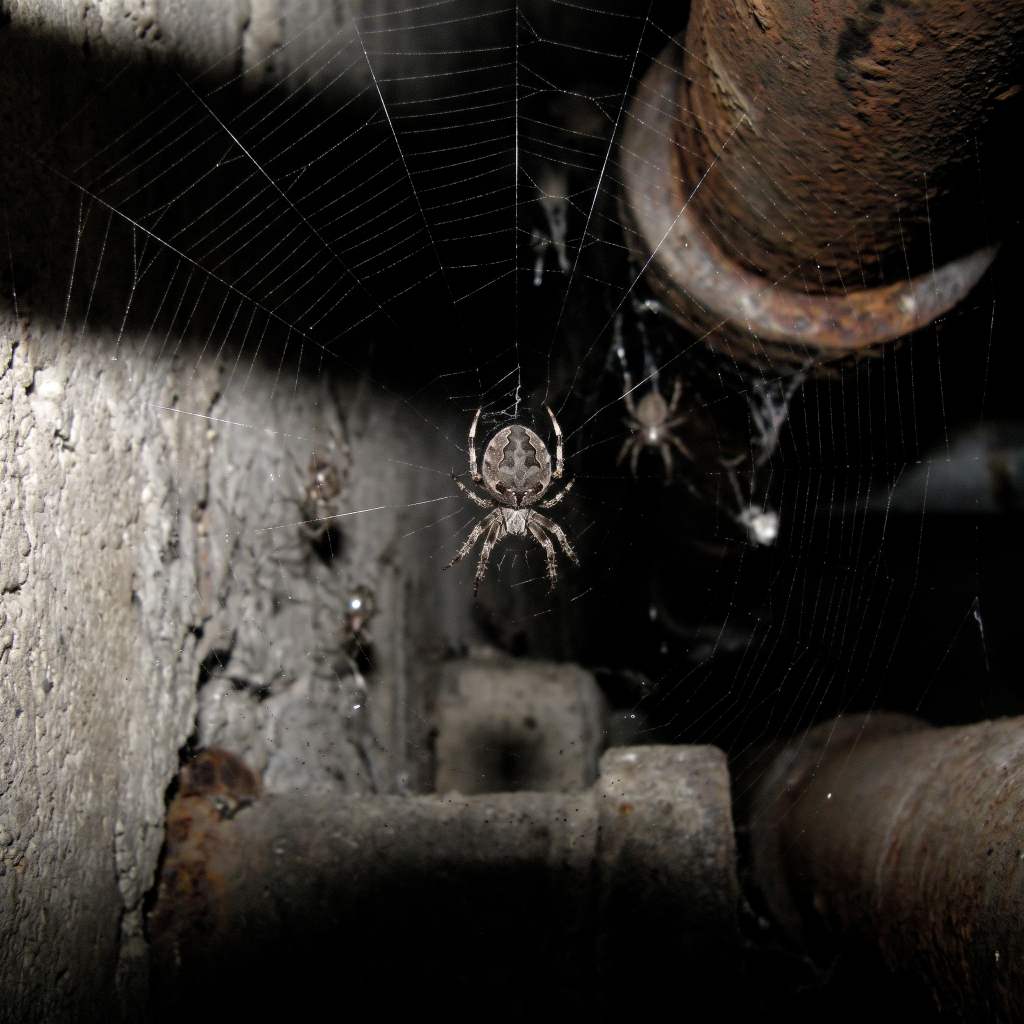
In late October 2009, managers at Baltimore's Back River Wastewater Treatment Plant called in entomologists to deal with what they described as an "extreme spider situation." Inside a sand filtration building spanning nearly four acres under a single roof, an estimated 107 million spiders had turned the cavernous interior into the largest aggregation of orb-weavers ever recorded.
The facility had no side walls, just a massive roof built to block sunlight and limit algae growth in the sand beds below. Across that open interior, sheets and three-dimensional masses of silk draped from ceiling beams, electrical conduits, and catwalks. In one section, the sheer weight of the webbing pulled an eight-foot overhead light fixture out of alignment. Where maintenance workers had swept the silk aside to reach their equipment, it lay piled on the floor in rope-like clumps as thick as a fire hose.
Operations personnel had raised concerns about the risk of bites, prompting an interagency team of arachnologists and urban entomologists to inspect the site. On November 6, researchers collected web samples and extracted 31,194 spiders from those samples alone, including more than 24,000 hatchlings. By measuring the webbing across the building's nearly four-acre footprint and extrapolating from the sample counts, the team estimated 40.4 million hatchlings and 66.8 million older spiders living under the roof. Even at 107 million, they called the estimate markedly conservative, noting densities in spots exceeding 35,000 spiders per cubic meter.
Although nine genera across six families appeared in the samples, the silk shroud was built almost entirely by two normally solitary orb-weaving species: a long-jawed orb-weaver (Tetragnatha guatemalensis) and the bridge orb-weaver (Larinioides sclopetarius). Both species thrive near water, and the treatment plant accidentally engineered their ideal habitat. The filtration beds supplied steady clouds of emerging aquatic insects, overhead lights drew prey straight into the silk, and the four-acre roof sheltered the webs from the wind and rainstorms that normally shred large communal webs outdoors.
When researchers checked back during the winter, cold weather had tattered most of the webbing, confirming that the entire buildup was largely the work of a single season. As for the workers' fears, the entomologists offered a straightforward recommendation: reassure the staff that the orb-weavers were harmless, and recognize the facility's silk shroud as a record-breaking natural history event.
Image is for illustration purposes only.
Source: Greene, A., Coddington, J. A., Breisch, N. L., De Roche, D. M., and Pagac, B. B. (2010), An Immense Concentration of Orb-Weaving Spiders With Communal Webbing in a Man-Made Structural Habitat, American Entomologist 56(3): 146-156