
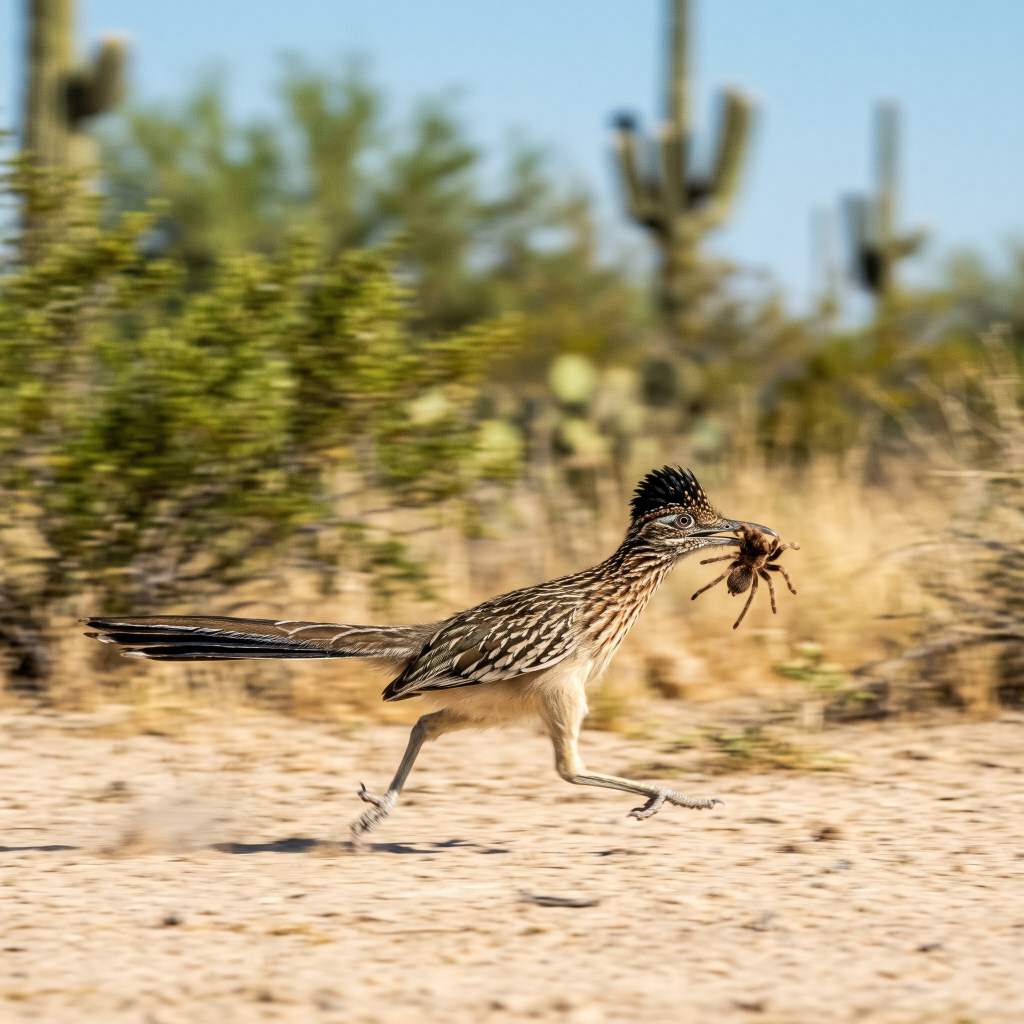
Greater roadrunners eat tarantulas, scorpions, centipedes and black widow spiders, and biologists have found no sign that venomous prey does them any harm. The bird hunts on foot. It walks quickly across open ground watching for movement, then dashes forward and grabs its prey with its bill.
Anything large gets beaten. The roadrunner holds the animal in its bill and slams it against the ground or a rock until it goes limp. For a long time people assumed this was simply how the bird killed. In 1979, Kathleen Beal and Linda Gillam tested that idea with captive roadrunners and found the birds could subdue mice without beating them, yet kept doing it anyway. The beating breaks up the skeleton, which makes the carcass longer and narrower so the bird can swallow it whole.
The chicks are fed the same kind of food. Both parents raise them on lizards, snakes, scorpions and insects. During the first twelve days, one adult guards the nest while the other hunts, and they swap places each time the hunter comes back with food.
When a snake is too long for a chick, the parent pushes down as much as will fit and leaves the rest hanging out of the chick's beak. In Texas, researchers who put cameras on roadrunner nests found the diet was built mostly on reptiles, especially Texas horned lizards. The young leave the nest at 18 to 21 days, but the parents keep feeding them for another 30 to 40 days.
Tarantulas are on the menu as well, and one roadrunner in Arizona got one without catching it at all. Naturalist Pinau Merlin came across a roadrunner taking a paralyzed tarantula away from a tarantula hawk and feeding it to its young. The wasp was left alone.
A tarantula hawk is a spider wasp nearly two inches long, blue-black with orange wings. The female stings a tarantula in the nerve center that controls its legs and fangs, and according to entomologist Justin Schmidt, the spider is permanently paralyzed within one and a half to two and a half seconds. She then drags it to a burrow and lays a single egg on it, and the larva eats the living spider over about three weeks.
Schmidt rated the wasp's sting by taking it himself and called the pain "instantaneous, electrifying, excruciating, and totally debilitating." He wrote that no predators successfully prey on healthy female tarantula hawks.
Schmidt included Merlin's account in his 2016 book, The Sting of the Wild, and described the roadrunner as "that intrepid predator of many life forms, including rattlesnakes." The spider it carried off had already been caught and paralyzed as food for a wasp larva. The roadrunner's chicks ate it instead.
Source: Birds of the World, Cornell Lab of Ornithology / Beal & Gillam (1979), The Condor / Texas Parks and Wildlife / Texas A&M AgriLife Research / Audubon / Justin O. Schmidt, The Sting of the Wild (2016)