
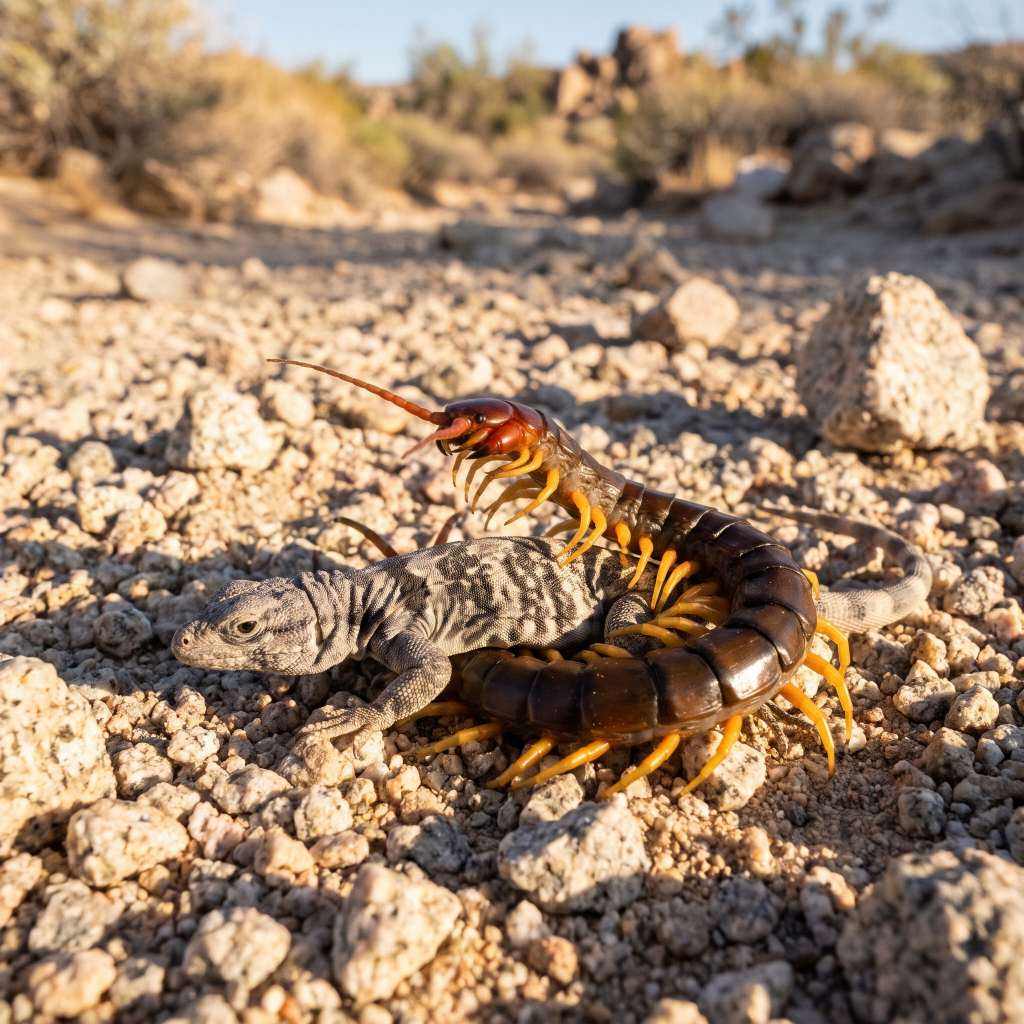
In September 2022, a team of field observers walked up on a predator-prey interaction that flips the usual desert food chain upside down. On the coarse sand of Arizona's Tinajas Altas Mountains, at the bottom of a granite wash about a mile south of Raven Butte, an adult giant desert centipede was curled around the body of a juvenile common chuckwalla.
Even at 6:40 in the morning on September 9, the desert air temperature had already climbed to nearly 90 degrees Fahrenheit. When the researchers stepped closer and disturbed the scene, the centipede did not drop its meal or scuttle under a boulder. Instead, the arthropod held its ground and furiously defended the lizard carcass.
In the rock-strewn washes of the Sonoran Desert, the common chuckwalla is built to survive almost anything trying to pull it out of a crevice. Growing up to nine inches from snout to vent as adults, these wide-bodied iguanid lizards have loose, baggy folds of skin along their necks and flanks. While adults are dark and heavy, juveniles are gray with dark crossbands across the body and tail.
Primarily herbivores that browse on desert plants and the occasional insect, chuckwallas escape coyotes, hawks, and snakes by darting into tight granite cracks and gulping air to inflate their lungs, wedging their rough bodies so tightly against the stone that most predators cannot pry them loose.
A giant desert centipede has no trouble following prey straight into the dark.
As the largest centipede in North America, Scolopendra heros regularly reaches six to eight inches in length. Rather than hunting by sight, it prowls rocky washes and crevices using sensitive antennae and dozens of walking legs tipped with sharp claws that can grip vertical stone or wrap like a cage around a struggling animal.
Behind its head sits a pair of heavy, pincer-like venom claws known as forcipules, which are modified front legs that inject a fast-acting cocktail of neurotoxins and tissue-destroying compounds capable of paralyzing small rodents, frogs, snakes, and lizards.
Because the research team, led by Daniel Koleska of the Czech Republic's Zoopark Zájezd alongside five colleagues, arrived after the centipede had already secured the juvenile chuckwalla, the initial strike went unwitnessed.
Whether the centipede ambushed the young lizard in the early morning twilight or found it shortly after it died remains unverified, though the observers noted in the journal Reptiles & Amphibians that the chuckwalla appeared freshly killed when they found it.
Once the centipede finished defending its prize from the intrusion, the researchers stood back and watched it work for the next 40 minutes.
Using its mandibles and gripping legs, the centipede methodically severed the juvenile chuckwalla's head from its body and began hollowing out and feeding on the head from the inside.
While giant centipedes are well known to biologists as opportunistic hunters of small vertebrates, documented records of arthropods overpowering or consuming lizards from the iguana family are exceedingly rare in scientific literature. A 2020 global review of more than 1,300 arthropod-on-vertebrate predation events across 89 countries logged only a single case involving an iguanid lizard. According to Koleska and his co-authors, that September morning in the Tinajas Altas Mountains marked the first documented record of a giant desert centipede feeding on a common chuckwalla.
Image is for illustration purposes only.
Source: Koleska et al. (2023), Reptiles & Amphibians 30(1): e18966 / Valdez (2020), Global Ecology and Biogeography / Holycross et al. (2022), A Field Guide to Amphibians and Reptiles in Arizona.