
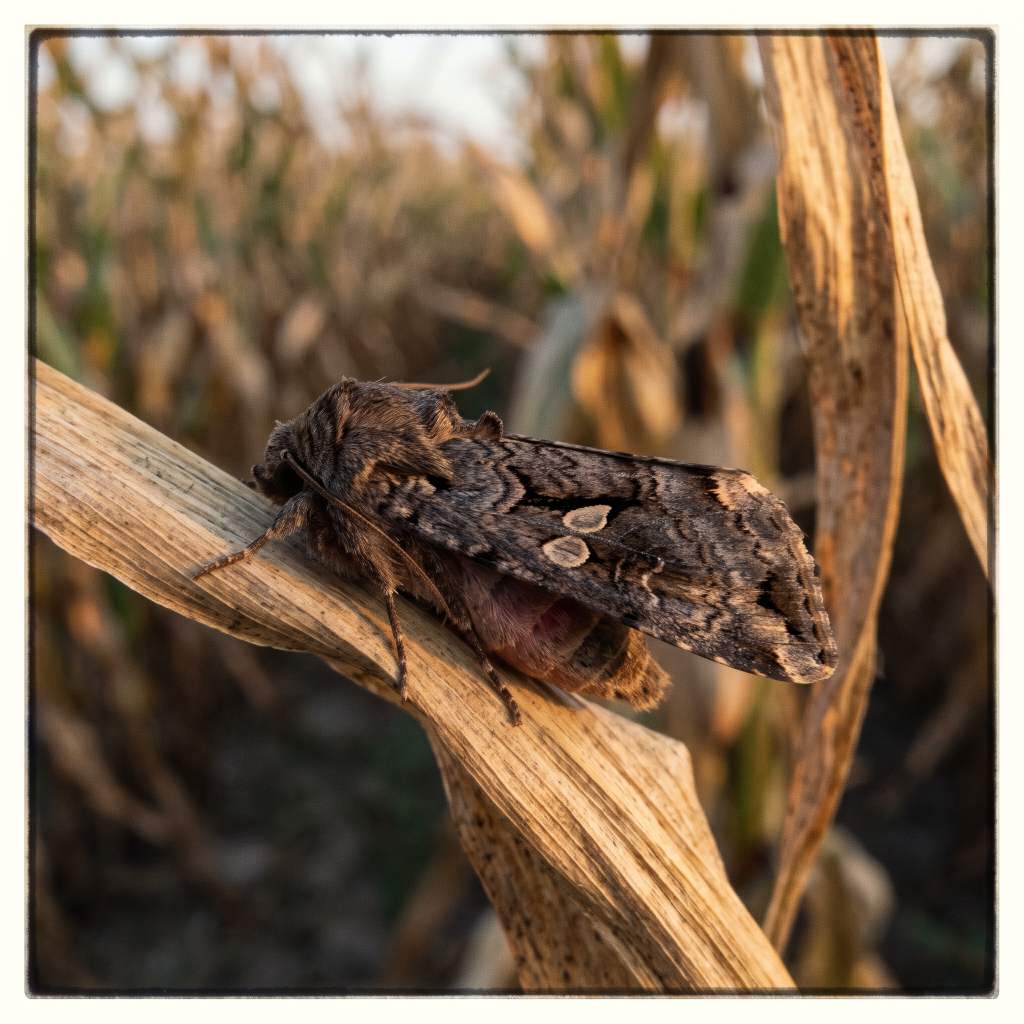
A red-dyed black cutworm moth released at dusk in Ankeny, Iowa, on September 17, 1987, turned up eight nights later inside a pheromone trap near Brownsville, Texas, right on the Mexican border 1,180 miles away.
For decades, agricultural entomologists knew that black cutworm caterpillars appeared across Corn Belt fields each spring after adult moths rode warm southerly winds northward out of Texas and Mexico. What remained unproven was whether the late-summer generation of moths emerging in the northern Midwest simply froze to death when autumn arrived, or if they possessed a return mechanism to carry them back to frost-free overwintering grounds in the south.
To test the southbound migration hypothesis directly, entomologist William B. Showers of the USDA Agricultural Research Service and Iowa State University teamed up with researchers across the central United States to run a mark-release-recapture experiment during the autumn of 1987.
Because external paint or dust could rub off in the wind or weigh down a moth with a wingspan of less than two inches, the team raised black cutworm larvae in the laboratory on an artificial diet laced with Calco Red N-1700, an oil-soluble dye. As the caterpillars fed and pupated, the red pigment bound permanently to their internal fat bodies and wing scales, allowing any recaptured adult to be positively identified when crushed or inspected in the lab.
At dusk on September 17, 1987, the team released thousands of these internally marked moths into the evening air at Ankeny, just north of Des Moines.
Across the central and southern states, cooperators monitored grids of sticky wing traps baited with synthetic female sex pheromones to intercept any marked males flying down out of the night sky. One moth from the September 17 release drifted east and was captured in Illinois. Another took a completely different trajectory.
Shortly after the Ankeny release, a cold front swept across the Midwest, bringing a shift to strong northerly winds behind the passing weather system. Riding that high-altitude airflow during the nocturnal hours, one of the red-dyed males traveled all the way down the Great Plains to the Lower Rio Grande Valley.
On the morning of September 25, 1987, eight nights after leaving central Iowa, the moth was pulled from a pheromone trap near Brownsville, Texas.
Measured as a straight line on a map, the distance between the Ankeny release site and the Brownsville trap was 1,180 miles, averaging nearly 150 miles per night. Because atmospheric trajectories curve with shifting pressure systems, the moth's actual flight path through the sky was likely even longer, providing the first physical proof that Corn Belt cutworm moths can ride autumn cold fronts all the way back to the subtropics before winter sets in.
Image is for illustration purposes only.
Source: Showers, W. B., Smelser, R. B., Keaster, A. J., Whitford, F., Robinson, J. F., Lopez, J. D., & Taylor, S. E. (1989), "Recapture of Marked Black Cutworm Male Moths Found to Undertake Long-Range Migration," Environmental Entomology 18(3): 447-458 / Hendrix, W. H., & Showers, W. B. (1992).