
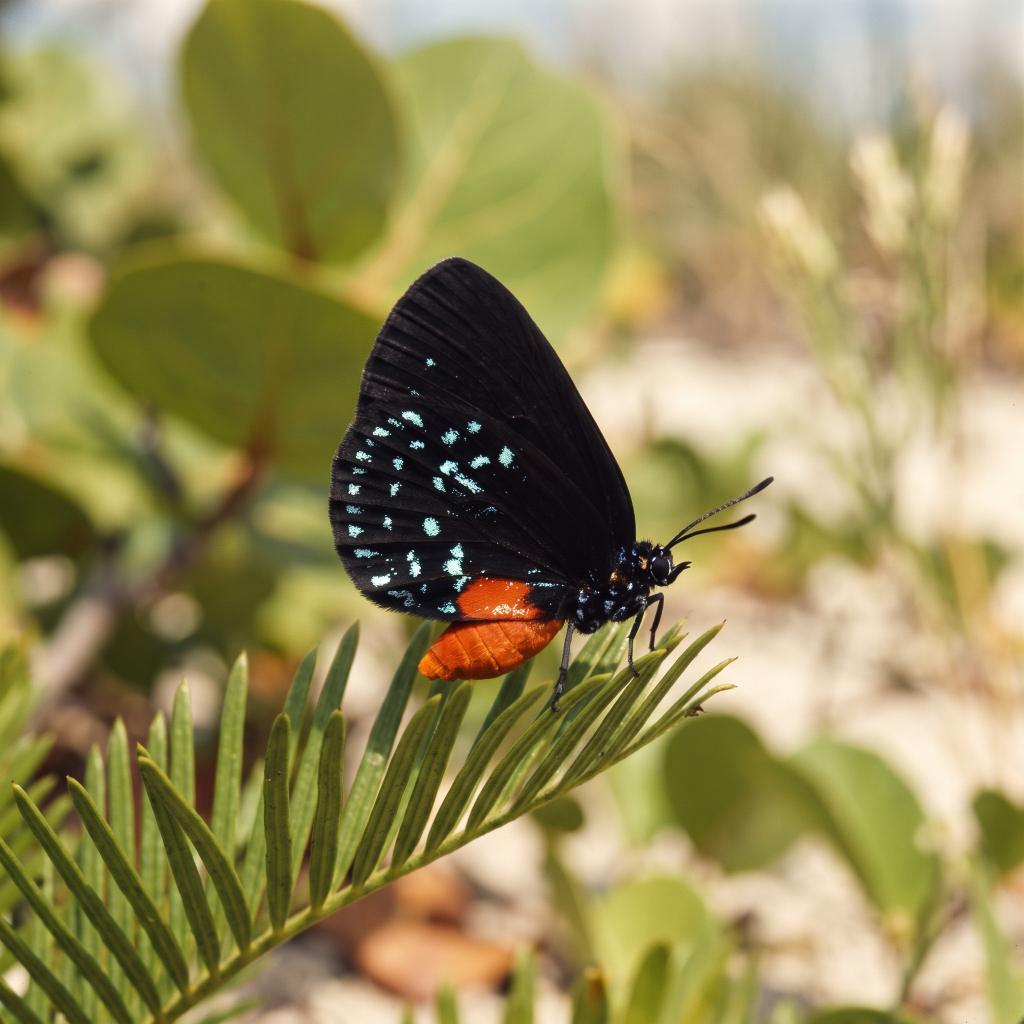
The man who rediscovered Florida's "extinct" Atala butterfly in 1979 kept the real location a secret. He told National Geographic the wrong island, and science repeated it for years.
He was Roger Hammer, who worked for Miami-Dade County's parks and later wrote a series of books on Florida plants and butterflies. When the magazine ran a short piece on the butterfly's comeback, Hammer said he had found it on Key Biscayne. The real spot was Virginia Key, the smaller island next door. He later admitted he did it to throw off butterfly collectors. The cover story held. In 2002, a scientific journal article still placed the 1979 colony on Key Biscayne.
The secret was worth protecting because the butterfly was supposed to be gone. Hammer's 1965 Peterson field guide listed the Florida Atala as presumed extinct.
On a day in 1979, Hammer was walking on Virginia Key looking at plants when he stopped at a wild coontie, a stiff, palm-like plant that grows low to the ground. Something was eating it. There were small red caterpillars with yellow spots down their sides, chewing the leaves. That surprised him, because coontie is poisonous. He didn't recognize them, so he collected a few, brought them home and raised them to see what they would become.
When they hatched, he knew exactly what he had. They were Atala butterflies, small black butterflies with wings speckled in shimmering blue and a bright red-orange body. Hammer later called it an "Oh, my God" moment.
The Atala's whole life depends on coontie. Females lay their eggs only on it, and the caterpillars eat nothing else. They store the plant's poison in their own bodies, which makes them taste bad to predators, and their bright colors work as a warning.
That dependence nearly killed them. More than a century ago, coontie grew all over South Florida. Native Americans had long made flour from its root by washing out the poison, and settlers turned it into an industry. The starch went into World War I rations and snacks like animal crackers. Nobody farmed coontie, and a plant takes 10 to 20 years to grow big enough to harvest, so the wild plants were dug out faster than they could come back. By the 1920s, the Atala was largely gone from Florida, and for decades afterward there were only scattered sightings.
Hammer called Sonny Bass, a biologist at Everglades National Park, who pointed out how hard it is to prove a butterfly is extinct. Then Hammer started breeding more on cultivated coontie and quietly releasing them into parks and preserves, including Everglades National Park.
The comeback took off when coontie became a popular landscaping plant. Butterfly enthusiasts knocked on the doors of homeowners who had coontie in their yards and asked to put caterpillars on them. The Atala had never been federally listed as endangered, because it was presumed gone when the Endangered Species Act passed in 1973. Without that listing, people were free to move and release it.
Today, Atalas range well up both of Florida's coasts. In some places they are doing too well. At Montgomery Botanical Center in Miami, which grows rare cycads from around the world, the caterpillars have stripped valuable plants down to their stems. The center's director put it plainly: "The healthier the butterfly, the worse it is for the cycads." Zoo Miami now collects the surplus. It took nearly 6,000 Atala caterpillars and pupae from the garden in each of 2022 and 2023, and more than 4,000 by July 2024.
Image is for illustration purposes only.
Source: WUSF / WLRN (2024) / WUWF / Miami Herald (2024) / University of Florida IFAS / Journal of the Lepidopterists' Society (2002) / Entomology Today (2016)