
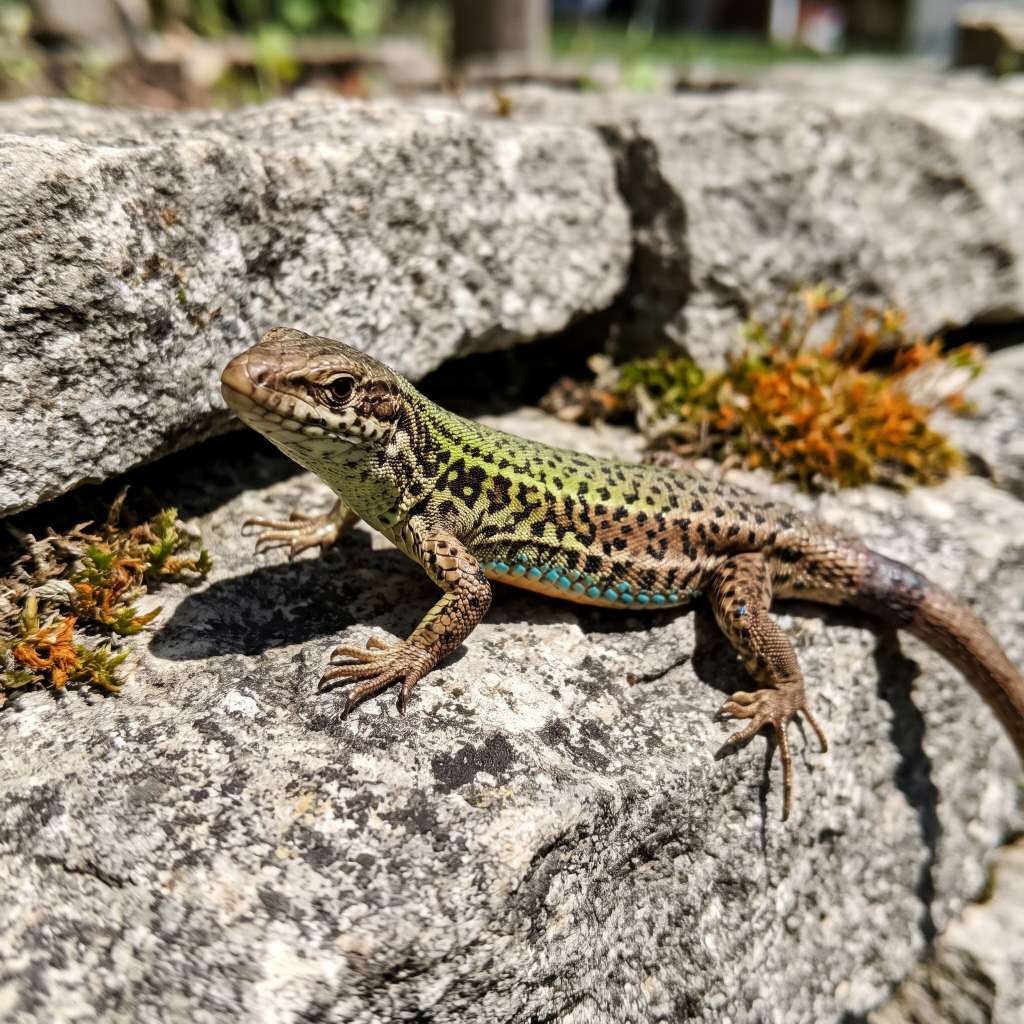
In 1951, a 10-year-old boy smuggled about 10 Italian wall lizards into Cincinnati in a sock. Today hundreds of thousands live there, many with very high levels of lead in their blood and no sign of poisoning.
The boy was the stepson of Fred Lazarus, of the family behind the Lazarus department store chain, which later became part of Macy's. On a family vacation at Lake Garda in northern Italy, he saw small common wall lizards running across the rocky slopes and caught some. Accounts put the number between 6 and 10. He hid them in a sock, got them through customs and let them go at the family home on Torrence Court in Hyde Park, on Cincinnati's east side.
For years it sounded like a local legend. In 1989, by then an adult, he wrote to the Cincinnati Museum of Natural History to explain how the lizards got there, and he told the same story to The Cincinnati Enquirer.
The lizards did well on Torrence Court, and the street picked up the nickname "Lizard Hill." Cincinnatians started calling them "Lazarus lizards" after the family. The name is a little unfair, since the boy brought them in, not the store owners.
Cincinnati turned out to suit them. A 1980s study found the city's climate is very close to Milan's, near their home range. The city is hilly, and many older neighborhoods are held up by stacked-rock retaining walls with no mortar between the stones. Those walls give the lizards endless cracks to hide in and a way to get underground in winter. They also faced fewer predators and parasites than in Europe, and no other lizard competing for the same spots. Some neighborhoods now hold as many as 1,500 lizards per acre, far denser than wall lizard populations in Europe. The Ohio Division of Wildlife has declared them "permanent residents."
The puzzle was how such a tiny starting group managed it. A handful of founders usually means inbreeding, and inbreeding can bring out harmful genes that weaken a population. In March 2026, a team led by Ohio State University published whole-genome results in the journal Molecular Ecology. They sequenced lizards from northern Italy and Cincinnati, plus a short-lived population in Columbus that appeared in 2021. They used the Columbus group as a stand-in for the original 1951 release, since it was probably started by only a few animals.
The Columbus lizards were heavily inbred. The researchers concluded the Cincinnati lizards went through the same thing in their first years: a drop in genetic variation and a brief bottleneck with more inbreeding. Then the population grew so fast that the damage never had time to build up. Senior author H. Lisle Gibbs put it simply. "If you think you have a bottleneck, but it doesn't last very long, then you don't have a bottleneck."
The genomes also showed something odd. One gene pathway linked to learning and memory looked like it was under selection. In humans, that pathway helps reduce the effects of lead poisoning. Cincinnati's wall lizards carry very high levels of lead in their blood, likely from old city soil, but show no signs of lead poisoning. In lab tests, lead exposure didn't noticeably affect their endurance or health.
The city may be changing them in other ways too. Researchers have found Cincinnati's wall lizards seem to be getting bigger and growing longer legs, possibly to outrun house cats, their main predator in the city. Despite their numbers, they have stayed in town and haven't spread into the surrounding countryside. Researchers still don't know why.
Image is for illustration purposes only.
Source: Bode et al., Molecular Ecology (March 2026) / Ohio State University / National Geographic (2025) / University of Cincinnati / Ohio State University Extension / The Cincinnati Enquirer