
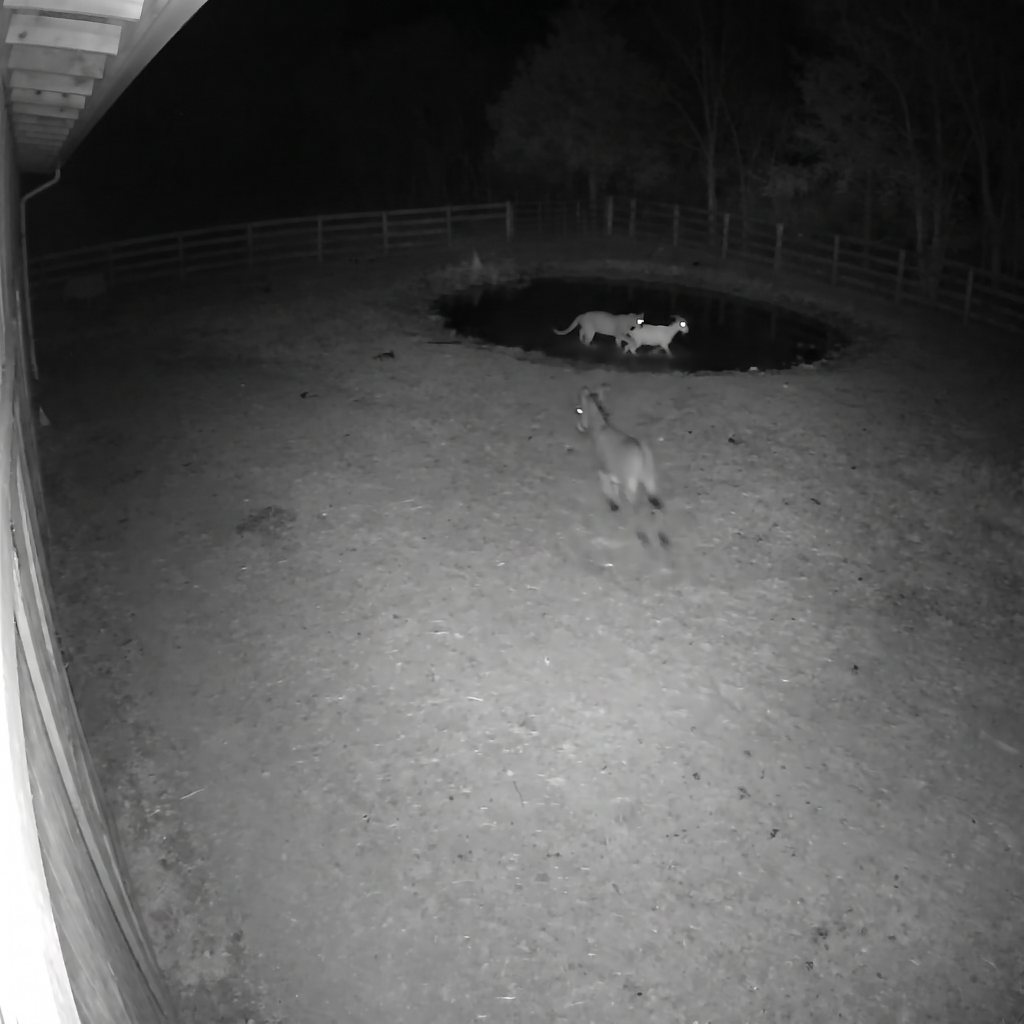
In 2010, a donkey in Paradise, California charged into a nighttime mountain lion attack and drove the cat off a goat it already had by the face.
Property owner Art Colyer woke to the sound of his goat, Buttermilk, crying out in the dark. Outside, a mountain lion had gripped the goat by the face and nose and was pulling her out of a small pond.
Before the cat could drag her away, Poppy, a donkey sharing the property, moved in. Poppy began circling the mountain lion and striking at it with both her front and rear legs. According to Colyer, she kept kicking until the mountain lion finally released Buttermilk and jumped over the fence to escape.
Buttermilk survived the encounter with bite and claw wounds across her face and received treatment for her injuries.
To most people, watching a prey animal walk straight toward a big cat looks like a mistake. In donkey behavior, it is an ancient survival reflex. Horses evolved on wide, open grasslands where running in a tight herd offered the best odds of outlasting predators. Donkeys descend from wild asses of arid, rocky deserts where animals lived alone or in small, scattered groups. On rugged ground with nowhere to run, standing firm, braying, biting, and kicking became the primary way to survive.
Ranchers across the American West have used that instinct for generations, keeping a single donkey in pastures with sheep, goats, and calves. Raising one donkey alone with livestock encourages it to bond with the herd rather than with other donkeys. Most of the time, those guard donkeys are put to work against coyotes and roaming dogs. Donkeys carry a strong territorial hostility toward canines and will frequently chase them straight out of a fenced lot without hesitation.
A mountain lion is a much larger problem. In the brushy Sierra Nevada foothills around Paradise, mountain lions regularly travel through rural neighborhoods and small farms at night, drawn by deer and unsecured livestock. Unlike pack hunters, a mountain lion hunts entirely alone. It depends on ambush, speed, and a clean hold to bring prey down without taking damage in return.
That solitary lifestyle makes mountain lions strict calculators of risk. A broken jaw, a cracked rib, or a crippled leg from a heavy hoof can leave a big cat unable to hunt and lead to starvation. When an ambush goes wrong and a several-hundred-pound animal starts circling and throwing hooves at close range, abandoning the meal is often the smarter move.
Livestock specialists and wildlife agencies still caution that donkeys are not a foolproof solution in mountain lion country. Big cats are strong enough to injure or kill a donkey, and agricultural extension programs generally recommend secure night enclosures alongside any guardian animal.
Image is for illustration purposes only
Source: ABC7 News (2010) / KHSL-TV (2010)