
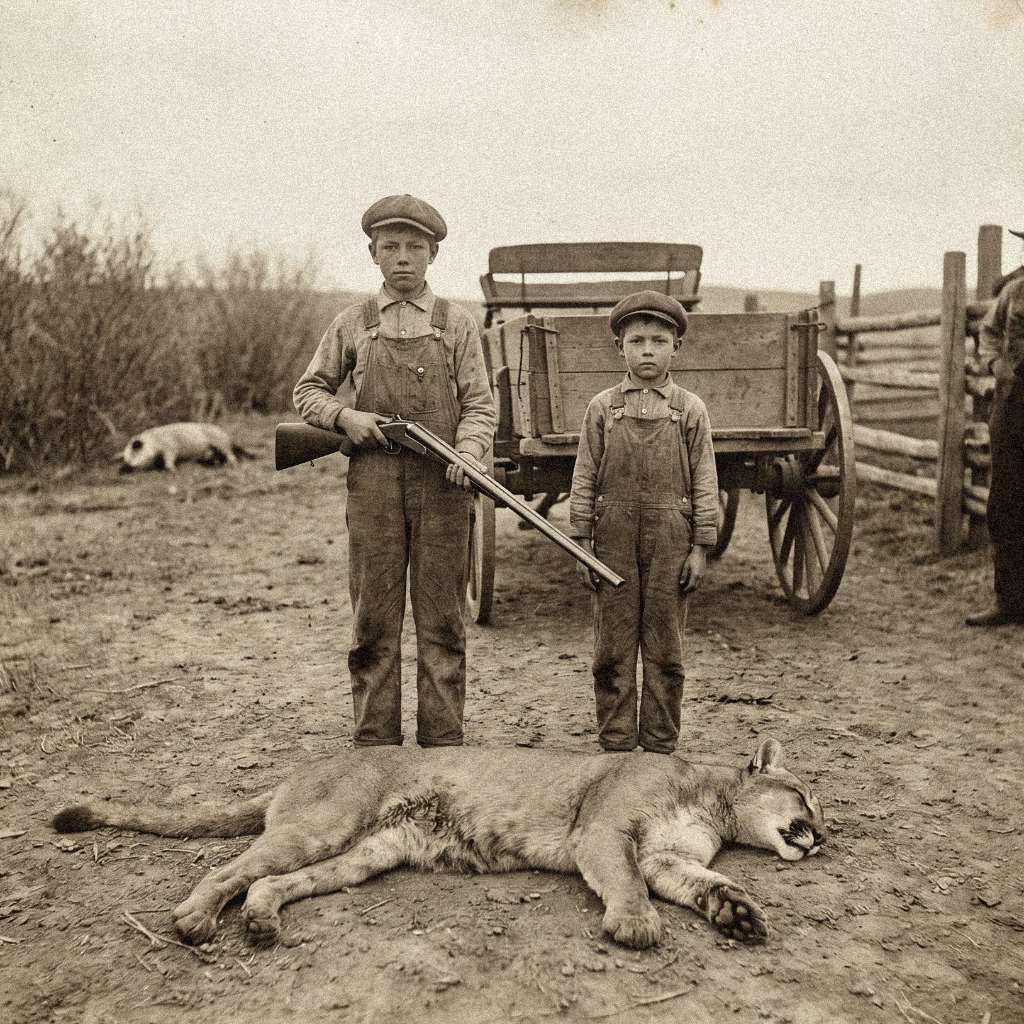
In 1904, a rancher in central Utah sent his fourteen-year-old and eight-year-old sons to town to buy strychnine. A mountain lion had killed one of the family's pigs down in the willows along Lost Creek, and the plan was simple. Ride back, lace the carcass with poison, and let the cat come back to finish its meal. What happened instead was that the boys rode straight into the lion while it was still on the kill.
That is the part of frontier life that does not translate to a modern reader. The father did not go himself. He did not call anyone. He sent two children on horseback with a shotgun and a packet of strychnine to handle a livestock predator because that was the ordinary expectation of the time. A mountain lion on a fresh kill was not a wildlife event. It was a line item. You dealt with it the same way you dealt with a broken fence or a sick calf. You sent whoever was available.
The newspaper dispatch that follows was published in the Salt Lake Herald out of Richfield, Utah. It is a brief, matter-of-fact account written in the flat tone that rural correspondents used for stories they did not consider remarkable. Nobody in the readership would have found it unusual. Two boys, a dead lion, and a casual note at the end about the country being full of bears and cats for anyone sporting enough to go after them. Read it for what it is: a window into a time when the predator density in the mountain West was high enough that encounters like this were local news, not national news.
"Two boys, one 14 and the other 8 years of age, the sons of Jay Sterns, of Aurora, did some pretty nervy work for boys in killing a mountain lion a few days ago. The lion had killed a pig belonging to their father in Lost Creek, and he sent the boys in town for some strychnine to poison the carcass for the lion. When the boys were returning with the strychnine, and as they were emerging from a bunch of willows close to where the pig lay, they discovered the lion devouring his prey. The elder boy had a shotgun and he at once fired at the lion. The shot took effect and the animal gave a loud growl, which so frightened the boys’ horse that it turned and ran back. In trying to control the horse the gun was switched out of the boys’ hand by the willows. The younger boy jumped from the horse, grabbed up the weapon and turned the other barrel into the lion. It was a well-directed shot, entering the throat of the lion and tearing away a portion of its brisket. It bounded into the air and fell dead. The animal measured nine feet from nose to tail tip, and weighed close to 200 pounds. The boys got a cart, loaded the body in and drove home in triumph with their game.
There are a number of wild animals, such as lions, bears, coyotes, etc., in the mountains in the east part of this county, and a splendid opportunity is afforded for hunters who have the nerve to penetrate unbroken timber in quest of the animals. At the head of Daniel’s Canyon, on the east side, between Fish Lake and Grass Valley, is a regular camping ground for these animals. As many as seven bears have been seen at one time in this vicinity, and one and two frequently. About a year ago a man in Glenwood had a very narrow call with a bear there. The animal attacked him while he was getting out some timber and he had only an ax to defend himself with, but he used it to such advantage that the bear was shortly afterward found dead.
These animals have become very bold and destructive. They have killed a number of head of cattle this season and in seasons past, and about a month ago one was so daring that it killed a riding horse which had been tied to a tree and which the rider had left for a few minutes.
The bunch of timber in which these wild animals have their home is very dense with quaking asp and underbrush and affords an ideal shelter for them. It is not much for a single person to undertake to hunt them, because the animals can take alarm and get out of the way before being seen. But if a party of hunters who like big game would like to try their hand the chance for some good lively sport is to be had.
Richfield, Utah, Cor. Salt Lake Herald."
The nine-foot, two-hundred-pound tom the boys killed was a genuinely large animal. Historical measurements were sometimes generous and weights were often estimated rather than scaled, but even accounting for that, a dominant male cougar holding territory in productive livestock country with abundant prey would have been at the upper end of the size range.
Source: The Pittsburgh Press, 26 September 1904 (Archive)
Image is for illustration purposes only