
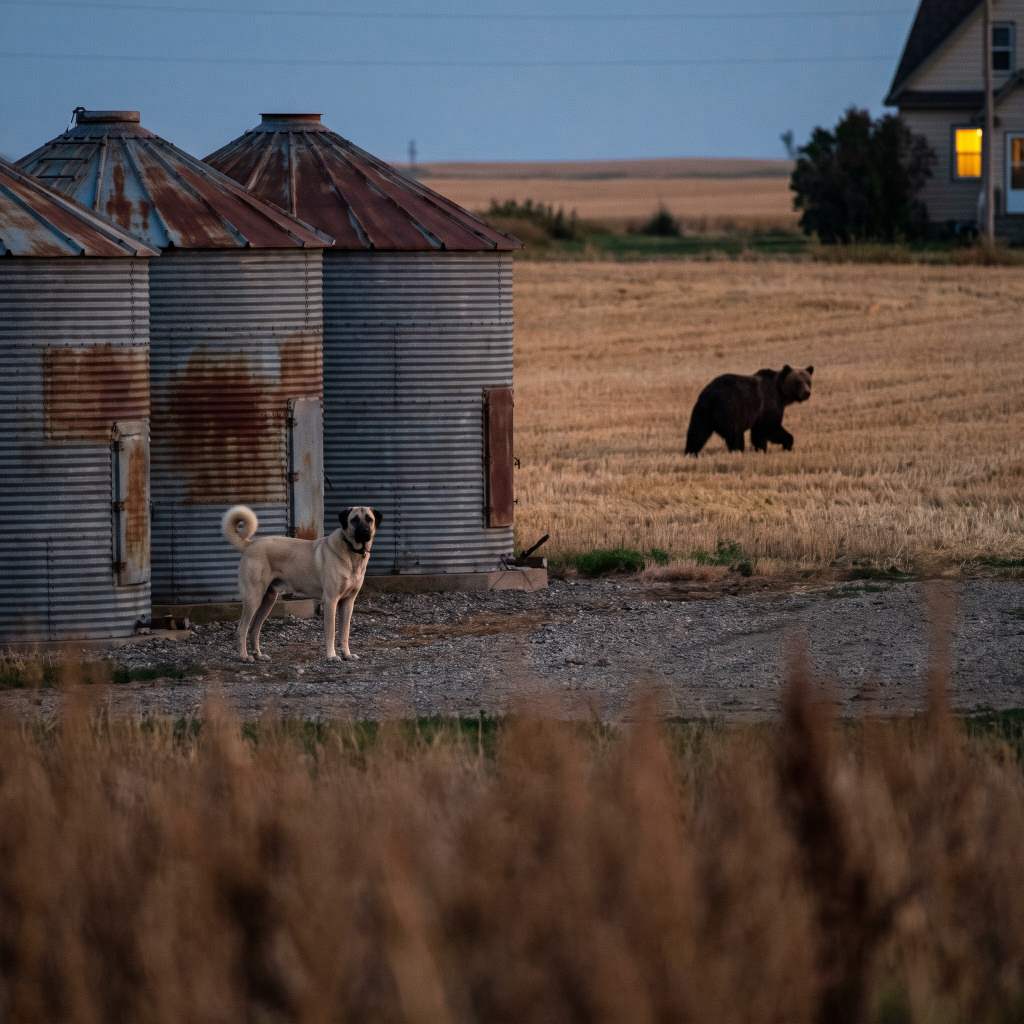
On Montana's prairie, grizzly bears were bedding down inside grain bins a few steps from family homes. Wildlife officials brought in five Turkish guardian dogs, and the bears mostly stopped coming.
Grizzlies in the Northern Continental Divide area, which includes Glacier National Park, number more than 1,000 and are spreading out from the mountains into the open grassland to the east. That's farm country, with wheat, barley, lentils and canola. Every farm has metal grain bins, and grain spills on the ground whenever trucks load or unload. A grizzly can smell it from a long way off.
The bears came for the spilled grain, and some started sleeping inside open bins during the day. The bins are usually right next to the house, where farm families walk past them many times a day. Grizzlies are still listed as threatened in the lower 48 states, so killing them wasn't an option. Wildlife managers needed a way to keep them away from people.
Montana Fish, Wildlife and Parks bear specialist Wesley Sarmento and Utah State University ecologist Julie Young tested an old tool in a new place. Livestock guardian dogs have protected sheep and goats from wolves and bears for thousands of years. This time, there would be no flock to guard. The dogs would guard the farmyard.
They picked four farms where grizzlies had been showing up again and again, and paired each one with a neighboring farm less than 2 miles away that would not get a dog. Five dogs went out, one in 2021 and four in 2022. They were Kangals, Boz shepherds and Anatolian shepherds, all large breeds from Turkey, and each was about a year old. The farmers got the dogs free, along with food, vet care and training help for the length of the study.
Each farm had four cameras pointed at spilled grain, set to shoot only at night. In 2021, the farm with a dog had no grizzly photos at all, while farms without dogs had bears show up as many as 25 times. In 2022, bears visited every farm at least once, but the farms without dogs had 58 times more bear detections than the farms with them. When bears did come to a farm with a dog, the cameras usually caught them looking around nervously or running. At farms without dogs, bears were mostly feeding or resting.
The team also tracked grizzlies wearing GPS collars. Within about 1,000 feet of the farms that got dogs, bear locations dropped by 87.8 percent after the dogs arrived. The time bears spent that close fell by 94 percent. Farther out, the bears were still around. They hadn't left the area, they just stopped walking into the yards.
The dogs wore GPS collars too. More than 90 percent of their locations were within about 1,000 feet of their own farmstead. Only one dog wandered enough that a single-wire fence was put up to keep it home. The dogs did most of their patrolling at night, when grizzlies were most likely to come around.
The researchers say the study was small: five dogs at four farms. They also noticed something they couldn't explain. Smaller carnivores showed up more often at the farms with dogs.
All four farm families said the dogs cut down their bear problems, and all four said they would get another one. "We absolutely love these dogs and they were absolutely effective in keeping bears away," one farmer wrote.
Image is for illustration purposes only.
Source: Young & Sarmento, Biological Conservation (2024) / Montana Fish, Wildlife and Parks / Utah State University