
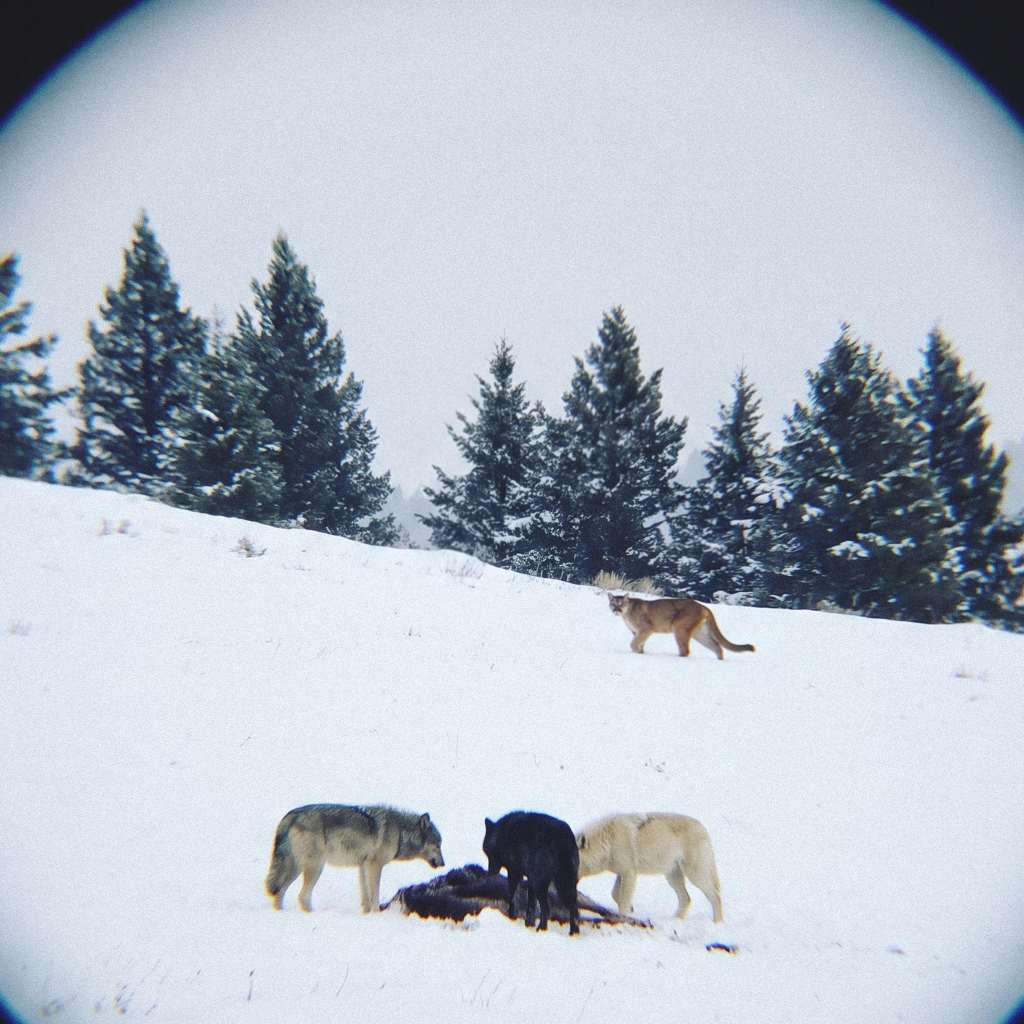
In Yellowstone, cougars cook for wolves, whether they like it or not. The cats almost never eat anything they didn't kill themselves, and wolves have learned to follow them to dinner.
That's the picture from a nine-year study led by Wesley Binder, an Oregon State University doctoral student who spent nearly a decade on the Yellowstone Cougar Project before starting his doctorate. From February 2016 to March 2024, his team followed GPS-collared wolves and cougars across the park's northern range. Each time the collars showed an animal lingering in one spot, the researchers could go to that spot and find out what had happened. They checked 3,929 of these sites.
They found 520 places where a cougar had fed. In 513 of them, the cougar had made the kill. Only seven times did a cougar eat something another animal had killed. Cougars also stayed away from places where wolves had recently made kills.
The wolves fed at 852 sites. They made 716 kills, mostly elk and bison, but 136 times they ate something they hadn't killed. Many of those meals came from cougars. The GPS data showed wolf movements were strongly tied to cougar kills, and wolves were especially drawn to them while the cougar was still there.
"There's a meal sitting there that wolves don't have to work that hard for," Binder said.
One on one, scientists believe a cougar would probably win. But a cougar hunts alone, and the average Yellowstone wolf pack has about 10 members. "Wolves know they can win that interaction," Binder said. When a pack shows up, the cat leaves. A cougar's safest spot is near escape terrain, usually a tree it can climb, and the study found cougars stayed close to it.
Sometimes the cat doesn't get away. During the study, wolves killed two adult cougars. One was a female that had brought down a bull elk in a grove of small pine trees. The wolves don't eat the cougars they kill. In the other direction, not one of the 90 wolf deaths the researchers recorded was caused by a cougar.
Elk are where most of the trouble starts. An adult elk weighs roughly 500 to 700 pounds, and a cougar needs days to finish one. That gives wolves plenty of time to find it. Wolves and cougars were six times more likely to cross paths when the cougar had killed an elk instead of a deer.
The cougars' menu has shifted. As Yellowstone's elk herds shrank, elk dropped from about 80 percent of cougar kills in earlier years to 52 percent, and deer rose from 15 percent to 42 percent. A deer is small enough to finish before the wolves arrive. Binder doesn't think the cats are doing this on purpose. "We don't really think that the cougars can put two and two together," he said. Whatever the reason, smaller prey means fewer meals lost to wolves.
The researchers call it an "enemies without benefits" relationship. Coyotes and foxes also lose some of their number to wolves, but they eat a lot of wolf leftovers in return. Cougars get nothing back. Even so, wolves haven't driven them out. Northern Yellowstone is home to up to 45 cougars and around 130 wolves.
Image is for illustration purposes only.
Source: Binder, W., et al. (2026), Diets, Dominance Hierarchies, and Kleptoparasitism Drive Asymmetrical Interactions Between Wolves and Cougars, PNAS 123(6) / Oregon State University / Jackson Hole News&Guide / Bozeman Daily Chronicle / National Parks Traveler