
On the evening of July 16, 2002, a crew of biologists working along the Liard River near Swan Point in Canada’s Northwest Territories watched 18 wood bison take to the current. The herd held 11 cows, three yearlings and four full-grown bulls.
The Liard is no slow pasture creek. At that point in the valley the channel was 1.1 miles wide, swollen above its usual summer level and running at nine to ten miles per hour.
The fast water carried the animals steadily downstream as they paddled, so they could not swim straight across. By the time they reached the far shore, the current had swept them so far down the valley that each bison had swum roughly 2.2 miles of turbulent water.
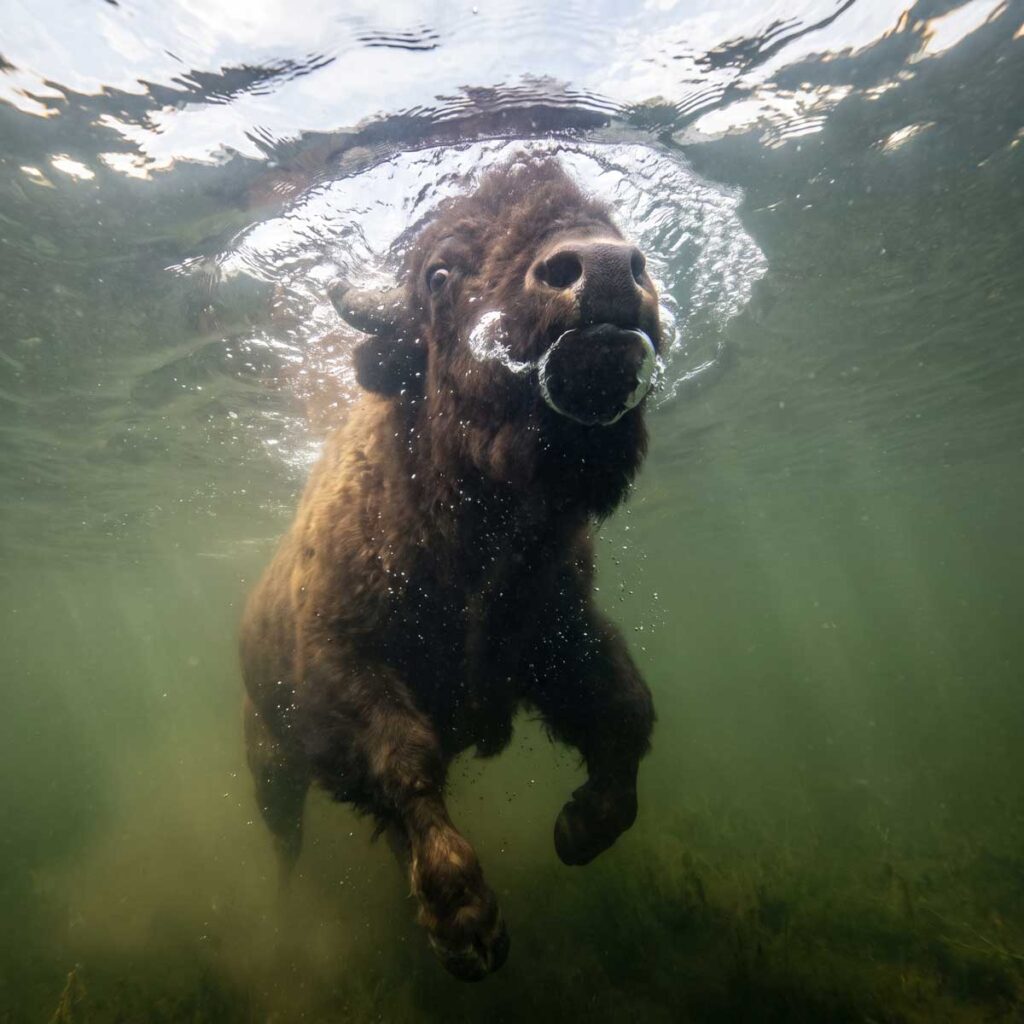
How they rode the river depended on how much muscle and bone they were carrying. The cows and lighter yearlings floated high enough to keep their entire heads clear of the surface. The four mature bulls, the heaviest land animals in North America, sat so low under the weight of their massive front quarters that their heads sank below the brown water. All the biologists could see of the bulls was the very top of the snout and the flared nostrils, skimming along the waterline like periscopes.
Riding that low slowed the big males down. The cows and yearlings climbed the far bank first, and the bulls fought the current for several extra minutes. The last animal dragged itself onto dry ground at 7:38 p.m., at least 27 minutes after the herd entered the river.
A year later, the same team watched two cows lead three young calves across a 650-foot side channel of the Liard in about three minutes, the calves paddling hard to hold their heads above the chop. Publishing their observations in the journal Arctic in 2003, Nicholas Larter and his colleagues concluded that even a mile-wide northern river at high water is no barrier to bison looking for forage on the other side. Later GPS tracking on the Liard logged 315 river crossings by 11 collared bison, almost all of them during the ice-free months and most often in July.
Bison are strong, deliberate swimmers that routinely cross wide, heavy rivers to reach new grass. Still, swimming with your nostrils an inch above the surface leaves almost no margin for error, and northern rivers kill bison every year. The researchers warned that the wake from a passing boat could swamp a swimming bull, and that young calves, with so little body mass, are the most likely to be chilled by the cold water.
Image is for illustration purposes only.
Source: Larter et al. (2003), Arctic 56(4): 408–412 / Thomas, Larter & Jung (2021), Wildlife Biology / COSEWIC Assessment and Status Report on the Plains Bison and Wood Bison (2013).