A grizzly bear that stops dead on a trail, looks in one direction, and reverses course has made a decision. For an animal that has almost no natural predators and knows it, that decision is worth examining.
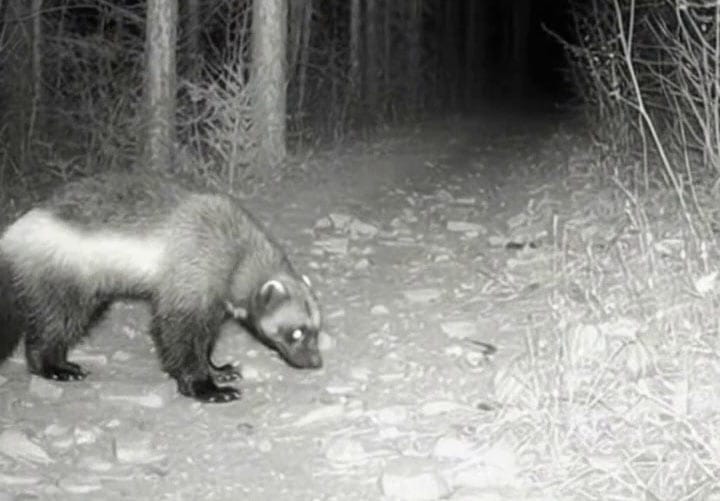
Trail cameras placed in wolverine territory occasionally capture exactly this kind of behavior. A bear moving confidently through forest at night, detecting something, and choosing not to continue. What follows, seconds or minutes later, is usually a wolverine moving through the same frame in the same direction. Unhurried. Apparently unaware of or indifferent to what just moved out of its way.
The documented encounters
The most striking recorded event happened in August south of Yellowstone National Park. Naturalist tour guide Doug MacCartney watched a grizzly sow and her three cubs feeding on a snowfield when 13 wolverines appeared and began pursuing them. As the grizzlies fled the basin, the wolverines split up and navigated vertical cliff faces to continue the pursuit, effortlessly traversing terrain that stopped the bears.
A mother grizzly with cubs is one of the most dangerous animals in North America. The fact that a group of wolverines sent her running is not something wildlife researchers dismiss lightly. The terrain matters here. Wolverines are built for snow and rock in a way bears are not. On that snowfield, the bears lost their size advantage and the wolverines knew it.
Individual encounters tell a more complicated story. A wolverine in Yellowstone was killed by a black bear after attempting to drag an elk carcass away from it. Researchers found evidence that the wolverine had instigated the encounter by trying to steal the bear’s kill. The wolverine decided to challenge a bear ten times its size over food and lost. That the encounter happened at all says something about wolverine psychology.
What the researchers actually say
The legend of the wolverine driving bears off kills has circulated in northern communities for centuries. In Mammals of North America, Vic Cahalane documented wolverines as known to drive bears and mountain lions off their kills, sometimes two or three at a time.
Alaska Fish and Game researchers who spent years GPS-tracking wolverines are more skeptical at the individual level. “You hear stories about them chasing bears off, I’ve never seen that happen, or known anyone who has,” said researcher Mike Harrington, who captured and collared 18 wolverines over several years of fieldwork.
The gap between the legend and the research findings probably reflects the difference between what happens in groups versus what a single wolverine does. One wolverine against one grizzly is a different calculation than thirteen wolverines working a snowfield together. Context determines outcome.
Why bears concede at all
The physical case for a bear being afraid of a wolverine is weak on paper. A grizzly bear outweighs a wolverine by roughly 30 to 1. Its bite force is more than ten times greater. In a direct confrontation, the outcome is not in question.
What makes wolverines effective against larger predators is not strength. It is the cost-benefit calculation they force on the other animal. A wolverine defending a carcass or territory does not back down. It escalates. For a bear, engaging a wolverine means absorbing real damage for no guaranteed gain. The carcass is not worth it. Moving on costs nothing.
This is not fear in the way humans experience it. It is efficient predator logic. The wolverine wins not by being stronger but by being more committed to the confrontation than the bear is willing to be.
The animal itself
Understanding these encounters requires some baseline facts about wolverines that most people do not have, because most people have never seen one.
A wolverine can cover 30 miles in a single night, working a circuit through rugged mountainous terrain. GPS tracking data confirmed this repeatedly across multi-year studies in Alaska. That stamina means a wolverine that decides to follow something or defend something has essentially unlimited persistence. A bear that backs down once is making a reasonable judgment about what comes next.
Their jaws can crush bone frozen solid. They cache food under several feet of snow and locate it weeks later by smell. They have been documented killing animals many times their own size when conditions favor them, particularly in deep snow where larger animals struggle to move.
In November 2023, the US Fish and Wildlife Service added the wolverine in the contiguous United States to the threatened species list. The threat is not from predators. It is from disappearing snowpack as temperatures rise, reducing the deep spring snow that wolverines require for denning. The animal that makes grizzlies reconsider their route is losing ground to climate change.
How rare these encounters are
Seeing a wolverine at all is considered a once-in-a-lifetime event by people who work in wolverine habitat professionally. The entire Cascades population in Washington state is estimated at fewer than 25 individuals. In Montana and Idaho, confirmed sightings are rare enough that researchers track individual animals by name.
Trail cameras placed specifically in areas of known wolverine activity sometimes capture them, usually moving through frame alone, at night, covering ground quickly. The encounters with bears that get recorded represent a fraction of what actually happens in those forests after dark.
What the camera catches is the moment after the decision has already been made. The bear detected something, ran its calculation, and chose a different direction. The wolverine shows up seconds later, moving at its own pace, apparently unaware that it just redirected a grizzly bear.