
If you spend enough time talking about mountain lions, somebody eventually brings up a 250-pound cat. Old hunting stories and internet forums are full of giant toms, including a famous 276-pound lion allegedly killed in Arizona in 1917. Wildlife biologists who spend their careers actually putting dead and sedated cats on certified scales treat those numbers the same way fishermen treat stories about ten-pound bass.
In his reference book Cougar: Ecology and Conservation, researcher Maurice Hornocker dismissed the 276-pound Arizona figure and similar frontier claims as probably exaggerated. In the real world, a healthy, mature male mountain lion in the western United States averages between 140 and 160 pounds. A 180-pound tom is a giant in almost any mountain range, and a true 200-pound cat is near the ceiling of what the species can grow. At that weight, a mountain lion is heavier than a full-grown female jaguar, heavier than the adult male jaguars that roam the Arizona-Mexico borderlands, and bigger than an average female Sumatran tiger.
To see what a documented heavyweight actually looks like in the modern woods, you only have to go back to March 5, 2018, in northeastern Washington.
Around 8:30 that morning, Bart George, a wildlife biologist for the Kalispel Tribe, spotted a set of fresh lion tracks crossing a snow-covered road north of Chewelah. He called Brian Kertson, a carnivore research scientist with the Washington Department of Fish and Wildlife, who was in the area collaring cougars to study how lions interact with wolves and elk. The tracks were fresh enough that the hounds could smell the cat right from their box in the truck. Once turned loose, the dogs had the tom treed in about 10 minutes.
Kertson fired a tranquilizer dart into the cat's hindquarter, and the dart popped right back out. At first, Kertson figured his dart gun had underfired. Only after they got hands on the animal did he realize the nine-year-old male was so heavily muscled that when he flexed his thigh, the tight muscle pushed the needle back out of his hide.
Even with a partial dose, the cat eventually dropped out of the branches into the crew's catch net. The jolt of the fall woke him back up. As Kertson walked in with a rope to tie the lion's feet, the cat started coming around fast, forcing Kertson to hit him with a second full dart. The tom walked about 30 yards through the snow before finally lying down for good.
When the two biologists hoisted the sleeping lion onto their scale, it read 197 pounds. It was the heaviest wild mountain lion ever captured and weighed in Washington state history.
Kertson, who stands six-foot-two and weighs about 260 pounds himself, said the cat's thick forearms made his own arms look puny. The tom's blocky head measured 56 centimeters, or 22 inches, around, fed by a steady diet of Washington elk. Kertson remarked that the cat looked almost cartoonish on the ground, built the way a kid would draw an oversized, swollen mountain lion. Even with two and a half doses of sedative in his system, the big male burned through the drugs fast. Fifty-five minutes after the first dart hit him, the collared 197-pound tom stood up and walked back into the timber.
While that Washington male is the benchmark for a live, modern research cat, the heaviest mountain lion ever reliably weighed in the United States goes back to February 14, 1901, near Meeker, Colorado. And the man who killed it was Vice President-elect Theodore Roosevelt.
Before heading to Washington to be sworn in under William McKinley, Roosevelt spent five weeks in the White River country riding behind the hounds of local guide Peter Goff. Unlike most hunters of the era who guessed at weights on the hoof, Roosevelt was collecting scientific specimens for Dr. C. Hart Merriam at the U.S. Biological Survey. He and Goff carried a steelyard scale and a tape measure, weighing and measuring all 14 lions they killed on the trip.
On the final day of the hunt, Goff's pack jumped a massive male that locals believed had been killing ranch cattle and a workhorse. The dogs ran the big tom for three hours through the canyons. The cat repeatedly climbed up into a tree to catch his breath, then dropped back to the ground to swat at the hounds and run again. When the pack finally held him in a pinyon pine, Roosevelt shot the cat through the back, knocking him out of the branches.
The wounded lion hit the snow and immediately started knocking dogs out cold as they closed in. Afraid of shooting a hound in the tangle, Roosevelt waited until one dog clamped onto the lion's ear and stretched its head out, then stepped in and finished the cat with a hunting knife behind the shoulder.
Back on the scale, that Colorado male weighed 227 pounds and measured eight feet from nose to tail. Roosevelt wrote in his hunting journal that the animal represented very nearly the maximum size for the species. He shipped the skull to the Smithsonian, where it scored 15 and 12/16 inches and stood as the Boone and Crockett world record for the next 63 years.
Record books for hunters go by skull size, length plus width in inches, rather than body weight. Roosevelt's 1901 skull was finally bumped from the top U.S. spot in 1964 by a 16-inch cat killed by Garth Roberts in Garfield County, Utah, followed closely in 1988 by a lion Gene Alford tracked down solo in Idaho's Selway-Bitterroot Wilderness that measured 16 and 3/16 inches. Both sit just behind the all-time North American skull record of 16 and 4/16 inches, taken in British Columbia in 1979.
None of those later record-book skulls were weighed on a certified scale before they were skinned. That leaves Roosevelt's 227-pound Colorado tom and Washington's 197-pound collared elk hunter as the two clearest markers of just how big an American mountain lion actually gets when you leave the camp stories behind and hang the cat from a scale.
Getting a mountain lion past the 200-pound mark takes a rare stack of biological luck. It starts with Bergmann’s rule, the ecological pattern where animals living in colder, higher-latitude country carry bigger frames to hold onto body heat than the same species down in the desert. Even with the right northern genetics, a male still has to survive long enough to fill that frame out. Most hunted toms get treed and shot before they turn four or five, while a cat's skull and heavy neck and shoulder muscles do not truly thicken up until he reaches his prime between six and nine years old.
Reaching that age requires holding down a quiet pocket of timber with an abundant, year-round supply of heavy prey like elk and mule deer, while avoiding houndsmen, highways, wolf packs, and the crippling injuries that come with wrestling 700-pound ungulates and fighting off rival males.
Even then, extreme bulk is mostly a curiosity for people holding the scale rather than an advantage for the cat. Beyond a certain point, carrying extra weight just demands more meat and slows down an ambush hunter that makes its living by launching silently out of the rocks.
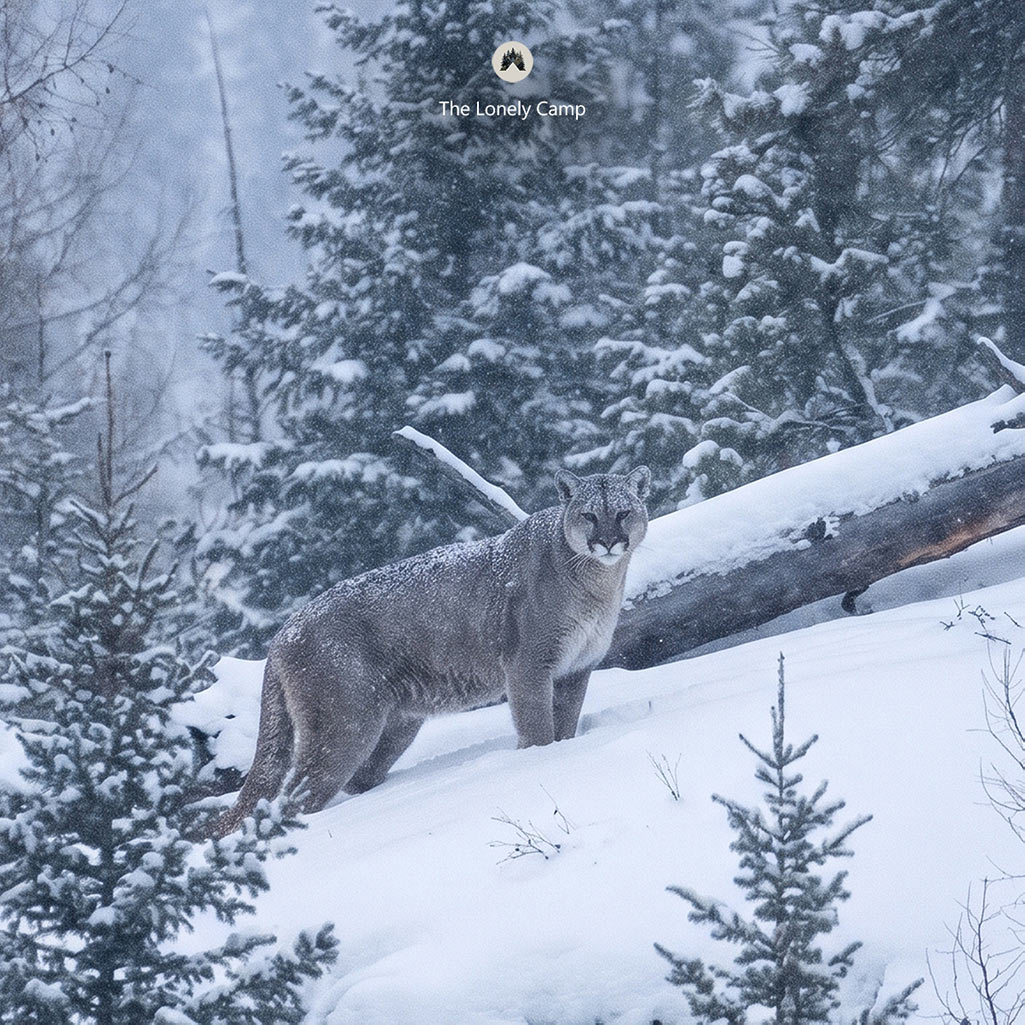
Image is for illustration purposes only.
Source: The Spokesman-Review / HeraldNet (2018) / Washington Department of Fish and Wildlife / Boone and Crockett Club / Roosevelt, Outdoor Pastimes of an American Hunter (1905) / Hornocker & Negri, Cougar: Ecology and Conservation (2010).