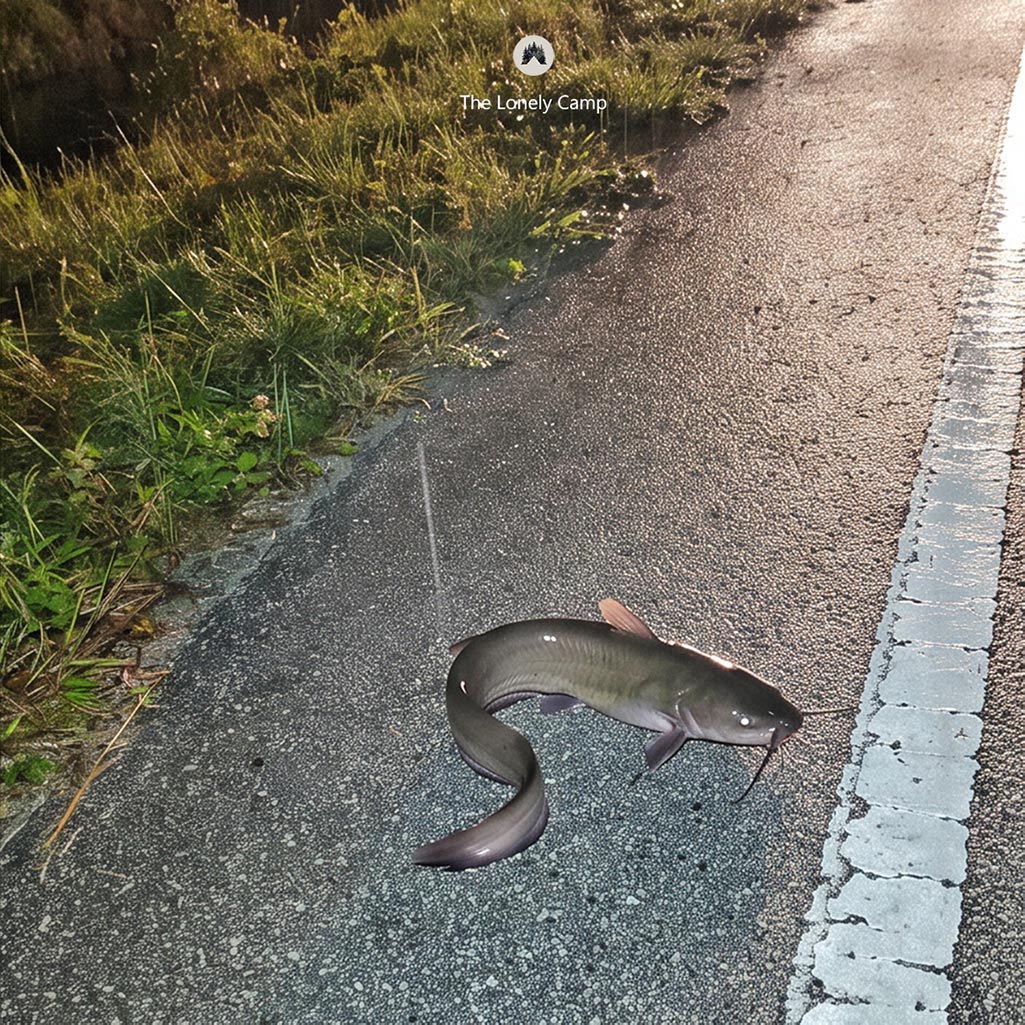
On warm, rainy nights across parts of South Florida, catfish climb out of the roadside drainage canals and crawl across the asphalt on their own, sometimes in such numbers that drivers run them over by the dozen.
The fish is the walking catfish, an invasive species brought over from Southeast Asia in the early 1960s for the home aquarium trade. Sometime in the mid-1960s, a batch of adult breeding stock imported from Thailand got loose in South Florida. Depending on which local account you trust, they either wriggled out of an outdoor holding pond at a fish farm in northeastern Broward County or spilled out of a transport truck hauling fish between Dade and Broward counties.
Every single one of those original escapees was an albino, bred with snow-white skin and pink eyes to look striking inside a glass living room tank.
A walking catfish does not have legs, but it does not need them. On dry ground, the fish props its front end up on the stiff, saw-toothed spines of its pectoral fins and whips its muscular tail from side to side like a snake, levering itself forward across wet grass or pavement. While a normal fish suffocates once its gills dry out, the walking catfish has a specialized, tree-like organ above its gill chambers that lets it gulp atmospheric air and absorb oxygen straight into its bloodstream. So long as its skin stays damp, it can travel overland for hours. Whenever a ditch starts drying up or runs low on food, the catfish simply wait for a wet night and go looking for a better pond.
That overland mobility made the fish impossible to quarantine. When Florida wildlife officials moved to outlaw possessing the species in late 1967 and early 1968, several tropical fish farmers around the Tampa Bay area reportedly dumped their banned stock straight into local ditches rather than get caught holding contraband.
In 1968, wild walking catfish were only found in three counties. Ten years later, they had colonized 20 counties across the southern half of the peninsula, swimming through South Florida’s vast grid of flood-control canals and crawling across the grass wherever a levee blocked the way. By the mid-1970s, they were firmly established inside Everglades National Park and Big Cypress National Preserve, despite a 1970 federal ban barring the entire air-breathing catfish family from crossing state lines.
Once the fish settled into the Florida swamps, natural selection went to work on their paint job. A glowing white catfish crawling across dark mud or swimming in tea-colored canal water is an easy target for wading birds, alligators, and largemouth bass. Predators picked off the pale fish so efficiently that albinos practically vanished from the wild population. Within a few generations, the descendants of those white aquarium fish had reverted to their ancestral camouflage, turning a muddy gray-brown dusted with tiny white spots.
When the invasion first hit the newspapers in the late 1960s, biologists worried the aggressive newcomers would eat their way through native bass and sunfish populations. Sixty years later, that ecological collapse has not happened. During the winter dry season, when water levels drop and native fish get trapped in shrinking, oxygen-starved marsh pools, walking catfish can take over a pothole because they can gulp air at the surface while everything else suffocates. In open lakes and canals, however, native predators keep them in check, and one field study of temporary Florida wetlands found that tiny native mosquitofish and topminnows actually ate more frog tadpoles than the walking catfish did.
Winter weather also keeps them penned into the southern half of the state. Water temperatures below 50 degrees are lethal to the tropical fish, and hard Florida freezes periodically wipe out massive numbers of them in shallow canals.
Where the walking catfish does cause real financial damage is right back where it started: on commercial fish farms. Hungry wild catfish routinely crawl out of roadside ditches at night, slither over the berms into ornamental aquaculture ponds, and feast on expensive tropical stock, forcing Florida fish farmers to build low barrier fences around their water just to keep the neighbors out.
After six decades of crawling across Florida roads, the fish is still hiding one final secret in plain sight. Ever since the first albinos escaped in the 1960s, state and federal records have listed Florida's invader under the scientific name Clarias batrachus. In 2008, taxonomists studying Southeast Asian catfish discovered that Clarias batrachus had been used as a catch-all label for at least four distinct species, and that the real Clarias batrachus lives only on the Indonesian island of Java. Because Florida's founding stock was shipped out of Thailand on the Asian mainland, biologists still have not settled on which species of walking catfish is actually crossing the highway.
Image is for illustration purposes only.
Source: Florida Museum of Natural History / U.S. Fish and Wildlife Service, Ecological Risk Screening Summary (2026) / U.S. Geological Survey Nonindigenous Aquatic Species Database / Schofield & Loftus (2015), Hydrobiologia / Ng & Kottelat (2008), Zoological Journal of the Linnean Society.
Walking Catfish Spread Across South Florida and Damage Fish Farms