
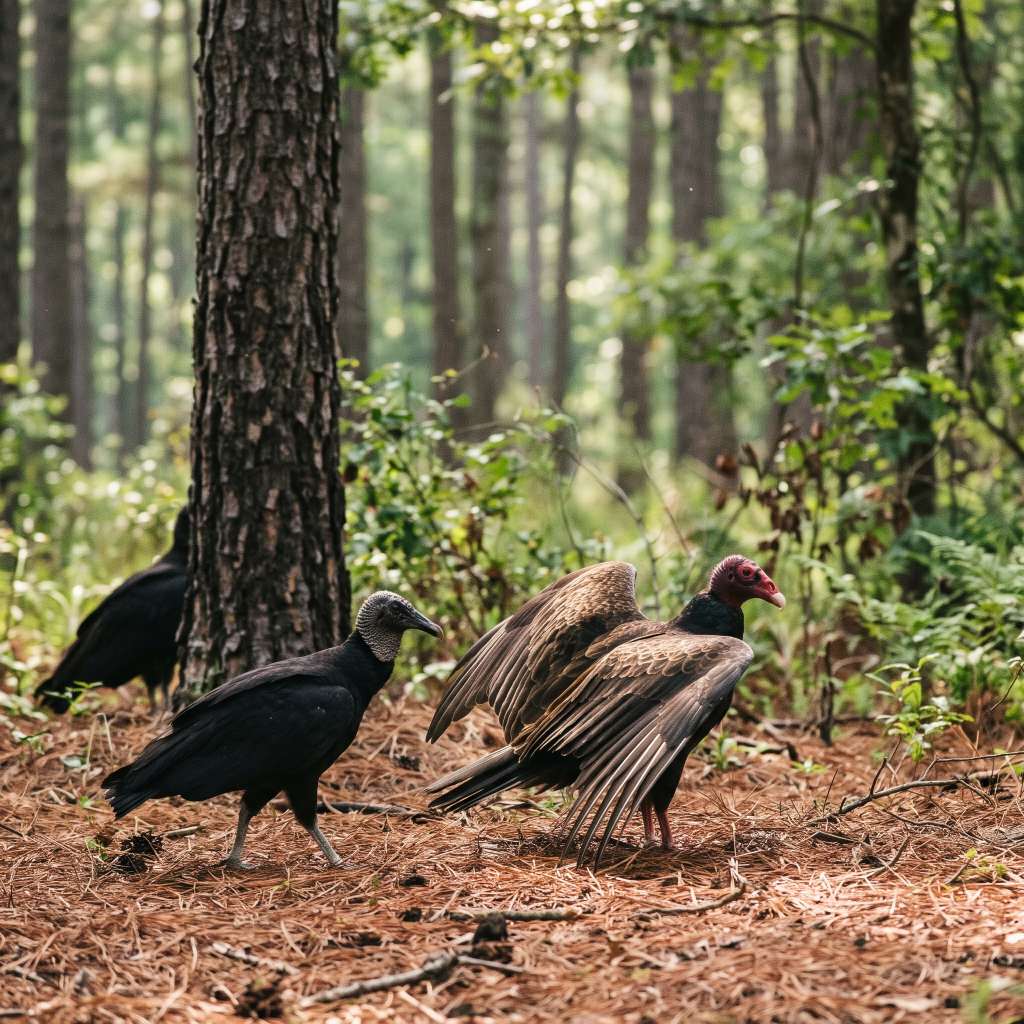
Three tons of dead feral pigs dumped intentionally across the floor of a Mississippi forest disappeared in just five days during the summer of 2016, stripped to bare bone by swarms of vultures, blowfly maggots, and groups of nine-banded armadillos.
In nature, sudden mass wildlife die-offs caused by disease outbreaks, extreme weather, or toxic algal blooms are almost impossible for scientists to study from day one because nobody knows where or when they will strike. By the time biologists hear about a major mortality event and reach the site, the first critical days of decomposition and scavenging have already passed.
To watch a mass mortality event unfold from the very first hour, wildlife ecologist Marcus Lashley at Mississippi State University, working alongside microbiologist Heather Jordan and forensic entomologist Jeffery Tomberlin, decided to build one from scratch.
Rather than killing native wildlife for the test, Lashley contacted the U.S. Department of Agriculture and state wildlife agencies that were already culling destructive, invasive feral hogs across the region to protect farm crops and native habitats. Over the summer of 2016, the research team collected 6,000 pounds of donated feral pig carcasses, froze them until the experiment was ready, and hauled three tons of thawed hogs out to test plots in the woods near Starkville, Mississippi.
In the sweltering southern summer heat, the forest cleanup crew mobilized almost immediately.
Within five days of the drop, black and turkey vultures, clouds of blowflies, and soil microbes reduced the three-ton pile of carcasses to scattered bones and hair. As millions of maggots poured off the decaying hogs and burrowed into the surrounding dirt to pupate, groups of nine-banded armadillos moved into the experimental plots, tearing up the soil around the bones not to eat the pork, but to gorge on the carpet of insect larvae.
In a larger follow-up experiment in 2019, the researchers expanded the setup across multiple plots to see how a massive die-off differs from an everyday wildlife death. Some forest plots received a single pig carcass to mimic a normal death in the woods, while others received up to 12 carcasses at once to simulate a localized catastrophe. Around several plots, the team also erected wire fencing to block out large vertebrate scavengers like vultures, coyotes, and opossums.
The comparison revealed a major bottleneck in nature's recycling system. When a single animal dies in the woods, vultures and mammalian scavengers quickly consume the meat before bacteria and flies can take over. During a sudden mass die-off, however, the sheer volume of meat completely overwhelms the local vultures and coyotes.
Because vertebrate scavengers get full long before the carcasses run out, the excess bodies sit rotting on the ground, turning into uncontested breeding grounds for blowflies and soil-altering bacteria that reshape the chemistry and plant life of the forest floor for years.
Image is for illustration purposes only
Source: Lashley, M. A., Jordan, H. R., Tomberlin, J. K., & Barton, B. T. (2018), "Indirect effects of larval dispersal following mass mortality events," Ecology 99(2): 491-493 / Baruzzi, C., Barton, B. T., Cove, M. V., Jordan, H. R., & Lashley, M. A. (2022), Ecology and Evolution