On an October evening in 2016, a woman named Linda Lohse was looking out of her kitchen window at her property in Kenny Lake, Alaska. She and her husband Ralph live on a piece of land between the Edgerton Highway and the Tonsina River. They keep chickens, ducks, and sheep. They have lived there for decades.
Sitting in the snow next to their chicken coop was a wild Canada lynx.
He was not running across the yard. He was not crossing the property. He was sitting upright, tail twitching, watching the chickens and ducks inside the coop the way a lion watches a herd of antelope. Linda called Ralph to the window. They watched him together for forty minutes.
Ralph Lohse is a fur trapper. He has lived and trapped in the Copper River Valley since 1967. By his own count, he has skinned roughly four hundred lynx over the course of his life. He knows lynx. The first thing a lynx does when it sees a human at a window is leave. This one did not.
The Week
Eventually, the cat jumped onto the wire mesh on top of the coop. The Lohses went outside to scare him off. The startled lynx ran off, but instead of running into the woods, he ran with their flock of sheep, as if he were one of them, before finally vanishing.
Over the next week, he came back.
Six chickens disappeared. Three ducks disappeared. Then he went after one of the Lohses’ sheep. He bit it through the throat. The sheep escaped him in the moment, but it died from the wound three days later.
A 25-pound wild cat had killed a 100-pound sheep with a single bite. This is what a lynx is, when nobody is watching.
Ralph picked up his rifle. Then he and Linda noticed something in the photographs they had taken of the lynx through the window. The cat was wearing a collar.
Someone, somewhere, was studying him.
The Coop
The Lohses changed their plan. Instead of shooting the cat, they decided to catch him alive.
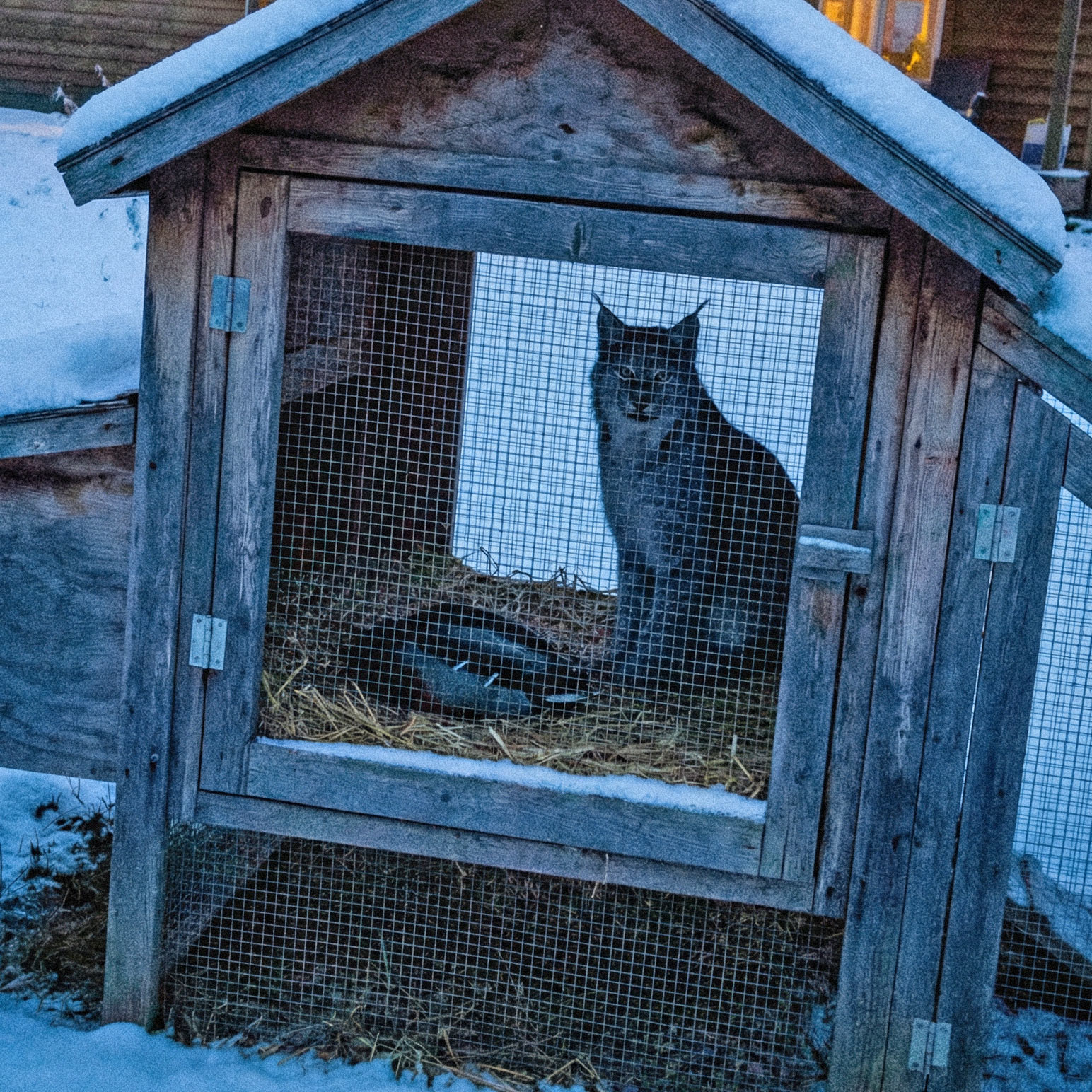
They tracked him to where he had been eating one of their ducks. They picked up the partially-eaten carcass and placed it inside their small wooden chicken house, the one they use to raise chicks. They wired a motion alarm to the door, then went back inside the farmhouse and waited.
A few hours later, the alarm went off.
Ralph walked out into the snow in the dark, in the freezing Alaskan cold, and approached the chicken house. He could hear the lynx inside, eating the duck. The cat had walked in through the small access door. Ralph reached over, took hold of the door, and quietly closed it.
A visual reconstruction for reference
A wild Canada lynx, one of the most elusive predators in North America, was now sitting inside his chicken coop.
The next morning, two biologists from the Tetlin National Wildlife Refuge drove out from Glennallen. They tranquilized the cat, removed his old collar, and replaced it with a new satellite collar provided by Knut Kielland, a wildlife biologist at the University of Alaska Fairbanks. They named him Max. They drove him fifty miles south down the Richardson Highway and released him into the wilderness near the Tiekel River.
Then they read the data on his old collar.
Where Max Came From
The collar showed that Max had been captured ten months earlier, in January of 2016, by a Canadian researcher named Allyson Menzies at Kluane Lake, in the Yukon Territory.
Kluane Lake is roughly 250 miles east-southeast of the Lohses’ chicken coop, as the crow flies. Between January and October, Max had walked from Kluane Lake, west through some of the most remote wilderness left on the continent. He had crossed the St. Elias Mountains. One of the readings on his old collar recorded him at over 10,000 feet of elevation. He had crossed rivers that should not have been crossable for a small wild cat in winter.
Two hundred and fifty miles in a straight line. The actual distance walked, accounting for terrain and detours and hunting along the way, was certainly far more. Maybe four hundred miles. Maybe more than that.
He had walked the entire way alone, on his own power, for reasons no one could explain, and ended up sitting outside a chicken coop on the property of a retired fur trapper.
What Biologists Have Since Learned
Until very recently, scientists believed adult Canada lynx held home territories of about 20 to 100 square miles. They believed lynx were stay-at-home animals, anchored to a small patch of forest where they hunted snowshoe hare. The collar data from Max should have been impossible.
It turned out not to be unusual at all.
In 2017, US Fish and Wildlife biologists put a satellite collar on a male lynx they nicknamed Hobo, captured at the Tetlin National Wildlife Refuge in Alaska. Over the following thirteen months, Hobo walked 2,174 miles. He crossed mountains. He crossed rivers. He crossed the border into the Yukon and continued into the Northwest Territories.
After Hobo, more long-haul cats turned up. One walked from interior Alaska all the way to the Chukchi Sea. One walked from the Brooks Range to British Columbia, a journey of more than a thousand miles. One was tracked making fourteen separate swims across the Tanana River, a swift glacial river over a mile wide in places, in temperatures down to ten below zero. Some of the crossings were at night.
Knut Kielland, the biologist who provided Max’s new collar, summed up what the data has revealed about lynx in one quiet observation. They travel “not only the sheer distance, but straight across country, sometimes almost on a compass bearing.”
The leading theory is that lynx are following the snowshoe hare boom-and-bust cycle across the continent. When hares crash in one region, lynx walk to find a region where hares are still abundant. But the journeys are too long, too straight, and too directional to be only about food. The cats know where they are going. We don’t know how.
Where Max Is Now
After his release at the Tiekel River, Max’s new collar tracked him for several months. He kept moving. He ranged widely. In the spring of 2017, the second collar’s battery died. Max disappeared from the data.
He may be alive somewhere in Alaska right now. He may have walked back to the Yukon. He may have walked another four hundred miles in a direction nobody would think to look. The Lohses do not know. The biologists do not know. Nobody knows where Max is.
A lynx in a chicken coop in rural Alaska. A small story, on the surface. A retired trapper, a duck, a closed door. But behind that small story is a much bigger one we are only beginning to understand. The wild cats of the boreal forest, animals so secretive that most Alaskans never see one in their entire lives, are walking journeys we did not know they made, for reasons we do not understand, on routes that cross half a continent.
The lynx we almost never see is not where we think he is. He is somewhere on the move, between somewhere and somewhere else. Tomorrow he will be somewhere we cannot guess.