
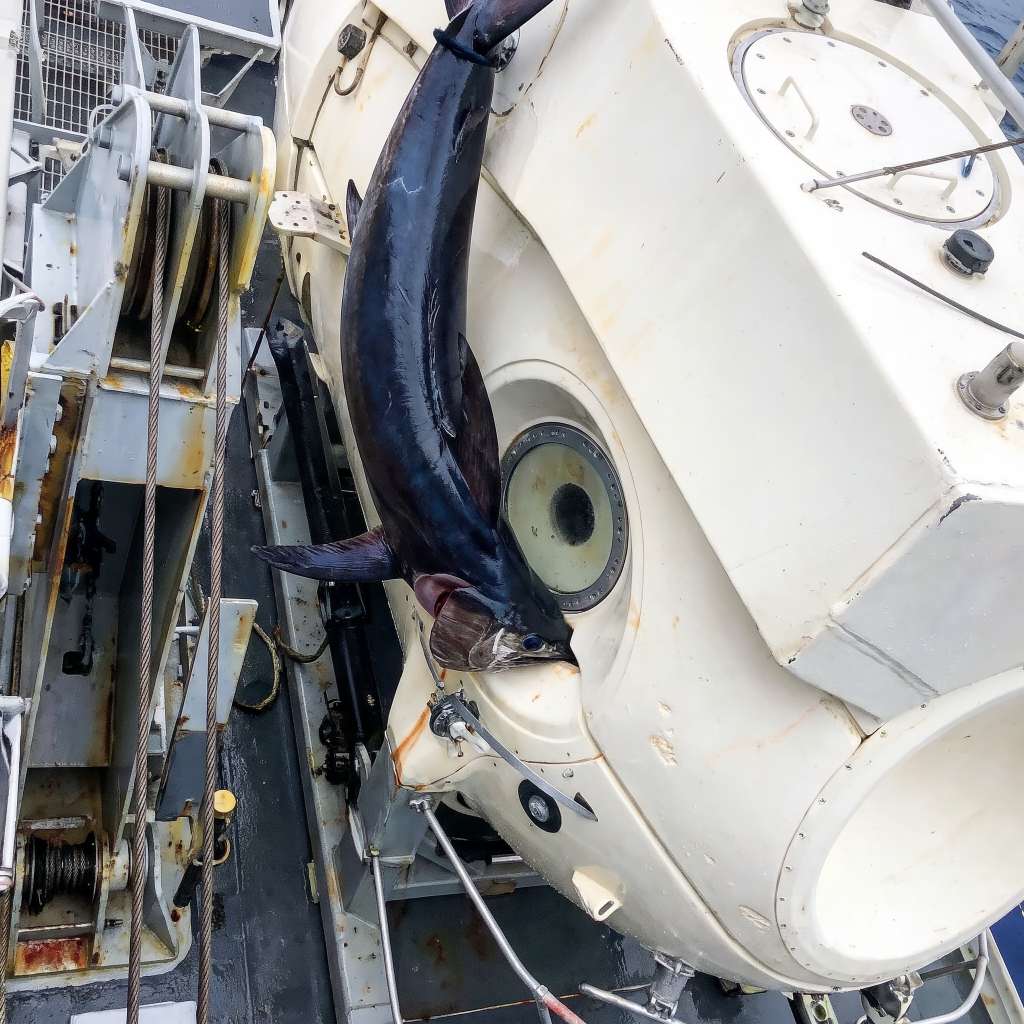
On July 6, 1967, the deep-sea research submersible Alvin was cruising just above the muddy bottom of the Blake Plateau off the coast of Georgia and northern Florida when a 196-pound swordfish erupted from the seafloor and drove its bill straight into the vessel's fiberglass outer hull.
At the time of the dive, Woods Hole Oceanographic Institution pilot Valentine Wilson and two geological observers, Edward Zarudzki and Dr. Frank Manheim, were exploring the plateau at a depth of about 610 meters, or roughly 2,000 feet. Looking out through the thick plexiglass viewports into the beam of the submersible's floodlights, the crew noticed what looked like a pale hummock resting on the pale gray sediment ahead of them.
As Alvin glided closer, the mound suddenly moved.
Startled from the mud where it had been resting, an eight-foot swordfish rose off the bottom, turned toward the blinding lights of the 23-foot white craft, and charged. Before Wilson could maneuver out of the way, the fish slammed headfirst into the starboard side of the submersible just inches below the viewing window.
Instead of glancing off the curved shell, the swordfish's flat, 30-inch rostrum hit a narrow joint between two sections of the outer fiberglass fairing. The force of the impact wedged the bill deep into the seam, pinning the nearly 200-pound fish directly against the hull right beside the wiring and junction boxes that sat outside the inner steel pressure sphere.
Inside the cramped cabin, the three men could hear and feel the trapped animal thrashing violently against the skin of the sub as it tried to wrench itself free.
Although the inner titanium-and-steel personnel sphere protecting the crew remained completely intact, having a large pelagic predator impaled near external electrical cables 2,000 feet beneath the Atlantic was a serious operational hazard. Wilson immediately aborted the geological survey and began bringing Alvin back toward the surface, carrying the trapped swordfish up through the water column for the entire ascent.
When the submersible broke the surface alongside its catamaran tender ship, Lulu, the swordfish was still firmly stuck in the hull seam. During the struggle at the surface as crews secured the vessel, the violent thrashing snapped the animal's bill near the base of its snout.
After hoisting Alvin onto the support ship's deck, engineers and crew members spent roughly two hours working with tools to pry the embedded section of the rostrum out of the fiberglass joint. Once weighed on deck, the eight-foot fish tipped the scales at 196 pounds.
The collision provided marine biologists with hard evidence of swordfish behavior in the deep sea. Before the 1960s, researchers rarely had direct visual proof of how deep swordfish traveled or whether they rested directly on the continental slope bottom. Zarudzki later co-authored the formal scientific account of the dive, documenting that swordfish not only descends into pitch-black waters down to 2,000 feet, but also lies directly on the bottom sediment and responds to sudden disturbances with an immediate, full-speed strike.
Image is for illustration purposes only.
Source: Zarudzki, E. F. K., & Haedrich, R. L. (1974), "Swordfish (Xiphias gladius) attack on submarine Alvin," Oceanology / Woods Hole Oceanographic Institution (WHOI) Archives, Dive 202 Records (1967).