A young guide who grew up at Gunung Leuser National Park in Sumatra said he had never once seen a Sumatran tiger in the wild. His father, who spent his entire life working in and around that same forest, had seen one. Once.
That is the Sumatran tiger. Fewer than 400 left on earth, moving through one of the densest rainforests in Asia, and the people who live closest to them almost never see them. They hear them occasionally. They find tracks. They find what’s left of livestock. But the animal itself stays invisible.
Which is exactly what makes footage like this worth paying attention to.
What a dangau is and why it matters
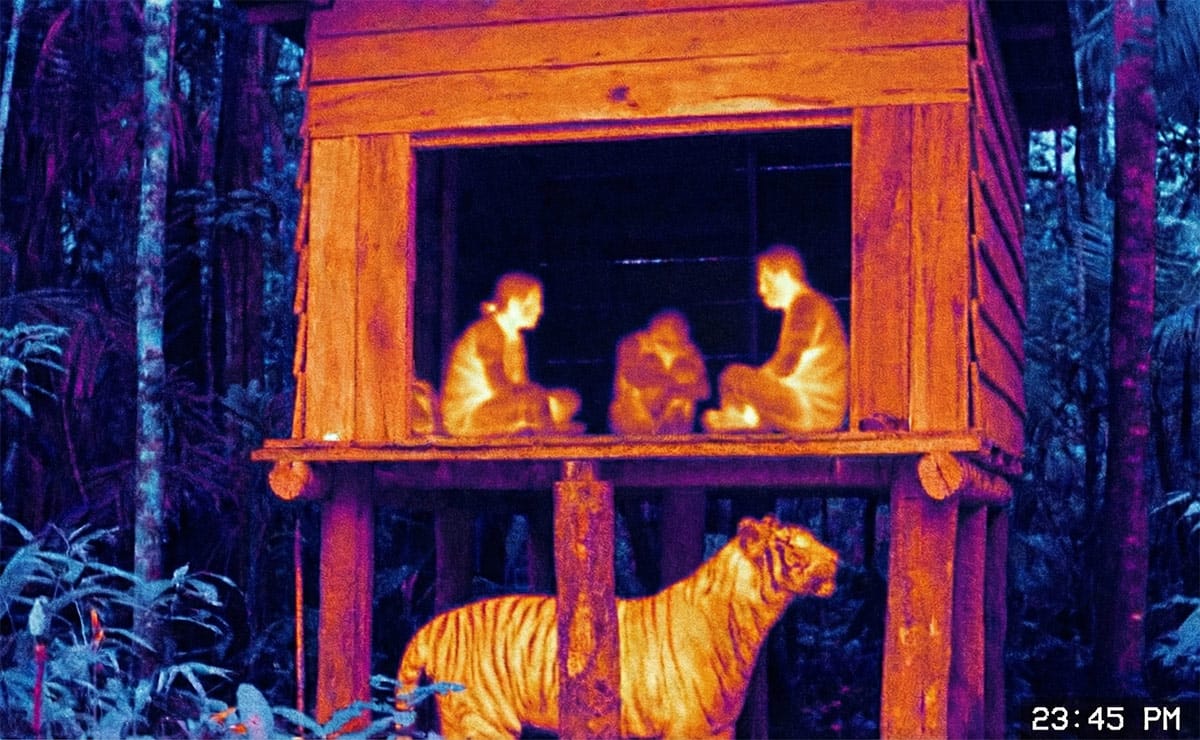
The structure in the footage is a dangau, a traditional elevated wooden shelter used by Indonesian forest workers, farmers, and loggers across Sumatra and Borneo. The elevation is practical, keeping occupants above ground moisture, insects, and the general unpleasantness of sleeping on a rainforest floor.
It does not keep them above a Sumatran tiger’s line of sight or reach. The platform height of a typical dangau puts a sleeping occupant at roughly the same level as the head of an adult tiger standing on its hind legs. The thermal camera in the footage captures exactly that geometry. The men are above the ground. The tiger is directly below them, motionless, listening.
It is not always a near miss
In February 2009, a father and son, illegal loggers working in protected forest in Sumatra’s Jambi province, laid down to sleep next to a pile of cut wood. A Sumatran tiger killed both of them as they slept. They were the fourth and fifth people killed by tigers in that province in less than a month.
The head of the Jambi nature conservation agency noted that preliminary findings suggested the attacks were happening because people were disturbing tiger habitat, adding that it was not common for tigers to attack humans in the area. That last part is worth holding onto. Not common. But documented.
About 40 people were killed by tigers on Sumatra between 2000 and 2004, according to the state conservation agency. The majority were forest workers, farmers, and people working at the edges of protected land. People sleeping in jungle shelters, exactly like the men in the footage.
Why conflict is increasing
The Sumatran tiger is running out of forest. About 12 million hectares of Sumatran forest has been cleared in the past 22 years, a loss of nearly 50% of the island’s forest cover. As the forest shrinks, tigers and humans are pushed closer together.
The loggers in the footage are part of that dynamic, whether they know it or not. Working in tiger habitat, sleeping in it, moving through it at night. The tiger standing beneath their shelter is not lost or confused. It is in its territory, assessing something in the dark.
The animal that stays invisible by choice
What the footage shows, more than anything, is deliberate restraint. The tiger approaches, investigates, and leaves. It is not hungry enough, threatened enough, or provoked enough to act.
That experience, frozen in place while a tiger decides what to do with you, is what the men in the footage were spared by sleeping through.
400 animals, 170,000 square miles of potential habitat
The math of encountering a Sumatran tiger in the wild is almost impossibly unfavorable. Fewer than 400 animals across an island of 170,000 square miles, most of them in two core populations in the Leuser Ecosystem and Kerinci Seblat national park. A young local guide who has spent his entire life near that forest and never seen one is not unusual. He is the norm.
The ones that do get seen are usually the ones that have been pushed to the edge of their range by habitat loss, or the ones that have already decided that the boundary between forest and human settlement is worth crossing.
The tiger beneath the dangau had not made that decision yet. It stood in the dark, listened, and left.
The men never knew it was there.