
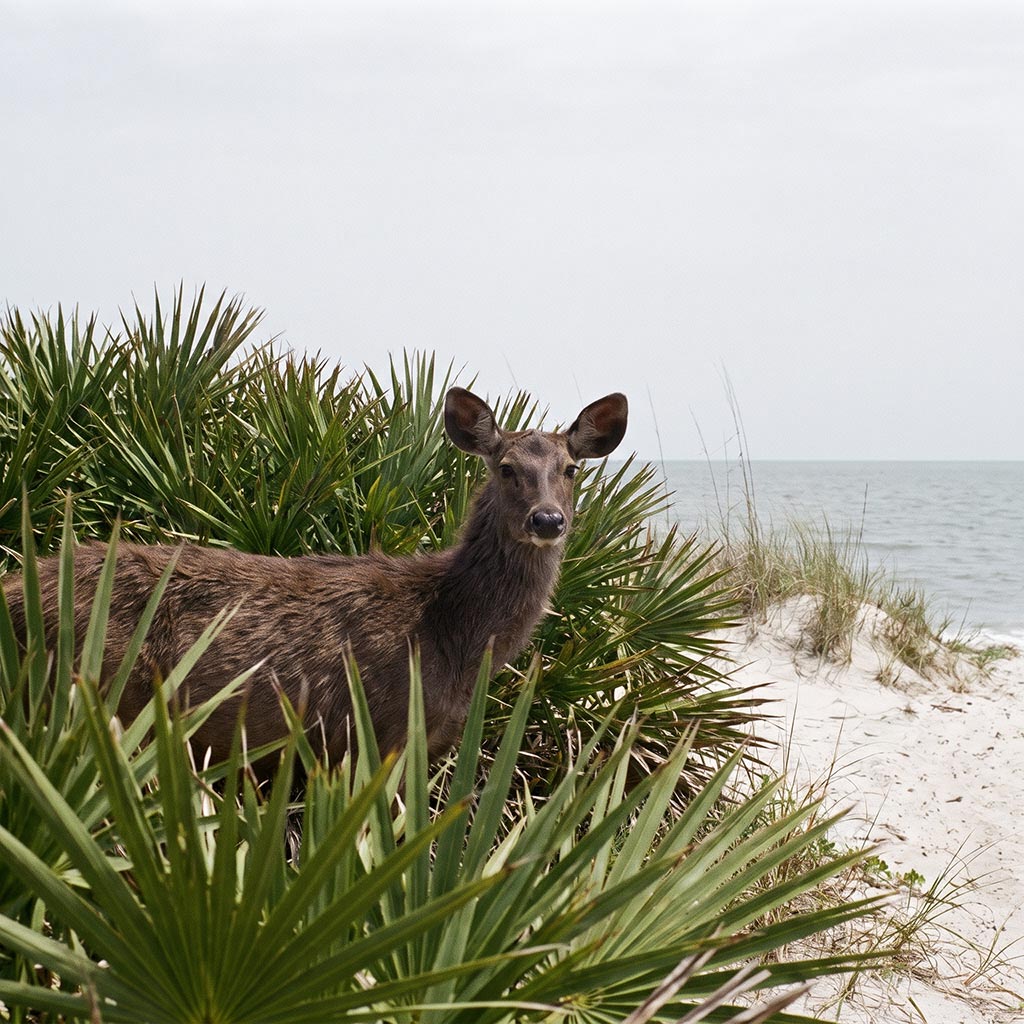
If you brought a group of hunters from India or Nepal to St. Vincent Island without telling them where they were, the first time a sambar barked in the marsh after dark their blood would run cold. Where they come from, that sound usually means a tiger is close.
St. Vincent is a 12,300-acre barrier island in the Gulf of Mexico off Franklin County, Florida, part of a national wildlife refuge. It is also home to a wild herd of sambar, a large deer from South and Southeast Asia that is one of the main prey animals of tigers across much of its native range. When a sambar spots a big cat, it stamps and lets out a loud, honking alarm call that carries a long way through the forest. Generations of tiger hunters and trackers in India learned to listen for it, because it often told them where the tiger was before anyone could see it.
The sambar got to Florida because of a patent medicine fortune. Dr. Ray V. Pierce, whose remedies sold across the country in the late 1800s, owned St. Vincent from about 1907 to 1914 and turned it into a private game preserve. He spent roughly $60,000 bringing in what he called Old World game animals, and he ran more than 400 head of cattle on the island. Most accounts date the arrival of the sambar to 1908.
In 1948, the Loomis brothers bought the island for $140,000 and kept stocking it. They added zebras, eland, blackbuck antelope, ring-necked pheasants, Asian jungle fowl, peacocks and semi-wild turkeys. Most of them never adjusted to a hot, wet Gulf island. According to a 2005 firsthand account, the zebras and blackbuck kept coming back to the hunting camp to be fed. When the U.S. Fish and Wildlife Service took over the island in 1968, it found sambar, feral hogs, a few cattle and a couple of blackbuck still there. The agency removed the rest and left the sambar.
The sambar made it because they found a part of the island nothing else was using. In their native range they are tied to water, feeding in and around wetlands and often wading in to escape predators. On St. Vincent they moved into the freshwater marshes and stayed there. The island’s native white-tailed deer, which average 100 to 130 pounds, keep to the dry pine uplands. The sambar weigh 400 to 600 pounds, according to the Fish and Wildlife Service, and live in the wet ground below them. More than a century later, the two deer still divide the island by habitat.
The refuge manages the herd with a lottery hunt. About 200 hunters a year draw permits for a three-day hunt in November, and they are allowed bows or muzzleloaders only.
The sambar share St. Vincent with an animal that would recognize their alarm call for what it is. Since 1990, endangered red wolves have been breeding on the island, raising pups in the wild before the young wolves are moved to the recovery area in North Carolina. A red wolf is not a tiger. But on a marsh island in Florida, a deer from the forests of Asia still gives the same warning bark it gave a century ago, and now and then there is a predator out there to hear it.
Image is for illustration purposes only.
Source: U.S. Fish and Wildlife Service, St. Vincent NWR / Jim Carroll, History of St. Vincent Island (FWS) / Stephen Bodio blog guest account (2005) / WTXL (2019)