
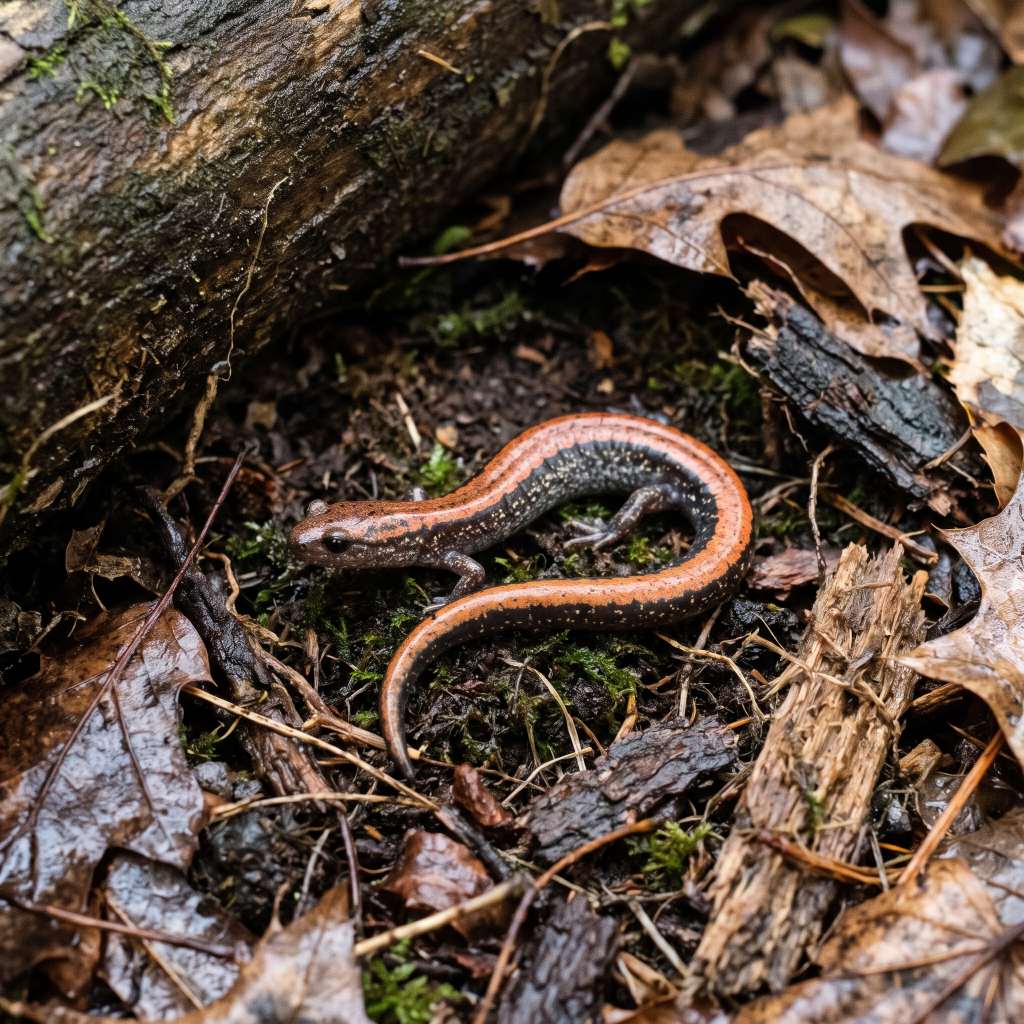
A forest patch the size of a football field in the northeastern U.S. holds about 5,300 salamanders. Almost nobody ever sees them, and together they can outweigh the deer.
The animal behind those numbers is the red-backed salamander, a slender three-inch amphibian marked by a muted reddish stripe down its spine. It is one of the most abundant vertebrates in eastern North America, yet a person can hike the same wooded ridge for decades without spotting one.
The reason comes down to anatomy. Red-backed salamanders have no lungs. They breathe entirely through their moist skin and the lining of their mouths, which means dry air and direct sunlight are fatal. To stay alive, they spend almost their entire existence tucked beneath rotting timber, flat stones, damp leaf litter, and deep underground burrows, surfacing mostly on wet nights.
Unlike many amphibians, they do not even need a pond to reproduce. Females lay small clusters of eggs inside damp, decaying logs or mossy crevices and stay coiled around them for weeks, guarding the clutch from predators and fungal growth until miniature, fully formed salamanders hatch. Once grown, they are surprisingly territorial for an animal that fits on a finger. Individuals patrol tiny patches of forest floor, mark their ground with scent glands, and bite rivals that cross the line.
Because they stay hidden underground and slip into soil cracks the second a log is rolled, biologists underestimated their numbers for decades. In the 1970s, a landmark survey at New Hampshire's Hubbard Brook Experimental Forest estimated roughly 2,950 salamanders per hectare, about two and a half acres. Even that early count showed they outweighed the forest's breeding birds two to one and matched all of its small mammals combined. A 2014 study in the Missouri Ozarks found densities two to four times higher still.
In 2024, a team led by the U.S. Geological Survey and Penn State published the first range-wide population estimate in Biology Letters, pulling together data from across eastern North America. The results climbed well past earlier expectations, with the densest pockets turning up in the foothills of Virginia's Blue Ridge Mountains. Individually, a red-backed salamander weighs barely a gram.
Multiplied by thousands across every wooded acre, they represent one of the largest pools of living animal weight in northeastern forests outside of insects, matching or exceeding the white-tailed deer browsing overhead.
All of that hidden mass shapes the woods from the bottom up. Penn State co-author David Miller described red-backed salamanders as the top predators of the forest-floor food web. They feed heavily on tiny soil invertebrates such as mites, springtails, and ants that larger animals cannot efficiently hunt, then pass those calories up the chain when they are eaten by snakes, woodland birds, and small mammals.
By keeping leaf-eating invertebrates in check, they also slow down how fast dead leaves break down, helping keep carbon locked in the soil rather than escaping back into the air.
Lead author Evan Grant of the U.S. Geological Survey warned that losing them would likely trigger major consequences across the entire ecosystem. That threat is no longer theoretical. A deadly fungal disease called Bsal, a close relative of the chytrid fungus that has devastated frogs worldwide, was first detected in the Netherlands in 2013 and has since wiped out salamanders across parts of central Europe. It has not reached the United States yet.
Image is for illustration purposes only
Source: Grant, E. H. C., et al. (2024), Biology Letters / U.S. Geological Survey / Penn State / Smithsonian's National Zoo and Conservation Biology Institute / Burton and Likens (1975), Copeia / Semlitsch et al. (2014), Canadian Journal of Zoology