
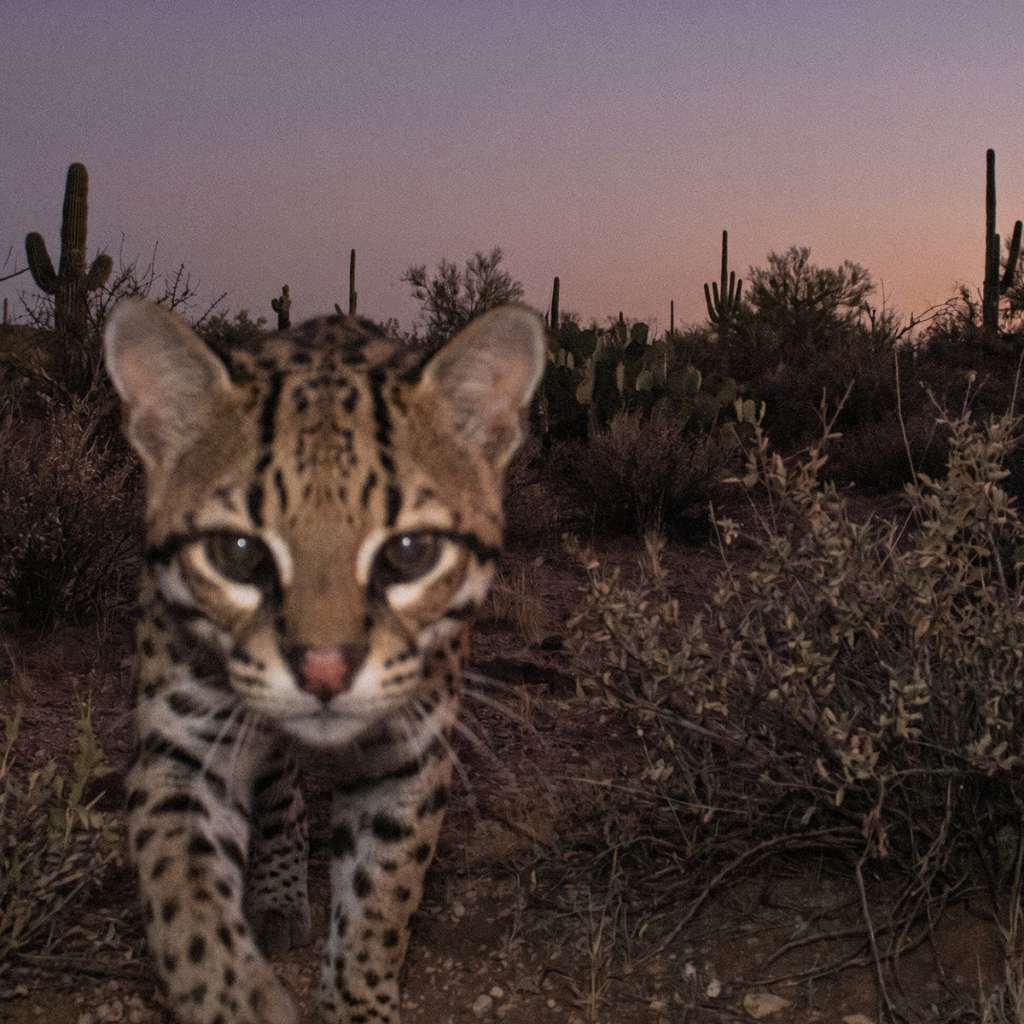
A lone male ocelot named Himdam walked 111 miles across four Arizona mountain ranges in a single year, the longest movement ever documented for his species, through terrain that no ocelot is supposed to be able to survive in.
Himdam is a word from the O'odham language, spoken by the Tohono O'odham Nation whose ancestral territory stretches across the Sonoran Desert of southern Arizona and northern Mexico. The land this ocelot walked across is their land. Students from the San Xavier District's Voices of Our Youth program worked with the Center for Biological Diversity and a tribal linguist to develop three names in their language for the cat. Al Ha'icu Ga'gdam, meaning Little Seeker. Al Dos, meaning Little Dot. And Himdam, meaning Traveler. They put it to a community-wide vote, and Himdam took 80 percent. A fourteen-year-old student named Isaac Valencia explained the choice: the cat is always on the move. The Chairman of the San Xavier District, Austin Nunez, put it more directly. Himdam represents movement, resilience, and connection to our homelands.
He started in Sonora, Mexico, in subtropical scrubland where ocelots are a functioning part of the predator community. Then he walked north. To reach the mountain ranges of southern Arizona, he had to cross up to a hundred miles of open Sonoran Desert. No canopy. No thornscrub. No cover at all for long stretches. Just exposed flats, dry washes, and open sky where a thirty-pound spotted cat is visible to every hawk, coyote, and border patrol vehicle in the valley. He crossed active highways. He threaded through border infrastructure. He moved through country where his camouflage, the one advantage that kept his species alive through a century of predator eradication in Texas, was useless against the bare dirt and open rock of the desert floor.
When he reached the mountains, the environment did not improve. It just changed categories of hostile. The Sky Islands of southern Arizona are isolated mountain ranges that rise out of the desert like forested towers. The Huachucas, the Santa Ritas, the Atascosas. They support pine-oak woodland, steep rocky drainages, and winter temperatures that drop below freezing. Nothing about this habitat matches the ocelot's biological spec sheet. The prey base is different. The terrain is vertical instead of flat. The cover is sparse compared to the wall-to-wall thorn brush of South Texas. An ocelot hunting in the Sky Islands is operating in an environment that its body was not optimized for, using a skill set that evolved for a completely different landscape.
Himdam made it work. His GPS collar data showed him moving through four separate mountain ranges over the course of a year, covering distances between ranges that required repeated crossings of the open desert valleys in between. He was not wandering randomly. He was searching. Male ocelots disperse from their natal range to find unoccupied territory and unrelated females, and in southern Arizona there are almost no females to find. The breeding population is in Mexico. The cats that show up on trail cameras in the Arizona ranges are almost exclusively lone males who made the crossing and found empty country.
Over the last decade, wildlife biologists have documented a handful of these males in the Sky Islands. A few trail camera frames here, a collar ping there. Each one represents an individual animal that independently made the decision to leave viable habitat, cross a hundred miles of desert, and climb into a freezing mountain range alone. There is no established Arizona population feeding these sightings. Every ocelot that shows up in the Huachucas or the Santa Ritas walked there from Mexico by itself.
Himdam's 111-mile track across four ranges broke every documented movement record for the species. Ocelots in their native thornscrub habitat typically maintain small, dense home ranges and rarely move more than a few miles. They are not built for long-distance travel. The legs are short. The frame is compact. The musculature is designed for explosive short-range ambush, not sustained overland movement. What Himdam's data showed was an animal operating so far outside its expected behavioral parameters that the biologists tracking him had to redefine what they thought the species was physically capable of.
The record matters because it changes the conservation math. If ocelots can cross a hundred miles of hostile terrain and establish themselves in mountain habitat that nobody considered viable for the species, then the recovery map for the American ocelot is larger than anyone assumed. The thornscrub of South Texas is not the only option. The Sky Islands are not a dead end. They are a corridor, and the lone males walking through them are proving that the connection between the Mexican population and potential American habitat is not theoretical. It is already happening, one traveler at a time.
Sources:
Center for Biological Diversity, April 20, 2026:
https://biologicaldiversity.org/w/news/press-releases/tohono-oodham-youth-name-rare-arizona-ocelot-himdam-following-cats-remarkable-journey-2026-04-20/
Sky Island Alliance, April 2026:
https://skyislandalliance.org/2026/04/endangered-ocelot-travels-across-4-sky-islands-setting-record/
KJZZ, May 5, 2026:
https://www.kjzz.org/tribal-natural-resources/2026-05-05/tohono-oodham-youth-help-name-the-male-ocelot-roaming-in-southern-arizona