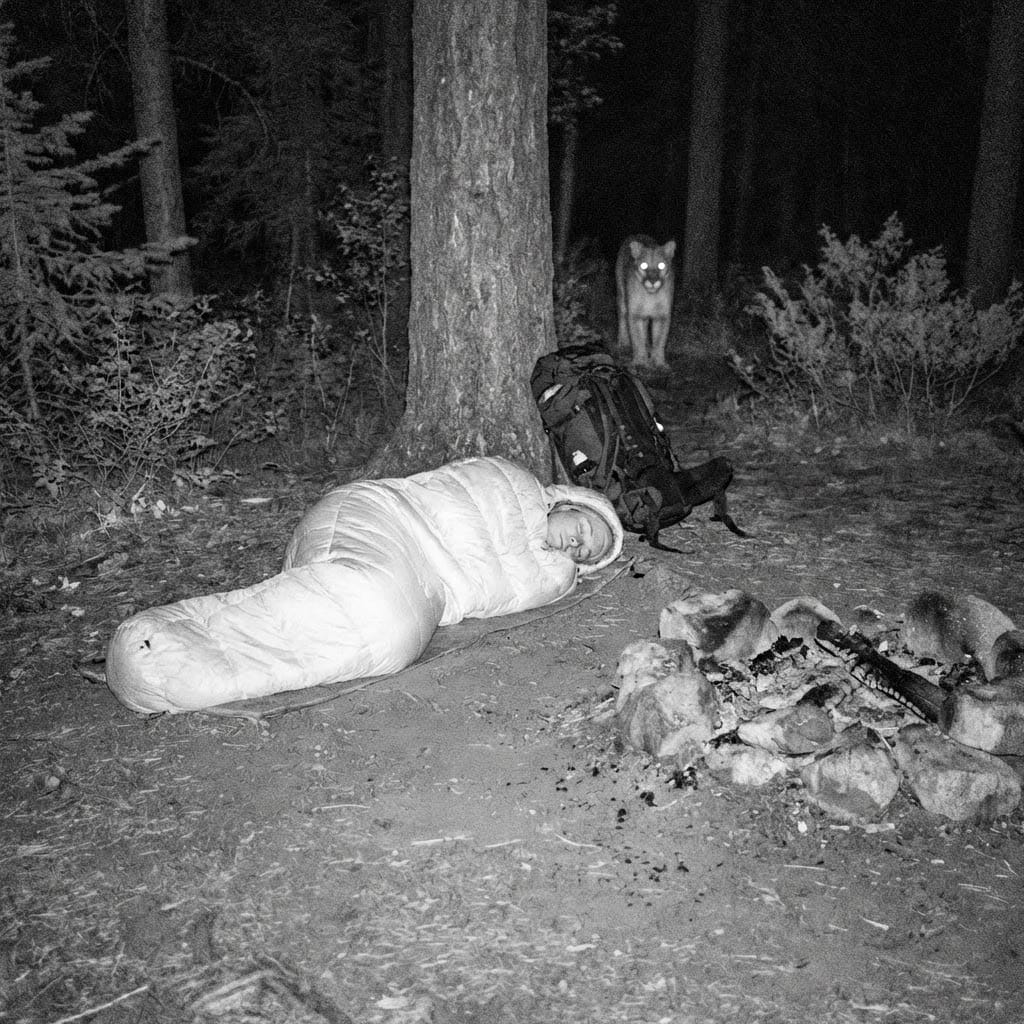
You can watch the footage and feel two things simultaneously. The first is obvious. The second takes a moment longer, a quiet suspicion that this probably doesn’t happen. That mountain lions don’t actually approach sleeping humans in their sleeping bags, sniff them, and walk away.
Your skepticism is reasonable. And the answer is more complicated than either side of that argument wants to admit.
What mountain lions actually fear
The starting point is this: mountain lions are genuinely afraid of humans. Not cautious. Afraid.
A UC Santa Cruz study placed audio equipment at mountain lion kill sites in the Santa Cruz Mountains. When a lion arrived to feed, hidden speakers broadcast recordings of people talking. In 29 experiments involving 17 pumas, the animals fled in 83% of cases the moment they heard a human voice. Frogs triggered the flight response exactly once.
That is the baseline. A mountain lion that hears a human typically leaves immediately. The problem with a sleeping camper in a sleeping bag is that they make no sound at all. To a mountain lion moving through its territory at night, a motionless human-shaped object in the dark reads as something unknown, not something to flee from.
It has actually happened
In July 2012, a 63-year-old man from the San Francisco Bay Area drove to his favorite hiking spot outside Nevada City, California. He laid out his sleeping bag without a tent, put on a stocking cap, and went to sleep. A mountain lion attacked him while he slept.
The wildlife officer who responded noted something that stuck. “The incident does not fit the typical profile of a mountain lion attack, in which a cougar mistakes a person for fleeing prey. He posed zero threat to this lion because he was asleep.”
That last sentence is worth sitting with. The standard mountain lion attack profile involves a running target, something that triggers the chase instinct. A sleeping human in a bag doesn’t run. The attack was not predatory in the normal sense. The lion approached something unfamiliar, in the dark, in its territory, and made a decision that it later apparently abandoned. The man survived.
This is the documented version of what trail camera footage captures. The approach. The investigation. In most cases, the departure.
Why the sleeping bag specifically is a problem
A tent provides a psychological barrier that matters more than its physical reality. A mountain lion approaching a tent sees a structure, smells multiple layers of fabric, and encounters a shape it recognizes as human habitation. Most avoid it.
A sleeping bag on open ground is different. The shape is animal-sized. The smell is human but concentrated and stationary. There is no structure to read as a warning. Wildlife experts noted the man’s stocking cap may have obscured the human profile of his head, making identification harder in low light.
The mountain lion in trail cam footage approaching a sleeping bag is not behaving abnormally. It is doing exactly what an apex predator does when it encounters an unfamiliar object in its range at night. It investigates.
How rare is rare
Between 1890 and 2004, there were 88 reported attacks on humans across North America, resulting in 20 deaths. That is across 114 years, an entire continent, and tens of millions of people recreating in mountain lion habitat annually.
Research tracking 22 mountain lions in the Santa Monica Mountains found that lions living near high human recreation areas shifted their activity toward the middle of the night and spent more daylight hours resting, actively restructuring their behavior to avoid people. They are doing the work of coexistence. Most of them, most of the time.
The footage is real in the sense that the behavior it shows is documented. A mountain lion approaching a sleeping human, investigating, and leaving without incident is not impossible. It has a recorded precedent. It is also vanishingly rare, which is why the footage is remarkable rather than routine.
What actually reduces the risk
Use a tent. Not because fabric stops a mountain lion, it does not, but because the structure signals human habitation and most lions avoid it.
Don’t sleep with food inside your bag or near your head. Scent is the primary trigger for investigation. A clean camp with properly stored food removes the most common reason a predator has to approach in the first place.
If you are camping in documented mountain lion territory, a fire provides meaningful deterrence. Mountain lions avoid fire consistently, and the light eliminates the ambiguity that makes a sleeping human an interesting object to investigate in the dark.
The camper who never woke up
In the footage, the lion approaches, sniffs, pauses, and leaves. The camper shifts slightly but does not wake. By every measure of mountain lion behavior, this is the expected outcome. The animal came close enough to determine what it was dealing with, found no trigger for aggression, and moved on.
That is how almost every one of these encounters ends. The lion sees you before you see it, makes its assessment, and disappears. The trail camera is usually the only record that it happened at all.