
Missouri had never positively identified the same mountain lion in the state twice until one male broke the streak across eight years. Pulled alive from a coyote trap in 2012, the cat vanished into the Ozarks only to leave his DNA behind again in 2018 and 2020.
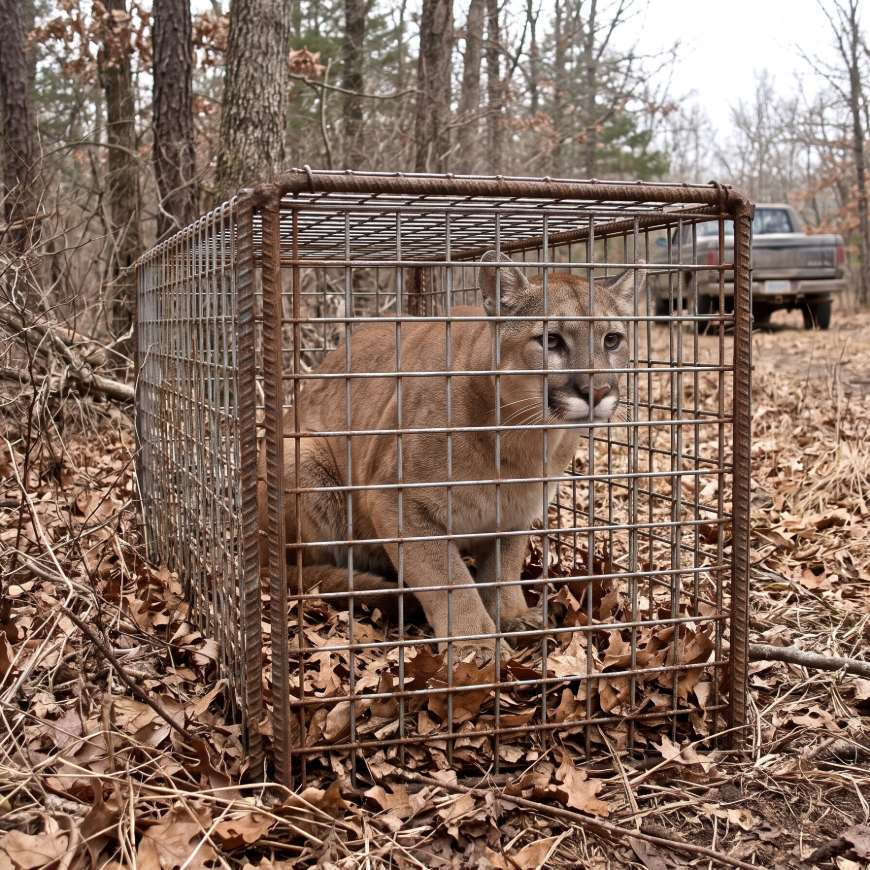
The story started on January 4, 2012, in Mark Twain National Forest. A Reynolds County trapper went to check a large wire cage he had set for bobcats and coyotes. Sitting inside was a 122-pound cougar.
Missouri law requires anyone who catches a mountain lion to report it within 24 hours. The next morning, the trapper called a conservation agent and drove the cat into the town of Centerville, still alive inside the trap. Local TV crews filmed the cougar sitting calmly at first before growing irritated as a crowd gathered around the cage.
The conservation agent and a Missouri Department of Conservation biologist hauled the cat to Current River Conservation Area to work on him away from town. The biologist sedated the cougar to weigh him and clip a small ear sample for DNA testing. The animal was a male roughly two years old in strong physical shape, with no signs of having ever been kept in captivity. Officials released him back into the woods.
Mountain lions were wiped out in Missouri by the 1920s, leaving the state without an established breeding population for nearly a century. When confirmed sightings began turning up again, one open question was whether those cats were escaped pets or wild animals traveling east.
Genetic testing settled that question for this male. His DNA traced to a probable origin in the Black Hills of South Dakota, nearly 800 miles away. Young males routinely leave home to search for open territory, and he had crossed the Great Plains to end up in a southern Missouri trap.
After his release, he disappeared from state records for six years.
In April 2018, conservation staff in neighboring Shannon County investigated the carcass of a cow elk suspected of having brainworm, a parasite that attacks the nervous system. Tracks around the kill and genetic testing confirmed a mountain lion had taken the elk down. When the lab ran the sample, the DNA matched the Black Hills male caught in 2012. It was the first time Missouri had ever positively identified the same mountain lion more than once.
He turned up again in February 2020, still in Shannon County. A photograph and a fresh round of DNA analysis confirmed it was the same male, eight years after he sat in a wire cage in Centerville. By then he was roughly ten years old and still hunting wild in the Missouri Ozarks.
Source: Missouri Department of Conservation (Missouri Conservationist, March 2012 / Confirmed Mountain Lion Reports) / Kansas City Star (2018)