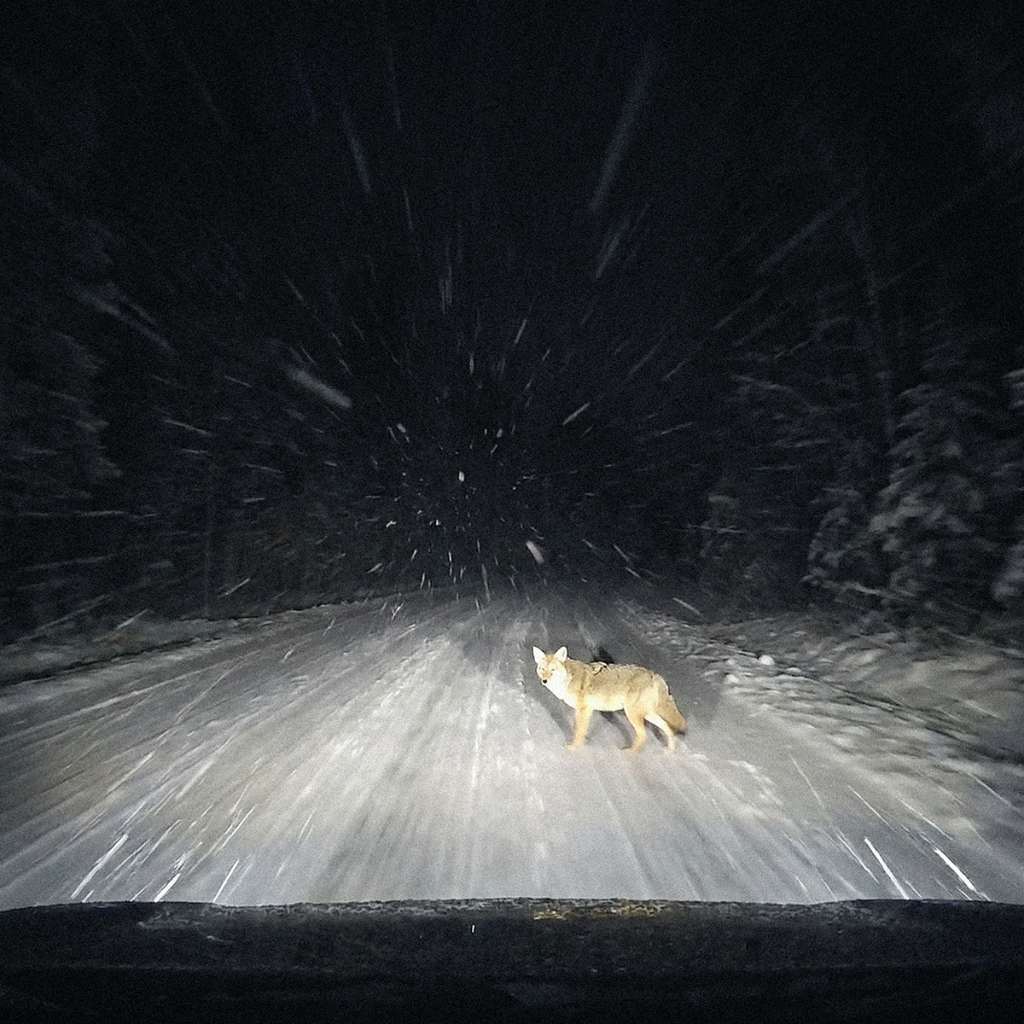
In November of 2019, a man named Eli Boroditsky was driving to his night shift. He was navigating a dark, rural highway in Manitoba, Canada, cruising at fifty-five miles an hour. It was late in the evening, right around nine thirty, a time when nocturnal predators are highly active. A shape bolted out of the ditch and directly into the path of his vehicle. Boroditsky felt the heavy, sickening thud of a high speed impact. He immediately pulled over to the shoulder to inspect the damage and find the animal.
He walked back down the dark asphalt and found an unconscious canine lying in the ditch. Because the animal had a thick, heavy winter coat and relatively large physical dimensions, Boroditsky made a massive biological miscalculation. He looked at the unconscious predator and assumed it was a lost domestic dog. He guessed it was a German Shepherd or a husky mix that had wandered away from a local farm.
What he was actually looking at was a mature, wild coyote. Northern coyotes carry different genetics and physical builds than the scrawny desert animals of the American Southwest. They are heavily furred, robust, and carry a distinct physical presence that can easily confuse a person standing on the side of a dark road. Driven by a sense of responsibility for the animal he just hit, Boroditsky decided to rescue it.
This is the moment where the story shifts from a standard roadkill incident into a terrifying mechanical gamble. Boroditsky physically picked up the limp, unconscious predator. He carried it to his vehicle, opened the door, and placed the wild animal directly into the back seat of his car. He then climbed into the driver's seat, put the vehicle in gear, and continued his twenty-five mile commute to the Bothwell Cheese factory in New Bothwell.
To understand the extreme danger of that confined space, you have to look at the biology of a trapped predator. You have a wild, carnivorous animal experiencing severe head trauma, waking up inside a sealed steel box. Under normal circumstances, a coyote trapped in a small enclosure will completely panic. The fight or flight response triggers a massive physiological dump of adrenaline. They will destroy the interior of a vehicle trying to bite and claw their way through the glass, and they will absolutely attack anything standing between them and an exit.
The extreme physical trauma of the collision temporarily overrode the animal's natural instincts. The coyote was suffering from a massive concussion. When it regained consciousness in the back seat of the moving car, the neurological shock entirely suppressed its defensive triggers. It did not panic. It did not attack. It simply sat there in a heavily sedated, docile state. Boroditsky was so convinced the animal was a domestic pet that he even reached back while driving and repeatedly petted the coyote. The animal allowed the physical contact without showing a single sign of aggression.
The reality of the situation did not set in until Boroditsky arrived at the factory parking lot. He parked the car, went inside, and asked a coworker to come out and help him with the injured dog. The coworker walked up to the glass, shined a light into the back seat, and immediately identified the biological truth. That was no German Shepherd. That was a fully grown, wild coyote sitting quietly on the upholstery.
The realization completely changed the atmosphere. Boroditsky and his coworkers wisely decided to step back and leave the animal secured inside the vehicle. They made calls to local conservation officers and wildlife rehabilitation centers, but due to the late hour, they were told to wait until morning. The coyote spent the entire night locked in the car, resting in the dark and slowly regaining its neurological baseline.
The next morning, a Manitoba Conservation officer arrived to extract the animal. The coyote was carefully removed from the vehicle and transported to the Wildlife Haven Rehabilitation Centre in Ile des Chenes. This is where the sheer physical durability of the wild canine was officially documented. The veterinary staff conducted a full medical assessment, expecting to find severe internal damage from the highway impact.
The medical charts defied all mechanical logic. Despite taking a direct hit from a vehicle traveling fifty-five miles an hour, the coyote did not have a single broken bone. Its skeletal architecture remained completely intact. The only physical damage consisted of a severe concussion, a deep laceration on its face, and some cuts on its rear legs where the bumper made initial contact. The animal had literally absorbed the kinetic energy, survived the neurological shock, and maintained its structural integrity.
The rehabilitation process required extreme caution. The care team needed the animal to recover from the brain trauma, but they also had to ensure it did not habituate to human contact during the healing process. A coyote that loses its fear of people becomes a lethal liability on the landscape. The staff monitored the animal closely for a full month. They watched its behavior daily, ensuring it retained its natural predatory instincts, its strict wariness of the caretakers, and its sharp physical reflexes.
By late December, the animal was fully healed and displaying completely normal, wild behavior. It was actively avoiding humans and showing no lingering physical or mental effects from the head trauma or its bizarre car ride. On December 27, exactly one month after being hit on the highway, conservation workers loaded the coyote into a transport crate and drove it back out to the rural habitat where the initial incident occurred.
They placed the heavy plastic crate in an open snow covered field, unlatched the metal door, and stepped back. The coyote walked out onto the frozen dirt. It took a few moments to get its bearings, scanning the tree line and processing the cold environment. Then it dropped its head, broke into a steady canine trot, and disappeared back into the winter brush.