
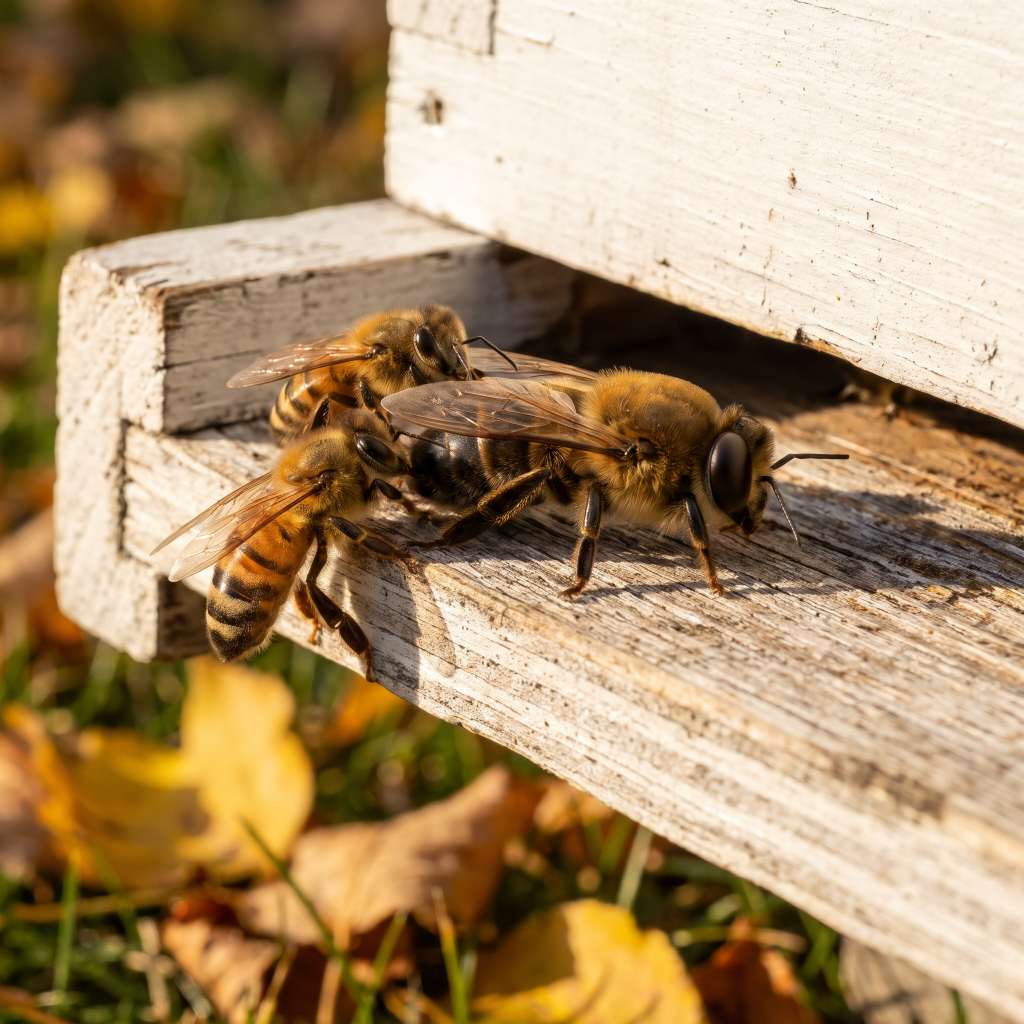
The moment a male honey bee finishes mating with a queen, he goes paralyzed and drops dead out of the sky.
Inside a western honey bee colony, males are called drones. They have no stingers and do none of the daily chores that keep a hive alive. They do not forage for nectar, build wax comb, feed larvae, or defend the entrance.
Their oversized eyes and heavy flight muscles exist for one purpose: catching a virgin queen in midair.
On warm afternoons, thousands of drones from neighboring hives gather in open-air zones called drone congregation areas, typically 30 to 100 feet off the ground. When a young queen flies into that airspace, her pheromones draw a trailing comet of competing males.
Only the fastest fliers reach her. When a drone mounts a queen in flight, he forces hemolymph, the insect equivalent of blood, into his reproductive organ, known as the endophallus. The sudden surge of hydraulic pressure turns the organ inside out with such force that researchers have recorded an audible pop.
The transfer takes only a couple of seconds. As soon as it ends, the drone locks up and flips backward off the queen.
Because the endophallus is anchored inside her, the breakaway tears the organ and part of the drone's lower abdomen clean out of his body. Hollowed out in midair, he tumbles to the ground and dies within minutes.
That violent exit is not a design flaw. The severed tissue stays behind inside the queen as a temporary plug called the mating sign. It helps keep sperm from leaking out while also serving as a bright visual marker that guides the next male into position.
A single drone is never enough. Over the course of a few mating flights, a virgin queen will mate with roughly 10 to 20 males, with each new suitor dislodging the previous mating sign before leaving his own. She stores millions of sperm in an internal sac called the spermatheca, building a lifetime supply that lets her lay fertilized eggs for years without ever mating again.
For the drones that lose the race in the sky, survival is only temporary. They return to their colonies each evening to eat honey and wait for another warm afternoon.
When autumn arrives and flowers stop producing nectar, the female worker bees cut their losses. With winter approaching, a hive cannot afford to feed hundreds of non-working mouths. Workers stop feeding the surviving drones, bite at their wings, and physically drag them out the front entrance, blocking them from climbing back inside until they starve or freeze in the grass.
In a honey bee colony, a male gets two choices. Win the chase and die in midair, or lose the chase and get evicted at the first sign of fall.
Source: Mark L. Winston, The Biology of the Honey Bee (Harvard University Press, 1987) / Gudrun & Nikolaus Koeniger, Mating Biology of Honey Bees (2014) / USDA Agricultural Research Service