
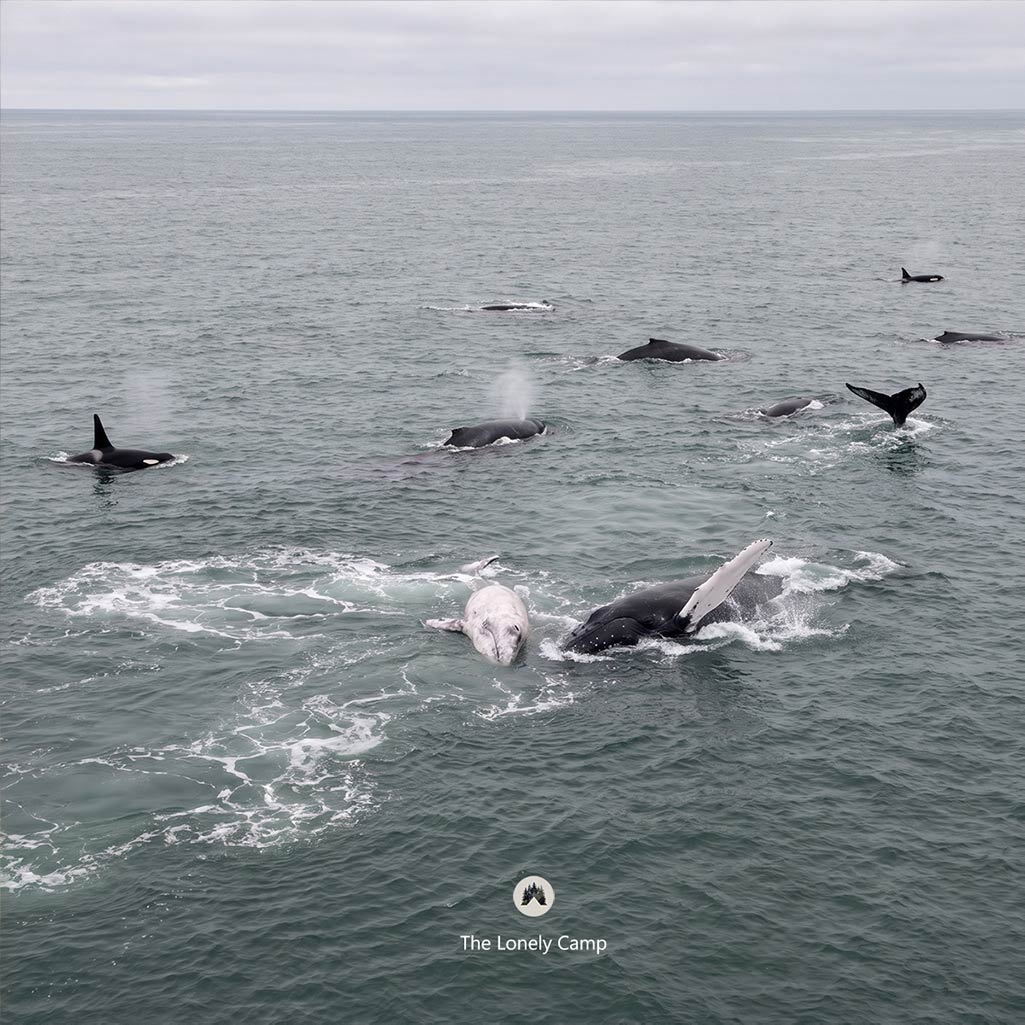
In May 2012, a pod of transient killer whales ambushed a gray whale mother and her calf in California's Monterey Bay. After a hard fight, the orcas separated the pair and drowned the calf.
Under normal circumstances, that would have been the start of a multi-hour feeding frenzy. Instead, the local humpback whales moved in and shut the meal down.
Two humpbacks were already in the water nearby when the attack happened. Right after the calf died, about 14 more humpbacks swam in from across the bay to join them. As whale researchers including Alisa Schulman-Janiger watched from a boat, one big humpback parked itself directly alongside the floating gray whale carcass.
For the next six and a half hours, that whale refused to let the orcas eat. Every time a killer whale tried to slip in and tear a piece of blubber off the calf, the humpback blew loud bubble clouds, trumpeted, and slashed at the predators with its tail fluke and 15-foot pectoral fins. The water right around the standoff was thick with krill, the humpbacks' main food source, and the whales ignored all of it to keep the killer whales pushed back. It remains the longest confrontation between humpbacks and killer whales ever recorded.
To find out if the Monterey Bay standoff was just a strange one-off event, marine ecologist Robert Pitman and Schulman-Janiger pulled together 115 documented accounts of humpbacks squaring off with killer whales across decades of global field records, publishing their findings in *Marine Mammal Science* in 2016.
What they found was that humpbacks routinely go out of their way to pick fights with mammal-eating killer whales. Out of all those encounters, the humpbacks were the ones initiating the contact 57 percent of the time, often swimming in from miles away as soon as the orcas started vocalizing during a hunt.
Even stranger was what the killer whales were actually hunting when the humpbacks showed up. In only 11 percent of the attacks were the orcas going after another humpback. The other 89 percent of the time, the humpbacks charged in to break up attacks on completely different animals, including gray whales, harbor seals, stellar sea lions, and Dall's porpoises. In one case, humpbacks swam over to harass killer whales that were going after a pair of ocean sunfish.
While it is easy to look at a whale guarding another species and call it compassion, the researchers point toward a much more practical survival instinct. Mammal-eating killer whales rarely kill adult humpbacks, which weigh up to 40 tons and carry barnacle-crusted flippers that act like clubs, so they target young humpback calves instead. In fact, many of the adult humpbacks seen charging into these fights carry thick white rake marks on their flukes from surviving orca teeth when they were calves themselves.
Pitman and his colleagues suspect the behavior starts with a simple rule of thumb: whenever humpbacks hear the distinct calls of mammal-eating killer whales going on the attack, they swim straight toward the commotion to defend any calf in danger, which might be a relative. By the time the humpbacks arrive on the scene, their instinct to mob the predators and run them out of the area takes over, even if the animal in trouble turns out to be a sea lion, a sunfish, or a gray whale calf that is already dead.
Image is for illustration purposes only.
Source: Pitman et al. (2016), Marine Mammal Science 33(1): 7–58 / National Geographic (2016).