
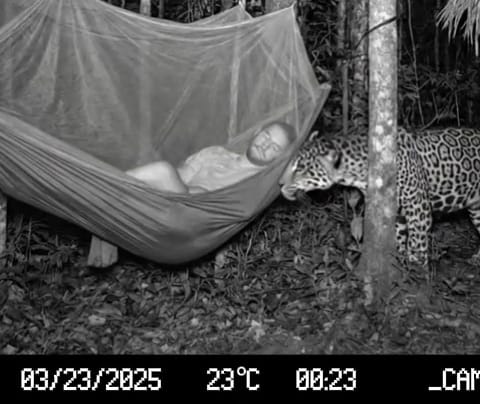
Hammock. Rainforest. Night. No tent walls, no hard shell, nothing between you and whatever is moving through the undergrowth. Just fabric and a zipper.
The comments under footage like this tend to split predictably. Half the people are calling the camper an idiot. The other half are asking where to book the trip. Both reactions miss the more interesting question, which is what the jaguar was actually doing, and how close this kind of encounter really is to an attack.
The answer is more nuanced than either camp wants to hear.
What the jaguar was doing
Jaguars are not ambush hunters in the way most people imagine. They are opportunistic, methodical, and patient. They investigate. A jaguar approaching a hammock in the dark and sniffing at it is not necessarily a predator evaluating prey. It is an apex predator doing what apex predators do, which is gather information about every unfamiliar thing in its territory.
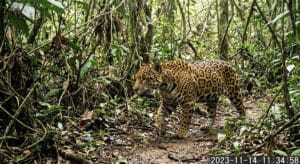
The fact that it left is the telling detail. A jaguar that has decided something is prey does not sniff and walk away. It does not give the target time to shift position or make noise. The approach and withdrawal is more consistent with curiosity than with predatory intent, and researchers who study jaguar behavior in the Amazon recognize this pattern.
That said, curiosity and danger are not mutually exclusive in a 100 kilogram cat.
The numbers people don’t talk about
Jaguar attacks on humans have long been described as vanishingly rare. A comprehensive study published in 2025 compiling all known records of jaguar attacks on humans in the Brazilian Amazon between 1950 and 2025 identified 84 cases, averaging roughly 1.12 attacks per year. That sounds low. It probably is low. Researchers note that most incidents occur in remote areas, rarely enter official statistics, and underreporting is likely significant given that improved internet access in rural Amazonian communities has only recently contributed to a rise in reported incidents.
What the data does show is a clear pattern in who gets attacked. The majority of victims were adult men, most of whom were unaccompanied, and fatalities were more frequent when victims were alone or lacked defensive tools. Approximately half of all cases were apparently unprovoked.
Solo. Unarmed. In jaguar habitat. The hammock camper in that footage checks every box.
The context of many unprovoked attacks, including victims crouching, sleeping, or ambushed from behind, suggests predatory motivation was likely in a significant portion of cases. Sleeping in a hammock in the Peruvian Amazon is not a neutral act from the jaguar’s perspective.
Peru specifically
An estimated 22,000 jaguars inhabit the forests of Peru today, making it the second largest jaguar population outside Brazil. That recovery is a conservation success story. It also means that anyone moving through the Peruvian Amazon is moving through some of the densest jaguar territory on earth.
An increasing human population and changing demographics through migration from the Andes to the Amazon, combined with reduction of jaguar habitat through expansion of agriculture and livestock production, means interactions between jaguars and people have become more frequent. The forest is shrinking. The jaguars are not.
What makes the jaguar different from other big cats
The jaguar kills differently from lions, tigers, or leopards. Its powerful bite allows it to pierce the carapaces of turtles and pierce directly through the skull of mammalian prey between the ears to deliver a fatal blow to the brain. It does not go for the throat. It goes for the head. That matters in terms of how quickly an attack escalates and how little warning precedes it.
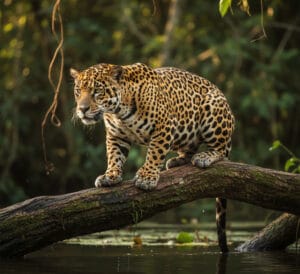
It is also the only big cat in the Americas capable of taking large prey reliably. Deer, peccaries, capybara, caiman. A human sleeping in a hammock is within that size range, which is not a comfortable thing to acknowledge but is worth knowing.
What to actually do
The hammock camping community in jaguar territory is not small, and the vast majority of nights pass without incident. Indigenous communities across the Amazon have lived alongside jaguars for centuries, and jaguar attacks on people in communities that have long coexisted with the animals are almost unheard of. Familiarity and coexistence are real factors.
But for a solo outsider camping in unfamiliar jaguar habitat, a few things reduce risk considerably.
Camp away from water sources at night. Jaguars hunt near rivers and lakes. The edges of waterways in the Amazon are not where you want to be sleeping alone after dark.
Fire helps. Jaguars are cautious around fire in a way they are not cautious around a hammock. A maintained fire at camp changes the calculation.
Don’t camp alone. The data on attacks is consistent: solo individuals are overwhelmingly more at risk than groups. This is true across every large predator that has been studied.
And understand what the sounds around you mean. The Amazon at night is not quiet. What matters is when it goes quiet. Prey species stop moving and calling when a predator is close. A section of forest that suddenly drops to silence is telling you something.
The guy in the hammock
He woke up and had no idea. That much is clear from the footage. Whatever woke him, it wasn’t the jaguar, which had already left.
He got lucky, or the jaguar was never interested in the first place. In the Amazon those two things are sometimes the same thing, and sometimes they are not, and there is no reliable way to know which one you are dealing with until it has already been decided.