The standard advice for camping in bear country is well known. Pack out your food. Hang your bear canister. Keep nothing with a scent inside the tent. Most experienced campers follow it. Most of them sleep fine.
What the advice doesn’t fully prepare you for is the gap between doing everything right and being genuinely safe. Those are not the same thing.
What a grizzly bear can actually smell
The surface area inside a human nose is roughly the size of a postage stamp. In a dog’s nose that area is about the size of a sheet of printer paper. In a grizzly bear’s nose it is about the size of four sheets of printer paper, lined with millions of scent receptors.
That distinction matters. The goal of bear food storage is not concealment. It is denial of access. A bear that smells your camp from two miles away and finds nothing it can reach will move on. A bear that finds something it can reach will come back, and will remember the location.
What they can smell that surprises people
Food is the obvious concern. What catches campers off guard is the list of non-food items that register the same way to a bear’s nose.
Bears are attracted to strong smells regardless of whether those smells indicate food. Vanilla lotion, toothpaste, lip balm, sunscreen, deodorant — a bear’s nose does not distinguish between a scent that is edible and one that merely smells interesting. There are documented cases of bears tearing into vehicles to reach lip balm left in a center console.
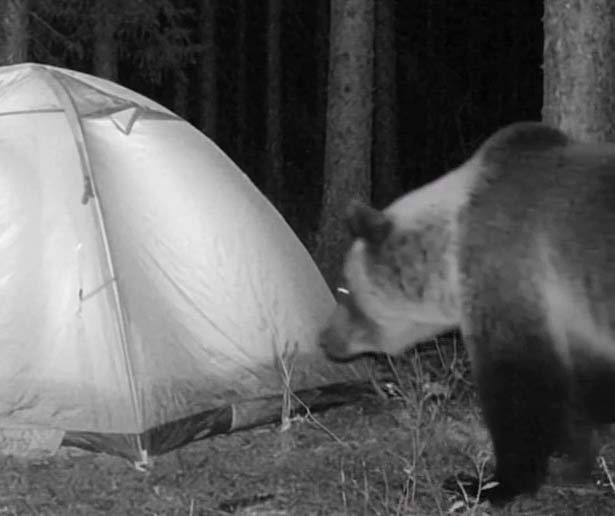
The camper who seals every piece of food in an airtight bag and hangs the canister 200 feet from the tent but leaves a tube of toothpaste in a jacket pocket has not done everything right. They have done most things right. The distinction, at 2 AM with a grizzly circling the tent, is not a comfortable one.
Why a bear canister is different from a stuff sack
The mechanics of scent containment matter here. A standard stuff sack, dry bag, or ziplock seals well enough that a human standing next to it can detect nothing. A bear working the same area with a nose calibrated to find food under three feet of snow is operating at a completely different threshold.
A hard-sided bear canister does two things a soft container cannot. It physically prevents access regardless of how motivated the bear is, and the hard plastic creates a more effective scent barrier than fabric. It is not perfect — bears can still detect what is inside — but it removes the possibility of a bear actually reaching the food, which is the outcome that matters.
For backcountry camping in grizzly country, the BearVault BV500 is the standard recommendation among wilderness guides and park rangers. It holds a week’s worth of food for one person, meets requirements for all national parks and wilderness areas that mandate canisters, and the wide mouth makes packing and accessing food straightforward. Required in most of Yellowstone, Grand Teton, and sections of the Sierra Nevada.
The odor-proof bag question
Bear canisters solve the access problem. Odor-proof bags address the scent problem at a different level, and are particularly useful for items that don’t fit in a canister — dirty cooking clothes, used food packaging, toiletries.
LOKSAK OPSAK bags are the most field-tested option. They use an airtight, multi-layer seal that reduces scent transmission significantly compared to standard ziplock bags. They are not marketed as bear-proof — no bag makes that claim — but they meaningfully reduce the scent profile of whatever is inside. Used in combination with a canister, they close most of the gaps that a determined or food-conditioned bear could exploit.
The LOKSAK OPSAK 2-pack in the 12×20 size covers most backcountry needs and fits inside a standard bear canister alongside food.
What food-conditioned means and why it matters
A food-conditioned bear has learned to associate human campsites with easy calories. It is not deterred by the presence of people, by noise, or by light. It is working a known food source by memory. The bear that circles a tent at 2 AM three hours after a camper sealed up and went to sleep is not investigating out of curiosity. It is following a scent trail to something it expects to find.
The camper who did everything right is protected because the canister is locked and the odor-proof bags reduced the signal. The bear confirms there is nothing accessible and moves on. That outcome, which looks uneventful from inside the tent, is the result of the preparation that happened before dark.