
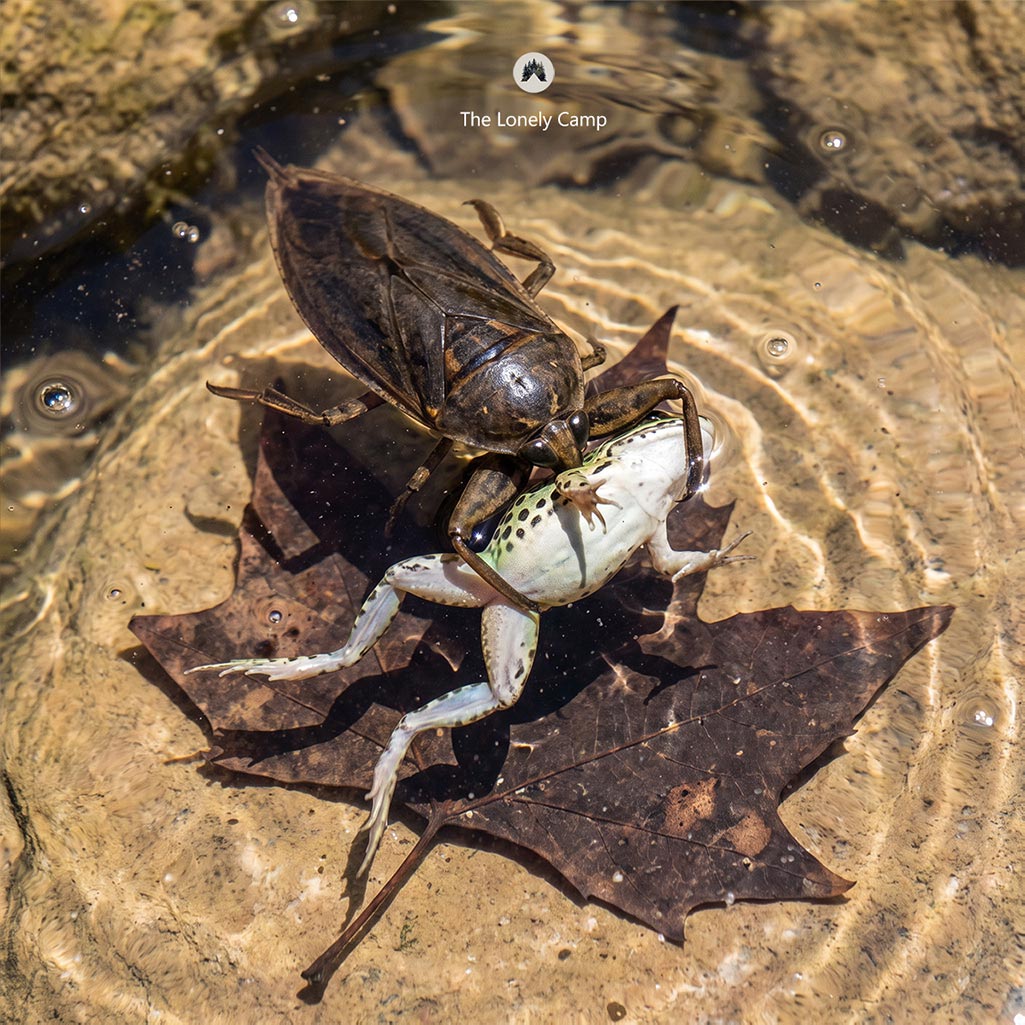
At up to four inches long, the American giant water bug, is the largest true bug in the United States and Canada. Anyone who spends time wading in warm, weedy farm ponds or slow backwaters knows it by a simpler name: the toe-biter.
Most people assume insects sit near the bottom of the pond food chain, existing mainly to get snapped up by bass, bluegills, and bullfrogs. The giant water bug flips that arrangement around. It is an ambush predator built to kill and eat vertebrates, including minnows, sunfish, tadpoles, adult frogs, salamanders, and small water snakes.
The bug hunts by clinging upside down to submerged cattail stems or dead wood just below the surface. Because it breathes air rather than pulling oxygen from the water with gills, it pushes a pair of short, retractable breathing tubes out the tip of its abdomen and pokes them through the surface film like a snorkel. Then it waits.
Its front legs do not work like normal walking legs. They are thick, hooked raptorial clamps built like a pair of vice grips, with a sharp groove in the femur that locks the lower leg tight against whatever it grabs. When a frog, small fish, or snake swims within reach, the bug snaps those front legs shut and drives a short, stout beak called a rostrum straight into the animal's body.
Once the beak punches through skin or scales, the bug injects a mix of paralyzing toxins and digestive enzymes. The venom shuts down the prey's nervous system and begins dissolving its muscle and internal organs into liquid right inside the skin. Over the next several hours, the bug uses its beak like a straw to pump the liquefied insides out, eventually dropping an empty, deflated husk to the bottom of the pond.
While the most systematic field studies of giant water bugs killing snakes and turtles come out of Japan, North American biologists have documented plenty of violent kills right here at home. In the summer of 1995, researchers tracking threatened Chiricahua leopard frogs across southern Arizona found giant water bugs actively hunting and draining adult frogs and metamorphs in rocky canyon pools. Other field notes across the continent have logged giant water bugs clamping onto garter snakes, rough-skinned newts, and small trout, and even ambushing a woodpecker that landed too close to the water's edge.
The same machinery that melts a frog's insides is what makes stepping on one in bare feet so memorable. The giant water bug tends to avoid humans, and it will normally swim away if given the chance. When cornered in a minnow trap, tangled in a fishing net, or pinned under a wader's toe in the mud, it defends itself by driving that beak into skin and pumping in a shot of digestive saliva. Entomologists who study insect stings rank the bite among the most painful in North America, leaving a throbbing, burning welt that can ache for hours.
When a shallow pond dries up or the food runs out, the problem moves out of the water. Giant water bugs have full sets of wings folded flat under their tough brown shells, and they take to the air at night to find new wetlands. Because they navigate by light, they regularly crash-land under bright parking lot floodlights, porch bulbs, and gas station canopies, giving concrete-bound folks a surprise meeting with the meanest bug in the marsh.
Image is for illustration purposes only.
Source: Jennings & Mueller (1996), Herpetological Review / Menke (1979), Bulletin of the California Insect Survey / Swart et al. (2006), Journal of Experimental Biology.