
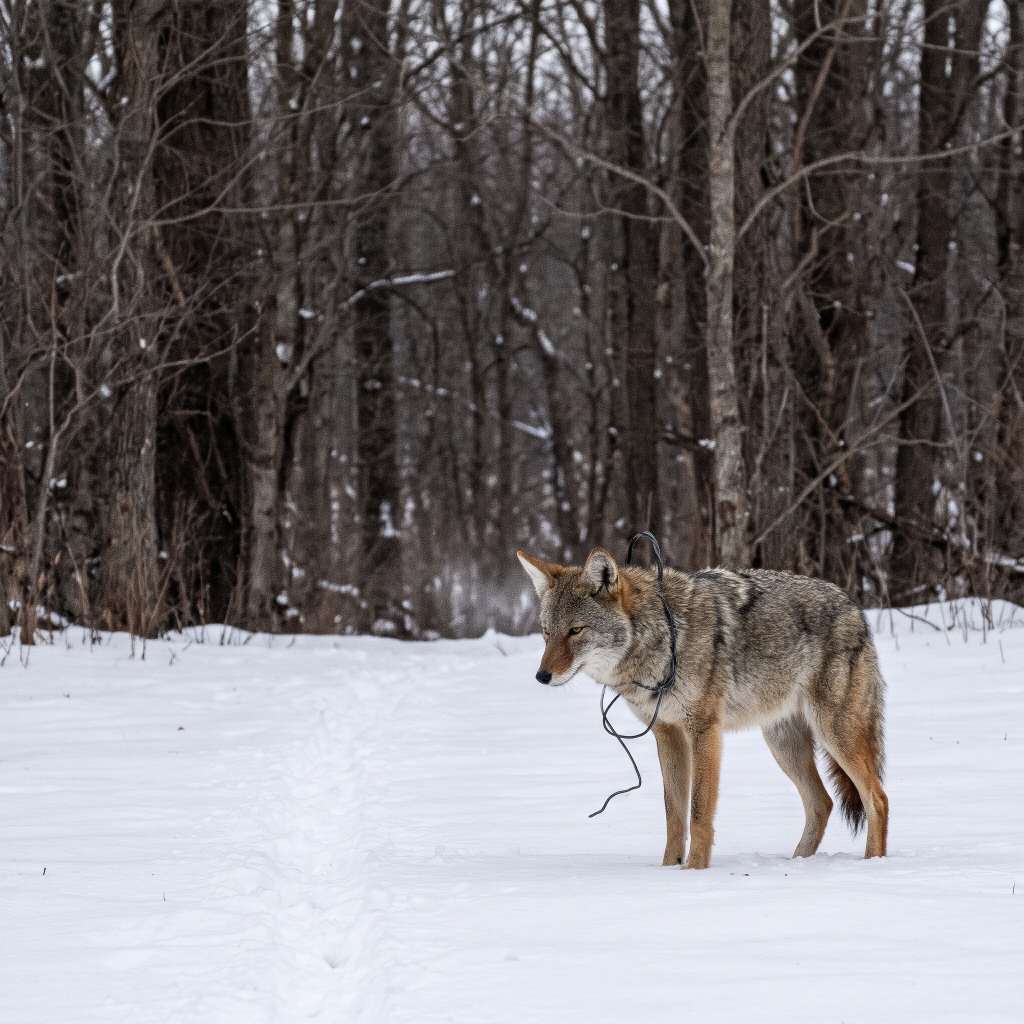
In late February 2019, a Fort Erie, Ontario, resident who had spent more than three years quietly watching a local coyote family noticed the father of the pack standing in the snow with what looked like a broken tree branch hanging from his chest fur. Nearly a week later, when the coyote showed up looking thin, lethargic, and wheezing for air, she looked closer and realized the object dangling beneath his neck was a twisted metal wire.
The adult male, whom the resident and her husband named Faith, had walked into a locking wire kill snare. Rather than dying at the trap site, the coyote had managed to wrench the metal cable loose from its anchor and drag the trailing wire away with him, leaving the tightened loop cinched around his throat for roughly eight days.
When the couple contacted Coyote Watch Canada and the Toronto Wildlife Centre, a seven-person rescue team converged on the wooded lot in Fort Erie where the weakened male was hiding. As the rescuers formed a wide circle in the snow and closed in, they could hear the coyote gasping from yards away. Weak from lack of oxygen, the coyote tried one brief dash under the low branches of a nearby tree before rescue team leader Andrew pinned him gently with a catch pole.
Before loading the animal for the two-hour drive north to the wildlife hospital in Toronto, Andrew had to use three separate cutting tools just to sever the heavy wire embedded around the coyote's neck.
When senior wildlife rehabilitators and Head Veterinarian Dr. Heather Reid cleaned the neck wound at the hospital, they discovered why the coyote had been struggling to draw breath. The wire loop had sliced clean through the skin and muscle of his throat and cut halfway through his trachea. Describing the severed windpipe as a "once in a vet's career" injury, Reid placed the coyote into an oxygen cage to stabilize him and brought in surgical specialists from the Veterinary Emergency Clinic in Toronto. Over a two-and-a-half-hour procedure, the surgical team reconstructed and closed the hole in his windpipe and stitched the deep laceration encircling his neck.
While the male spent weeks recovering in an enclosure two hours away, the biological bond that holds a coyote pack together played out back in Fort Erie.
Unlike many mammal species where males leave after the winter breeding season, eastern coyotes are strictly monogamous, forming pair bonds that often last until one partner dies. Both parents share the work of defending a territory and provisioning pups in the spring. Back on the home range, the resident who found him reported to Coyote Watch Canada and the hospital staff that the male’s pregnant mate was returning to the exact spot where he had been captured almost every night, standing in the dark and barking into the woods for him.
Knowing a new litter of pups was on the way and that the female would need her mate back to help hunt and guard the den, the veterinary team pushed to get him back onto his territory as quickly as his repaired trachea would allow. Once his airway healed and he passed his clinical checks in late March 2019, the team loaded him into a transport crate and drove him back to Fort Erie.
When the crate door opened at the edge of his home range, the coyote bolted straight out across the open fields and disappeared into the familiar tree line where his family lived. While the Toronto Wildlife Centre confirmed his successful return to his home territory, no one was deep inside the timber to witness the actual reunion with the mate that had spent weeks calling for him at the capture site.
Image is for illustration purposes only.
Source: Toronto Wildlife Centre (2019) / Coyote Watch Canada (2019) / Global News (2019).