
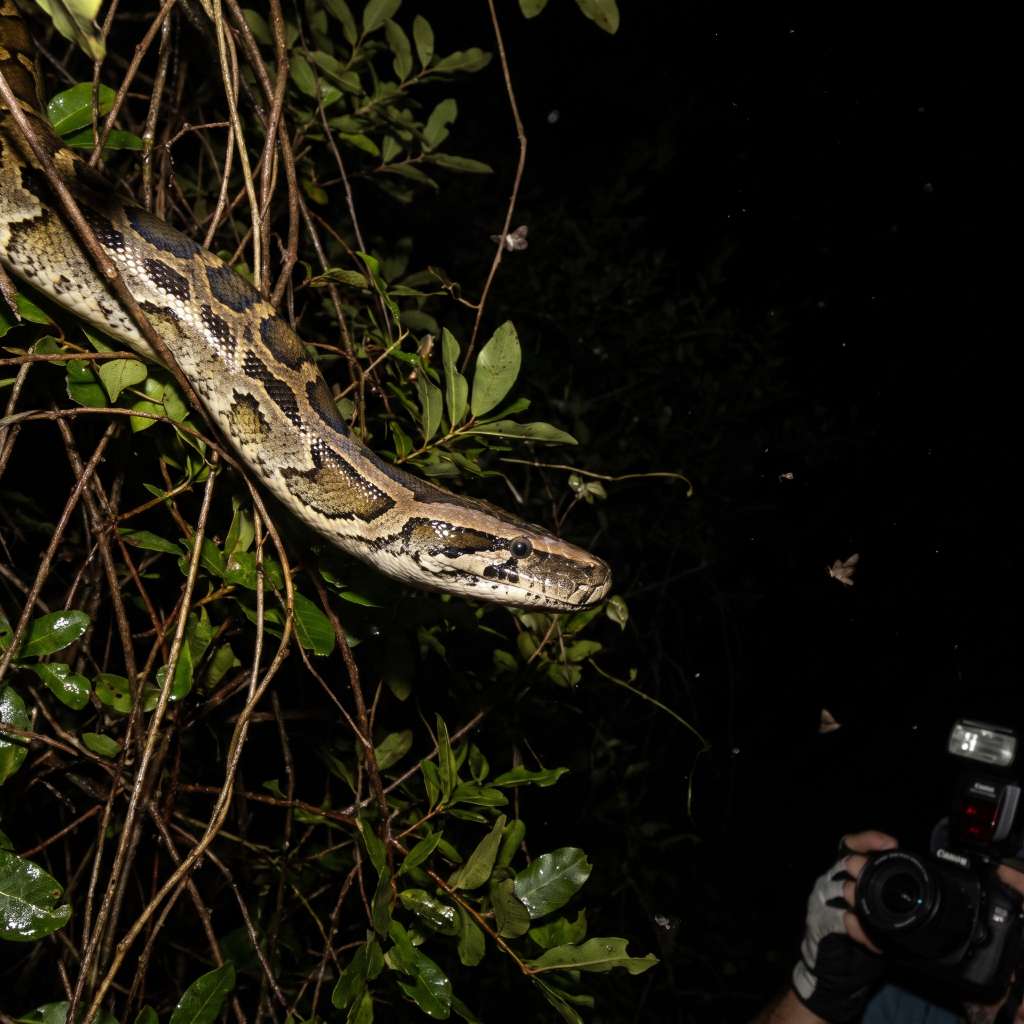
In 2024 state wildlife officials in Florida documented more than two decades of efforts to stop a second species of giant constrictor from breaking out of western Miami-Dade County. Since 2001, more than 46 northern African rock pythons had been pulled from a small footprint centered around the Bird Drive Basin on the suburban edge of the Everglades.
While the Burmese python gets almost all the national headlines after taking over millions of acres of southern Florida marshes, the northern African python gave state and federal biologists a very different kind of emergency. By the time wildlife managers confirmed that a breeding population of African pythons had taken hold near Bird Drive Basin in the late 2000s, they already knew exactly what happens when an old-world giant snake slips past containment.
On paper, the two constrictors look similar enough to confuse a homeowner, yet field herpetologists treat the northern African python as an entirely different animal to handle. Both species regularly grow past 15 feet and exceed 100 pounds, with the largest African rock pythons in their native sub-Saharan range pushing toward 20 feet.
Where a Burmese python introduced to the Everglades is often slow-moving and relies on camouflage until stepped on, the northern African rock python is notorious among snake handlers for its hair-trigger defensive temperament. Native to savannas, rocky outcrops, and seasonal wetlands across Africa, it strikes repeatedly right out of the egg, moves fast across dry ground, and packs enough muscle to kill adult antelopes, warthogs, and crocodiles in its home range.
For Florida officials, the silver lining was geography. Unlike the Burmese python, which was already scattered across the remote interior of Everglades National Park before anyone realized the scale of the breeding population, the northern African python appeared to be boxed into a roughly six-square-mile patch of brush, canals, and limestone spoil piles along the western edge of Miami. If crews could find and remove every snake in that pocket before they spread west into the open Everglades, Florida could actually eradicate a giant constrictor invasion.
Finding a 15-foot snake hiding in thick South Florida scrub turned out to be the hardest part of the job.
In 2017, state and federal agencies threw their best specialized tools at the Bird Drive Basin population. Officials brought in expert Irula tribesmen from southern India, traditional snake catchers who had just helped biologists track down dozens of Burmese pythons in the Everglades, and paired the effort with trained conservation detector dogs. The dogs alerted on several scent points of interest across the basin, and the Indian trackers combed the brush and canal banks, yet the teams walked away without capturing a single additional northern African python.
For a stretch, it looked as if the small population might have finally winked out. Then, in December 2021, a single member of the public walked into the Bird Drive Basin and pulled five northern African pythons out of the brush.
That sudden haul sent multi-agency crews scrambling back into the basin and going door to door through the adjacent residential neighborhood to pass out flyers, interview landowners, and ask permission to search backyards and private lots. Over a year later, in February 2023, after officials finally secured legal access to search a piece of nearby private land, biologists tracked down and removed yet another northern African python hiding on the property.
By the fall of 2026, the South Florida Water Management District reported that the total count of northern African pythons pulled from the Bird Drive Basin since 2001 had reached 49 snakes. When biologists opened up the stomachs of the recently captured specimens, they found the remains of rats, birds, raccoons, and an unidentified canid.
More concerning, necropsies on two large females revealed developing egg follicles, warning state managers that the population was likely still breeding in the brush and prompting plans for a radio-telemetry scout snake program to betray the holdouts. Even when wildlife agencies catch a giant predator invasion early and box it into a single corner of a county, twenty-five years of trackers, scent dogs, and neighborhood sweeps can still come down to what is hiding across the fence on one private lot.
Image is for illustration purposes only.
Source: South Florida Water Management District (2024; 2026), South Florida Environmental Report / Florida Fish and Wildlife Conservation Commission / U.S. Geological Survey Reed et al. (2010; 2011), Biological Invasions.