
Scientists gave a colony of fire ants a cup of sugar water spiked to make them drown. The ants didn't go in. They carried sand to the cup and built a siphon that pulled the sugar water out to them.
The ants were black imported fire ants, an invasive species in the southern United States. In the wild they feed mostly on honeydew, the sugary liquid aphids produce. Their bodies have a water-repellent coating, which lets them stand and float on the surface of a liquid while they drink from it.
In 2019, researchers from the USDA's Agricultural Research Service in Stoneville, Mississippi, and Huazhong Agricultural University in China collected colonies from northwestern Mississippi and brought them into the lab. They set out small containers of sugar water next to sand. At first the ants simply walked onto the surface and drank.
Then the researchers added a surfactant, a soap-like chemical that lowers the surface tension of water. That is the force that lets a light insect stand on a liquid without sinking. With less of it, the same sugar water became a drowning trap. Some ants that went in drowned.
When the surfactant concentration went above 0.05 percent, enough to make drowning a real risk, most of the ants stopped going into the containers. Instead, they started carrying sand grains to them, one at a time. They laid the grains inside the container and built connected strips up its walls, leading over the edge and out to piles of sand outside.
The structure worked like a siphon. The sugar water soaked into the sand and was drawn up and out of the container, the way a paper towel pulls water up from a spill. The ants could then drink from the wet sand outside, with no risk of drowning and more room to feed. Building one took them more than 90 minutes. Once it was finished, nearly half the sugar water moved out of the container within five minutes.
Ants were already known to use sand grains and bits of debris to soak up and carry liquid food. Changing their behavior to build a working structure when the risk changed was new. The British Ecological Society called it the first time this kind of sophisticated tool use had been reported in animals. Valerie Banschbach, a biologist at Gustavus Adolphus College who was not involved in the study, said the ants' flexibility to act in a creative way suggests higher cognitive abilities than traditionally believed.
The researchers are careful about how far to take it. Lead author Aiming Zhou noted that the experiments were done only in the lab and only with black imported fire ants. The next step is to find out whether other ant species can do the same.
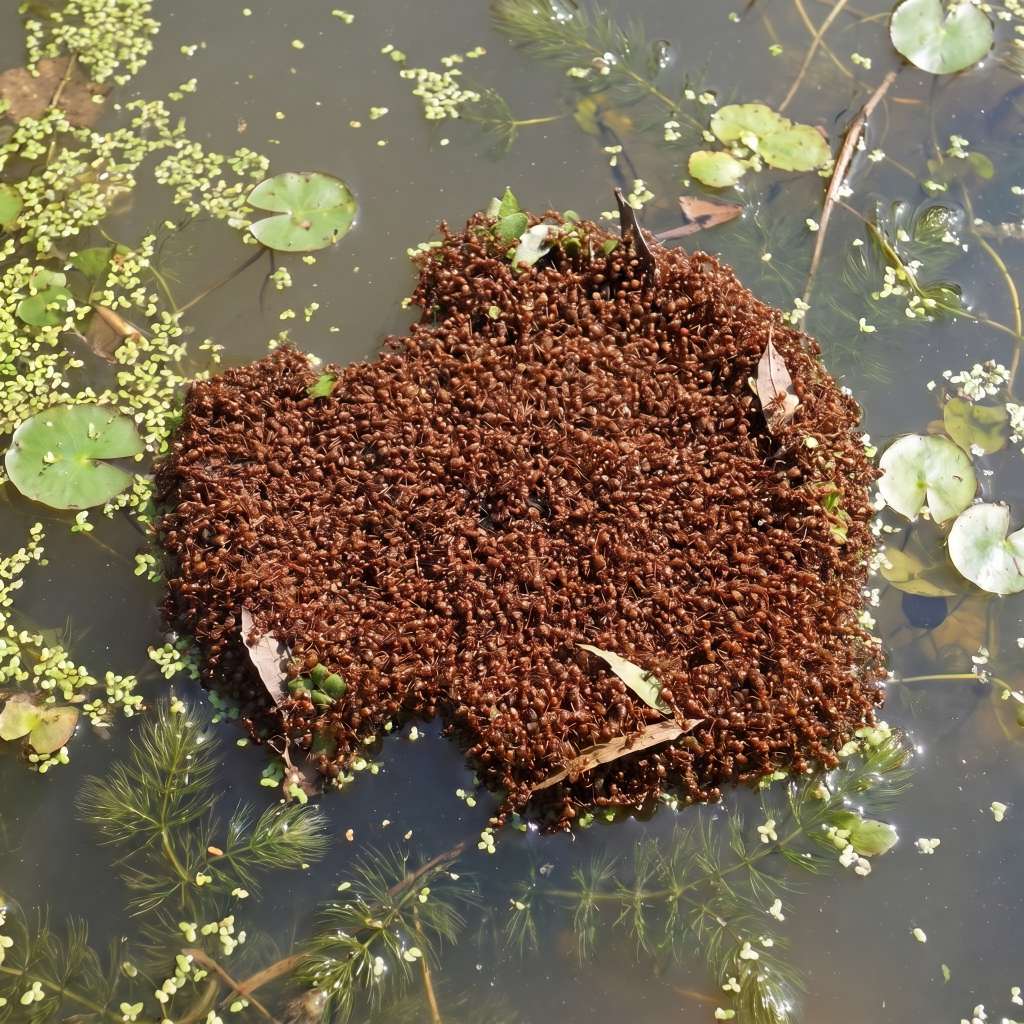
Image is for illustration purposes only.
Source: Zhou, A., Du, Y., and Chen, J. (2020), Ants Adjust Their Tool Use Strategy in Response to Foraging Risk, Functional Ecology / British Ecological Society / USDA Agricultural Research Service / Science News / UPI