
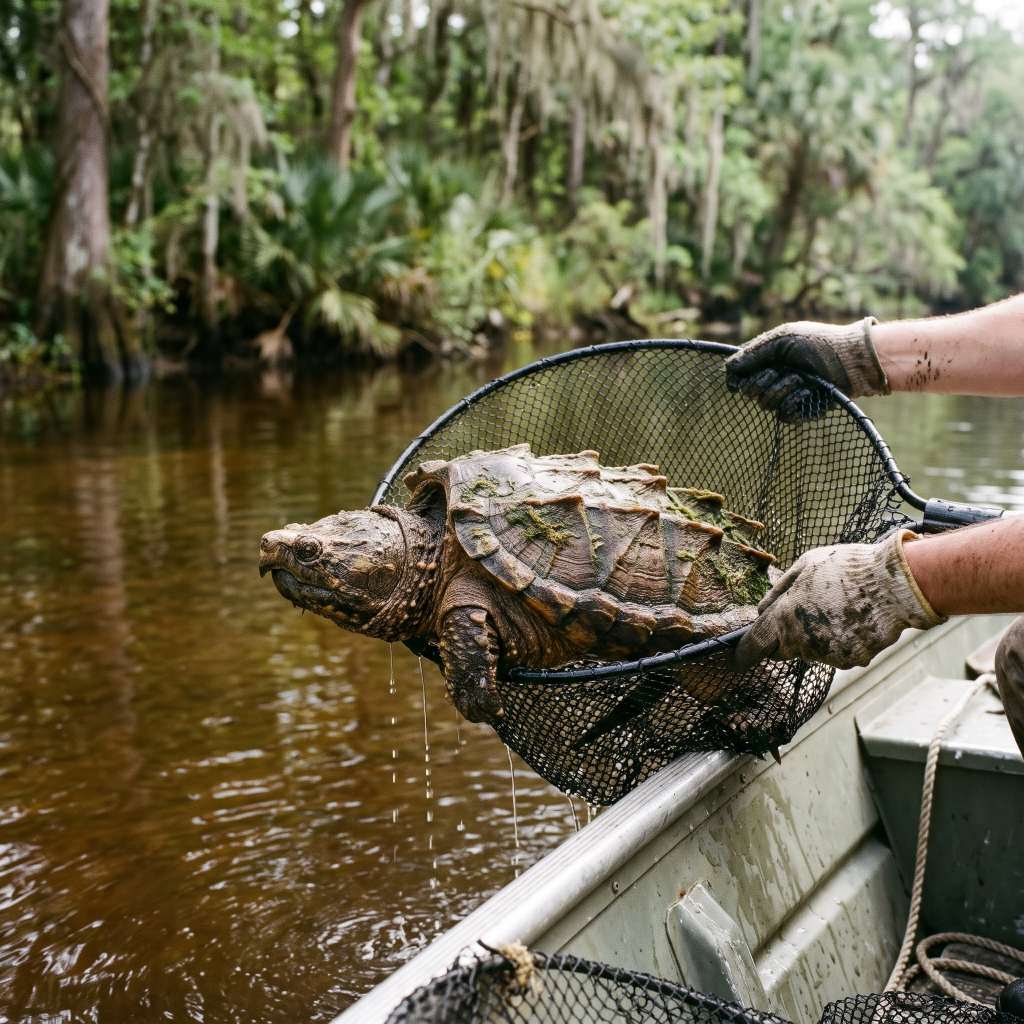
When four Suwannee alligator snapping turtles were donated to a small roadside attraction in Homosassa, Florida, in 1984 and placed inside a spring-fed pool beside Pepper Creek, nobody expected them to slip out into the coastal waterway and quietly establish a hidden breeding colony for nearly forty years.
Native exclusively to the Suwannee River basin of northern Florida and southern Georgia, the Suwannee alligator snapping turtle is a distinct, federally threatened species built for life on dark riverbeds.
Because the species is tightly bound to freshwater river systems and rarely travels overland or across open saltwater, its historical range stops well north of Citrus County. Yet in 1984, four Suwannee alligator snapping turtles, including one giant specimen weighing 126 pounds, were donated to a local attraction called Nature World in Homosassa and housed in a spring-fed pool bordering Pepper Creek, more than 43 miles south of the nearest native population.
According to former employees interviewed by researchers years later, heavy flooding in the 1990s likely allowed the captive turtles to breach their enclosure and vanish into the tannin-stained waters of Pepper Creek.
For decades afterward, the coastal creek flowed quietly through Homosassa with no official record of a resident alligator snapping turtle population. Because these ambush predators spend almost their entire lives submerged beneath undercut banks, sunken logs, and deep spring runs, even a 100-pound turtle can go completely unnoticed by boaters and anglers.
That changed during field surveys in 2023 and 2024, when biologists setting baited hoop traps in Pepper Creek began pulling up healthy alligator snapping turtles of multiple sizes and age classes. Over the course of the trapping effort, researchers captured 18 individual turtles in the creek system, confirming that the reptiles were not stray wanderers, but an established, reproducing group.
To figure out where the isolated turtles came from, geneticists analyzed DNA samples from 16 of the captured animals. The genetic profile pointed directly back to the vicinity of the Santa Fe and Suwannee rivers, matching the native range of the four turtles donated to Nature World back in 1984.
Even more telling, the genetic testing revealed tight family ties across the creek, showing parent-offspring and full-sibling relationships among the captured reptiles. Using capture-recapture modeling, the researchers estimated that roughly 33 Suwannee alligator snapping turtles now inhabit Pepper Creek, all likely descended from that small group of 1984 attraction residents that slipped out during high water in the 1990s.
Image is for illustration purposes only.
Source: Florida Fish and Wildlife Conservation Commission / University of Florida / Southeastern Naturalist (2024/2025).