
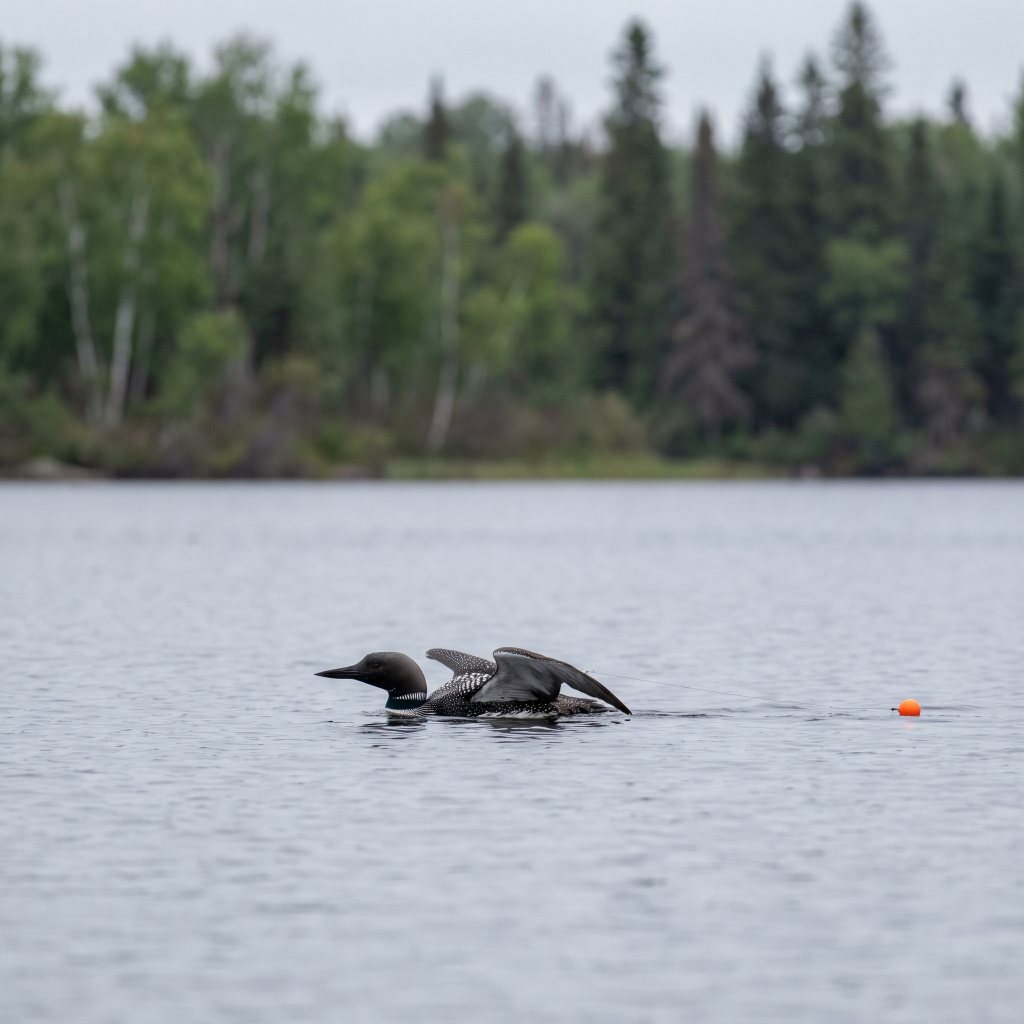
In August 2021, residents on DeLong Lake in Anchorage spotted a common loon dragging an orange fishing bobber. Tyler Lewis, a waterfowl biologist with the Alaska Department of Fish and Game, and Michael Bay of the Bird Treatment and Learning Center came out to take a look.
Through a spotting scope, they could see the loon was wrapped in fishing line. The line had also tangled its left wing, so the bird couldn’t fully extend it and couldn’t fly. A few days later the bobber came off, but the line stayed on.
The loon could still swim and dive, which kept it fed and made it very hard to catch. The two men went after it by spotlight at night, but they couldn’t find it in the dark. They tried a net-launching gun from a canoe during the day, and the loon got away. For weeks they kept going out in canoes and kayaks, day and night. The loon grew wary of the boats and dove before they could get close. By October, Lewis said the team had more or less given up.
Then the loon’s mate flew south with the other waterbirds, and it was left alone on the lake.
On a Monday morning in early November, residents called Bay again. Overnight, DeLong Lake had frozen almost completely over. Lewis and fellow biologist Michael Guttery went out and found a single patch of open water beside the shore, about 10 feet by 10 feet. The loon was paddling inside it. Loons take off by running across the surface of the water, and this one couldn’t fly anyway, so it had nowhere else to go.
The team tried dip nets and the net gun one more time, and both failed. They then strung a gill net across the opening. Within a minute, the loon swam into it, and they pulled it ashore.
Once the bird was in hand, they found a rusted fishing hook trailing behind it but not embedded. Monofilament line was wrapped around its leg, its primary wing feathers and its shoulder joint. When the line was cut away, the wounds underneath turned out to be minor abrasions with no infection. Bird TLC veterinarian Dr. Karen Higgs found some muscle loss in the left wing from months without flying, along with torn, ragged feathers and a few healing scrapes. She found no permanent damage.
Loons do poorly in captivity, and Bay knew that holding the bird too long could kill it. It needed water where it could dive for fish and rebuild its wing muscles. The loon was banded on its right leg, and Bay drove it south to Resurrection Bay near Seward, where the water stays open all winter, and released it into the bay.
The agency’s account ends with the release, and it gives no later report on what happened to the bird. Loons tend to return to the same lakes and usually keep the same mate, so the banded loon may come back to DeLong Lake next year.
Image is for illustration purposes only
Source: Alaska Department of Fish and Game, Alaska Fish & Wildlife News (December 2021), “Hanging on by a Thread: The Great Alaska Loon Rescue”