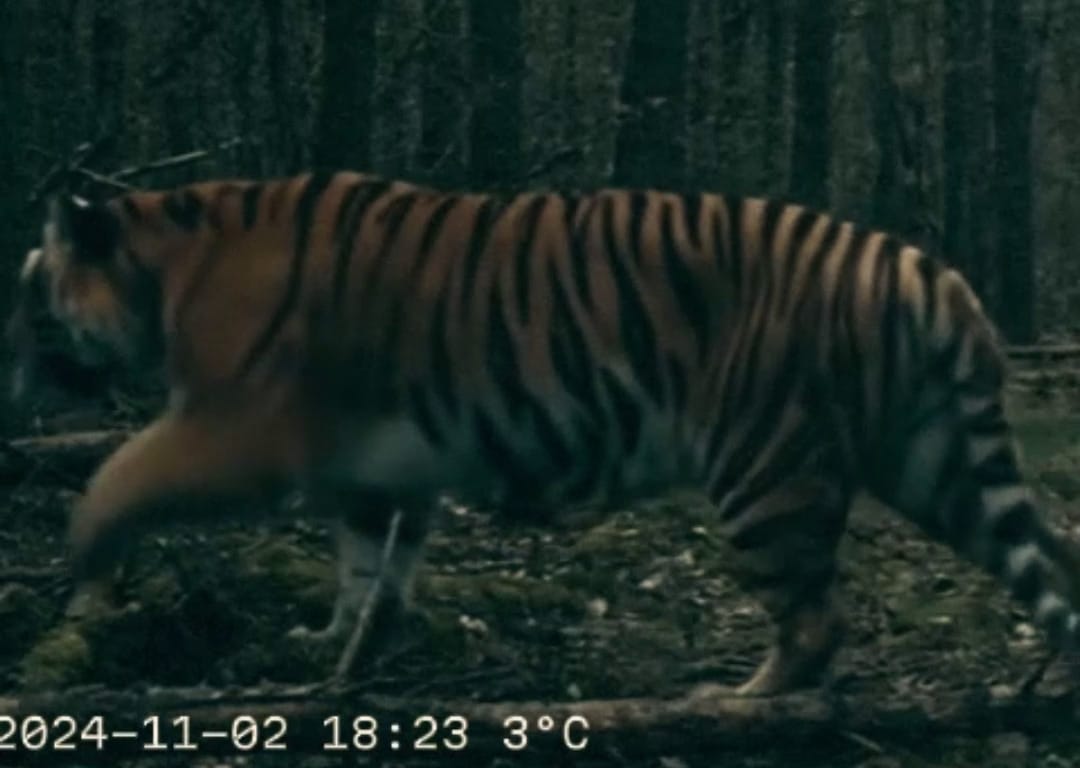
Trail cameras don’t have opinions. They sit in the dark, motion-triggered, recording whatever walks past. Most of the time it’s deer. Sometimes nothing for days. And occasionally the footage shows something that makes you rethink every solo hike you’ve ever taken in forested country.
Tigers follow trails. Not randomly. Deliberately, quietly, sometimes for several hundred meters behind a hiker who never knew they had company. This is documented behavior across tiger range in India, Nepal, and the Russian Far East. It has been recorded on camera repeatedly. It is not rare.
Understanding why it happens is more interesting than the footage itself.
Why a tiger follows you
The first thing to get straight is that a tiger trailing a hiker is almost never predatory. Tigers are ambush hunters. They select prey, close the distance under cover, and strike from behind at close range. A tiger genuinely targeting a human would not be visible on a trail camera twenty meters back. It would be invisible until it wasn’t.
What the cameras are actually capturing is territorial assessment. Tigers know everything that moves through their range. A lone human on a forest trail is an anomaly worth tracking, not as prey, but as an unknown variable. The tiger wants to know where you’re going and whether you’re a threat. It’s gathering information.
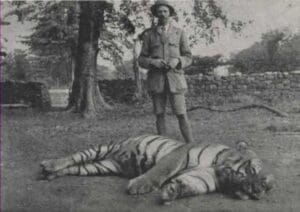
Jim Corbett spent decades in the Kumaon jungles and wrote about this directly. A tiger watching him from cover was close to a daily reality in certain forests. He was not alarmed by it. He understood the difference between a tiger that was curious and a tiger that had decided something. Most hikers walking those same trails today don’t have that distinction available to them.
Where it happens
Comments under footage like this always debate the same thing. Siberia or India. Amur or Bengal. The honest answer is both.
In the Russian Far East, Amur tigers range across territories exceeding 1,000 square kilometers for a single male. They are the largest cats on earth, with big males pushing past 300 kilograms. Any human moving through that boreal forest is moving through tiger space. The Wildlife Conservation Society has documented encounters with forest workers and hikers in this region consistently for years.
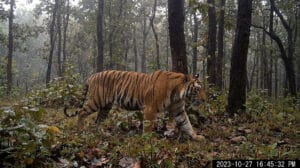
In India the situation is more concentrated, and the numbers tell a story worth paying attention to. India’s tiger population grew from 2,967 in 2018 to 3,682 in 2022, an annual rise of around 6%. More tigers means more overlap with human activity. A study published in Science in January 2025 found that in 20 states with tiger populations, about 45% of tiger-occupied area is shared by 60 million people. That overlap has consequences. Over 600 people lost their lives in tiger attacks between 2014 and 2024.
The attacks are not random either. More than half of tiger-related deaths between 2021 and 2025 occurred outside protected reserves. Buffer zones, forest corridors, the edges where human settlements meet tiger territory. That is where the risk concentrates, and that is where solo hikers are most likely to find themselves sharing a trail with something that knows the forest far better than they do.
Nepal’s Chitwan and Bardia tell the same story. Tigers there are habituated enough to human presence to observe it closely without retreating.
The sound that matters more than the animal
You probably won’t see the tiger. That is not how it works.
What you might hear, if you know what to listen for, is the sambar alarm call. A deep, resonant bark that carries through the forest. It means one thing: a predator is close. Every animal within range receives that information at the same moment.
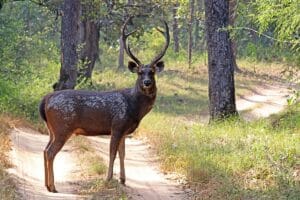
Corbett called it the jungle’s telegraph. He read it directionally. Which ridge the call was coming from, whether it was stationary or moving through the trees, how quickly it stopped. A call that moves means the predator is moving. A call that stops abruptly means something changed. Hikers without that knowledge walk straight through the message without receiving it.
What to actually do
By the time you know a tiger has been following you, it has almost certainly already moved on. Tigers lose interest. They assess, they track briefly, and they have other things to do. That is the most likely outcome of any trailing encounter.
That said, if you are hiking in tiger habitat, a few things matter.
Don’t go alone if you can avoid it. Tigers are significantly more cautious around groups. The trailing behavior documented on camera is almost exclusively behind solo individuals.
Make noise before blind corners. Not constant noise. Just enough to give whatever is ahead the option to move off. Tigers have been known to attack when a human surprises a sleeping or feeding animal, or a tigress with cubs. Removing that surprise removes most of the risk.
Pay attention to what the forest is telling you. Silence where there should be birdsong. Deer frozen and staring hard in one direction. The sambar bark echoing from the ridge above. None of that is atmosphere. It’s information, and it’s accurate.
The behavior is changing
This is worth noting separately because it’s a recent development. Conservation biologist K. Ullas Karanth and other experts suggest one reason tigers are increasingly targeting humans is that the big cats are losing their fear of people. Decades of protection have produced tigers that are less wary of human presence than previous generations. That is good for conservation. It changes the calculus for anyone moving through their territory on foot.
In Chandrapur district alone, tiger numbers grew from 30-40 animals in 2006 to around 250 today. Reserves that were designed for a fraction of their current tiger populations are now at saturation point. The animals are pushing outward into buffer zones and corridors where people live and work and hike.
The camera confirmed what was always true
Trail cameras didn’t reveal new tiger behavior. They gave us footage of behavior that was always happening, in forests people have been walking through for centuries without knowing what was behind them.
The tiger was always there. Now there’s just evidence.