
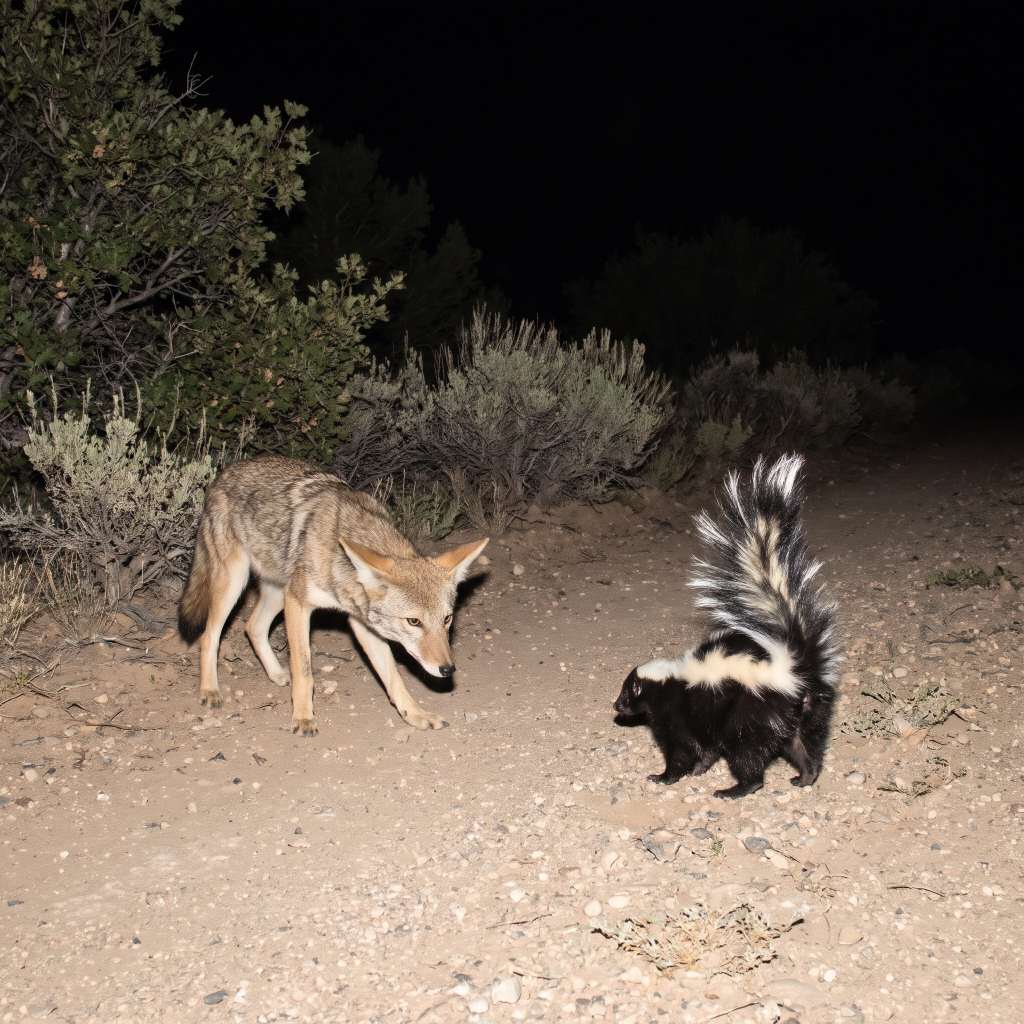
It takes an average of 2.4 direct hits to the face for an inexperienced coyote to finally figure out that a striped skunk is not worth the trouble. Put a young predator that has never encountered a skunk in front of those famous black-and-white stripes, and it will not automatically turn and run.
In 2024, researchers from California State University, Long Beach and Utah State University tested that exact scenario using captive coyotes with zero prior experience around wild skunks. Instead of bolting from the high-contrast fur, the naive predators approached taxidermied skunk models and had to take repeated blasts of a simulated chemical spray before they finally learned to keep their distance.
For generations, naturalists assumed North American carnivores came pre-programmed to avoid skunks. Across the animal kingdom, bold warning patterns, known to biologists as aposematism, advertise a toxic or painful defense to would-be attackers. Poison dart frogs, monarch butterflies, and striped skunks all wear bright, unmistakable coats designed to stand out rather than hide. Because seasoned wild predators routinely give skunks a wide berth, scientists long assumed that coyotes inherited an instinctive fear of the stripes at birth.
As California State University, Long Beach biologist Ted Stankowich put it in National Geographic, "These are things we assume. We think we know, but we just don't."
To separate hardwired instinct from learned behavior, Stankowich teamed up with graduate researcher Caitlin Fay and Utah State University wildlife ecologist Julie Young. Publishing their findings in the journal Animal Behaviour in June 2024, the team set up controlled trials presenting naive captive coyotes with mounted skunk models rigged to deliver a simulated spray defense, recording how the predators reacted on their very first encounter.
The trials showed that stripes alone do not stop a curious predator. While the stark contrast between black and white fur did make some coyotes pause or approach with extra caution, most were not born afraid of the pattern itself. They had to experience the unpleasant chemical consequence firsthand before connecting the visual warning to the miserable result.
Once the simulated spray entered the picture, the coyotes caught on fast. Because the researchers used a diluted, lab-safe version of the scent rather than a full-strength blast straight from a live animal's anal glands, it took an average of 2.4 sprays for a coyote to start avoiding the striped models altogether. Stankowich noted that in the real world, that learning curve would likely drop to a single spray if a young predator took a direct hit of 100 percent authentic skunk juice.
The study shows that skunk avoidance is a tight partnership between nature and nurture. The bold black-and-white coat gives a skunk a brief head start by making an unfamiliar predator hesitate for a split second, and it acts as a memorable visual blueprint that is easy to recognize the next time. The spray itself does the heavy lifting, locking that pattern into the predator's memory so the skunk does not have to waste its chemical reserves on the same attacker twice.
Those results also explain a frustration familiar to countless dog owners across rural and suburban America. Because domestic dogs share the same canid wiring as coyotes, a young dog has no built-in genetic alarm telling it to back away from a waddling black-and-white mammal in the backyard.
Until a dog learns through painful trial and error, or if its prey drive overrides the memory altogether, it will keep charging straight into the cloud, proving the same rule wild coyotes have to learn on their own.
Image is for illustration purposes only
Source: Fay, C., Young, J. K., & Stankowich, T. (2024), "Aposematic learning in a mammalian predator-prey system," Animal Behaviour, 212, 39-48 / National Geographic (May 14, 2024)