
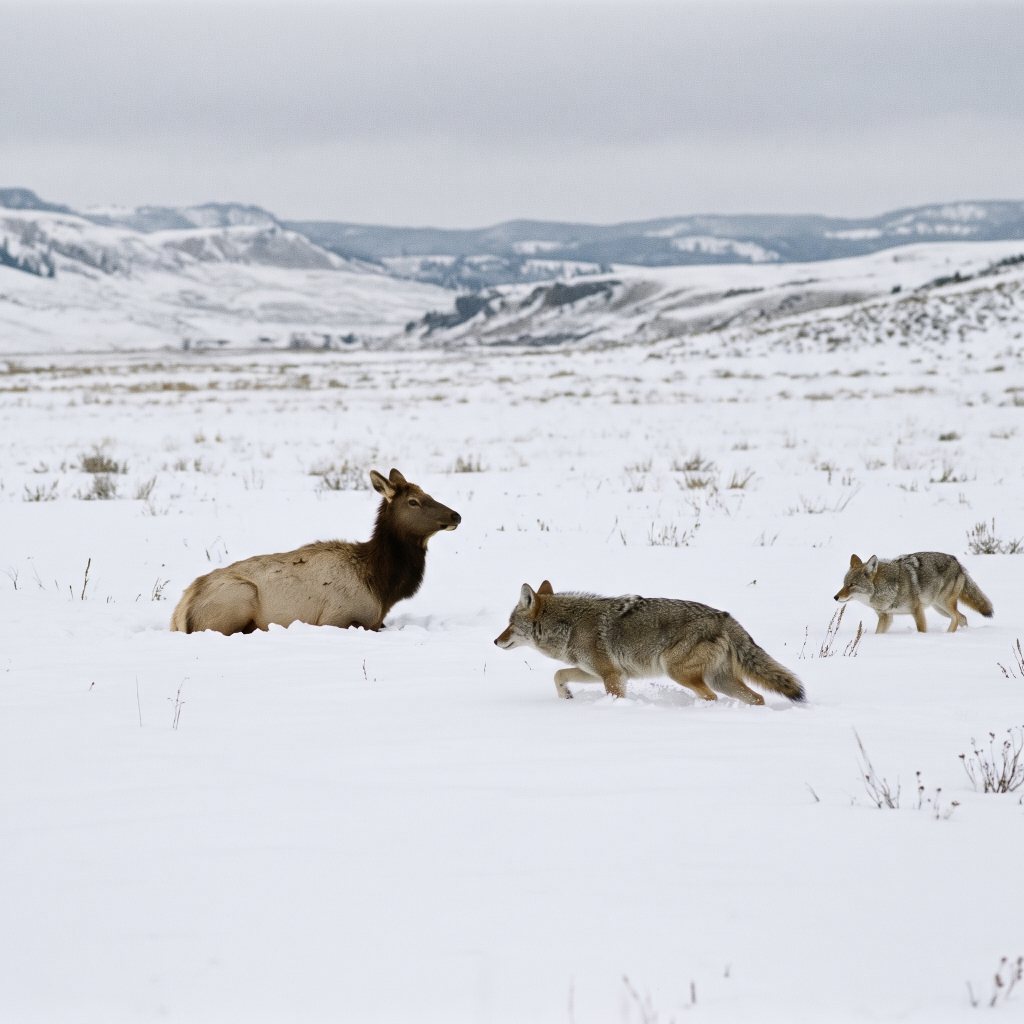
In January 1993, two coyotes in Yellowstone National Park brought down a full-grown cow elk in deep winter snow. But before she fell for good, she stood back up twice, kicked the male coyote completely off the ground, and dragged both animals through the snow.
At the time, wolves had not yet returned to Yellowstone, leaving coyotes as the primary predator of elk on the park's northern range. Most of what they took was winter carrion or calves. Watching coyotes attack an adult elk was rare enough that two wildlife biologists studying the area published every winter predation attempt they witnessed on deer and elk, nine in total.
At 10:20 a.m. on January 13, the researchers spotted a lone cow elk lying in a Lamar River Valley meadow where the snow measured about 18.5 inches deep. She had stayed in the same area for 12 days. Two lower-ranking coyotes from the local Soda Butte pack were resting 110 and 165 yards away.
At 11:12 a.m., the pack's breeding pair, including a six-year-old female, walked down a nearby road, passed the two resting packmates, and headed straight for the elk.
One minute later, the male charged. The cow turned to run, and he clamped onto her right hind leg. The female moved in toward the elk's belly but backed off to avoid her kicks. The cow dragged the male about 33 yards through the snow before her hind legs gave out and she went down. He let go.
She got back up. The male caught her left hind leg, and when she kicked out, he came completely off the ground. She dragged him another 11 yards before going down again. This time the female grabbed her right hindquarter. The cow climbed to her feet once more and dragged both coyotes about five yards before falling for the last time.
By 11:15 a.m., she was on the ground for good, though she kept striking at them with her front hooves while the pair dodged each blow. She died at 11:35 a.m., 22 minutes after the first charge. Five minutes later, the two resting coyotes walked in to feed, followed five minutes after that by two more members of the seven-coyote pack.
The carcass exam explained why she could not hold them off. Tooth wear put her at roughly 15 years old. The marrow in her thigh bone was brownish and gelatinous instead of firm and white, showing her body had burned through its fat reserves and left her in poor condition.
Even healthy elk were not always safe when terrain and snow stacked against them. Four days earlier, the same researchers watched two males from the Druid pack bring down a two-year-old cow elk in deep snow at the bottom of a gully, with three more coyotes joining in while she was still alive. When biologists checked her marrow, it was white and firm.
Coyotes rarely challenge a healthy adult elk on open, bare ground. When deep snow, steep terrain, and winter starvation narrow the gap, a pair of persistent coyotes can bring down prey many times their own weight.
Image is for illustration purposes only.
Source: Gese, E. M., and Grothe, S. (1995), Analysis of Coyote Predation on Deer and Elk during Winter in Yellowstone National Park, Wyoming, The American Midland Naturalist 133(1): 36-43