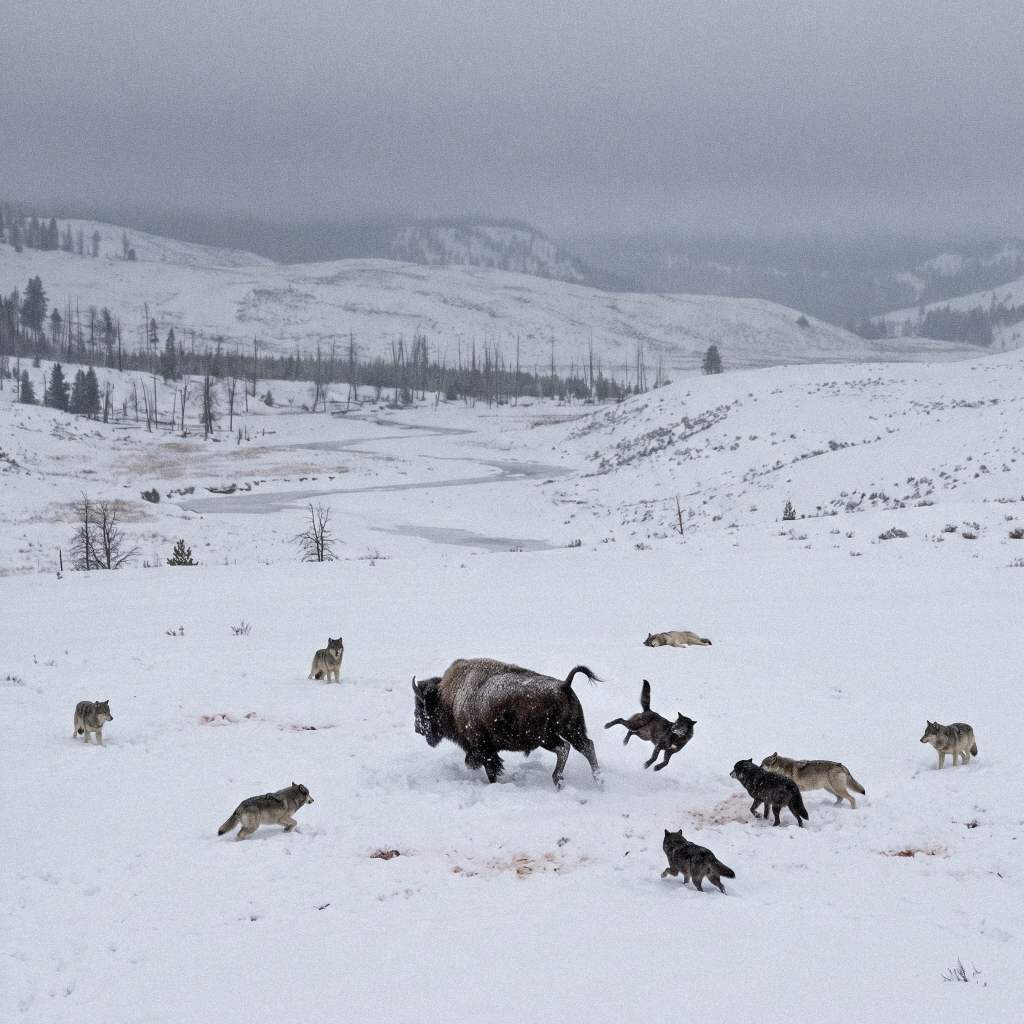
When a wolf pack in Yellowstone cornered a lone bison bull in deep snow in March 2003, the bull kicked one wolf over thirty feet into the air, hooked another with his horns and launched it several meters, killed a third, and fought the entire pack for a full day before he went down.
The pack was the Mollie's Pack, and they were not ordinary Yellowstone wolves. Most wolf packs in the greater Yellowstone ecosystem built their entire caloric strategy around elk. Elk are large enough to sustain a pack but manageable enough that a coordinated group of wolves can bring one down in minutes with a standard pursuit and hamstring attack. The Mollie's Pack did not have that option. Their territory was centered in Pelican Valley, one of the most remote and snowbound drainages in the interior of the park. In winter, the elk migrated out of Pelican Valley to lower elevations where the snow was survivable. The wolves stayed. What remained in the valley through the deepest months were bison, and bison are not elk.
The Mollie's Pack had to learn to hunt these animals or starve. There was no other winter food source in the valley that could sustain a pack. So they adapted, and over several winters they developed into the only wolf pack in Yellowstone that regularly targeted adult bison as a primary prey species. The hunts were nothing like elk takedowns. They were long, dangerous, physically devastating engagements that sometimes stretched over multiple days and regularly resulted in serious injury to the wolves.
The March 2003 encounter was documented by wildlife biologists and recorded in the official Yellowstone Wolf Project annual report. The pack located a lone mature bull in deep snow in Pelican Valley and surrounded him. Under normal predator-prey dynamics, encirclement triggers a flight response. The prey animal panics, breaks in one direction, and the wolves exploit the movement. They chase, they bite the hindquarters and the hocks, they open wounds that bleed and weaken, and once the animal's legs fail it goes down.
This bull did not run. He backed into the snow, planted himself, lowered his head, and faced the pack from a stationary position. He understood, on whatever level a bison processes threat, that running in deep snow with wolves on every side was a death sentence. Standing and fighting gave him a chance.
The wolves tested him. They circled. They darted in from the flanks and from behind, snapping at his hocks, trying to open the wounds that would start the clock on his endurance. The bull answered every approach. When a wolf came in from the rear, the bull delivered a kick that connected with full force and sent the wolf flying an estimated thirty feet through the air. The biologists observing the engagement described the distance as ten to fifteen meters. A wolf weighs roughly a hundred pounds. The force required to launch that weight that distance from a single hind-leg strike is enormous. The wolf that took that kick was not nipped or nudged. It was hit with the mechanical equivalent of being struck by a vehicle.
When another wolf tried to close from the front, the bull swung his head in a fast lateral arc and caught the wolf with his horn. The wolf was lifted off the ground and thrown several meters. The bull was not just defending himself passively. He was counterattacking. Every wolf that entered his range paid for it, and the price was high enough that the pack had to rotate wolves in and out of the engagement to manage their own injuries.
The standoff lasted the entire day. Hours of circling, testing, charging, kicking, retreating, regrouping. The wolves could not bring him down quickly because he would not move and he would not stop fighting. The bull was burning through his energy reserves standing in deep snow and swinging his massive body at attackers coming from every angle, but the wolves were burning through theirs too, and they were taking damage that the bull was not.
By the end of the day, the pack brought him down.
The bull that fought them for a full day in March 2003 was not exceptional by bison standards. He was a healthy, mature male doing exactly what his species is built to do when cornered. He did not outrun the threat. He stood in the snow and fought everything that came at him until he physically could not fight anymore, and before he went down he made sure the pack remembered what it cost them to take him.
Source: U.S. Fish and Wildlife Service / 2003 Rocky Mountain Wolf Recovery Annual Report
Image is for illustration purposes only