
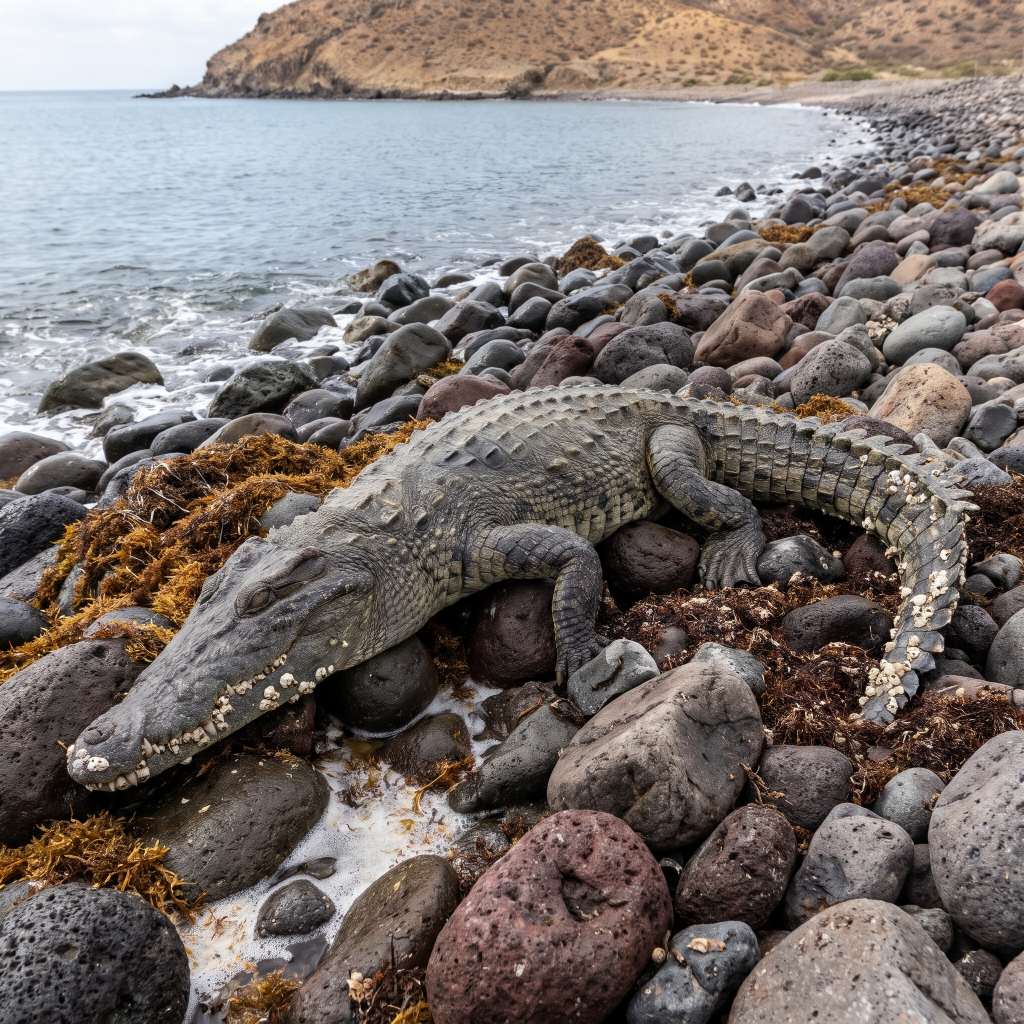
On October 8, 2021, beachgoers walking along Piedras Bolas Beach inside Cabo Pulmo National Park near the southern tip of the Baja California Peninsula came across a recently deceased, nine-foot-four-inch American crocodile washed up on the rocky shoreline.
The animal was heavily emaciated, and clusters of marine barnacles were cemented directly to its jaws and armored tail.
When researchers Luis Angel Tello Sahagún and Brandon Sideleau published the incident in the IUCN Crocodile Specialist Group Newsletter, it became the first confirmed record of a wild American crocodile ever documented on the Baja California Peninsula.
While American crocodiles thrive along the tropical Pacific estuaries and mangrove lagoons of mainland Mexico, the arid desert coastline of Baja California lies outside their established range and lacks resident breeding populations. Because the Cabo Pulmo coastline consists of exposed volcanic rock and coral reef with no freshwater rivers or mangrove swamps to support a resident crocodile, biologists had to look across the open ocean to explain how the reptile got there.
Looking east across the deep waters of the Gulf of California toward mainland Sinaloa, the researchers mapped the nearest thriving population of American crocodiles at the El Brinco Estuary inside the Ensenada Pabellones lagoon system. Measured in a straight line across the gulf, that mainland estuary sits roughly 138 miles east of Cabo Pulmo.
Unlike the American alligator, which lacks specialized salt-excreting glands and can only tolerate ocean water for brief stretches, the American crocodile is built for coastal seas. Equipped with lingual salt glands on its tongue that filter and expel excess sodium, the species routinely hunts in brackish lagoons and salt marshes.
Even with that biological hardware, open ocean crossings take a heavy toll. The crocodile at Cabo Pulmo showed no external wounds from boat propellers, fishing gear, or sharks, pointing instead to slow exhaustion and starvation out at sea.
The heavy crust of stalked and acorn barnacles attached to the crocodile's jaw and tail scutes told the story of an animal that had spent a prolonged stretch drifting and swimming through open marine waters before washing ashore on the peninsula.
Because no genetic samples were matched from the Cabo Pulmo specimen to specific mainland rivers, the 138-mile crossing from Sinaloa remains the shortest probable route rather than a confirmed track.
Image is for illustration purposes only.
Source: Tello Sahagún & Sideleau (2021), IUCN Crocodile Specialist Group Newsletter 40(4): 18-20 / CONANP Cabo Pulmo National Park.