
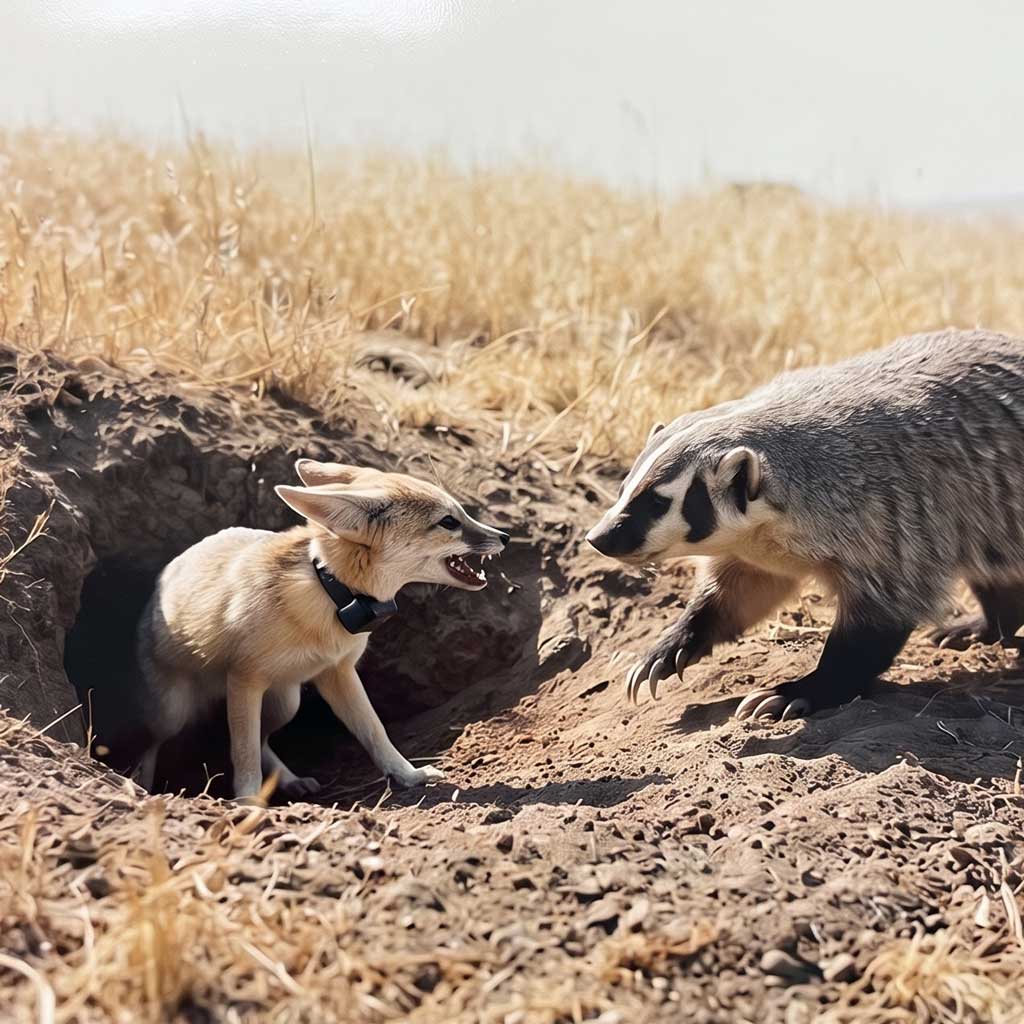
Researchers watched an American badger enter an occupied kit fox den. The fox’s mortality signal came the next morning. Across central California, a five-pound kit fox survives by ducking underground. Coyotes are the main killers of kit foxes on the open range, and a fox’s primary defense is an earthen den with an entrance pipe narrow enough to block a coyote at the surface.
On September 8, 1989, adult female kit fox #3877 was resting inside her burrow at Camp Roberts while biologists tracked her radio signal. Her collar was transmitting at its normal rate when the crew watched an American badger walk up to the den and disappear down the same entrance.
Unlike a coyote, which has to catch a kit fox in the open, an American badger is a subterranean predator built to hunt inside the earth. In the valleys where kit foxes live, badgers make their living pursuing burrowing rodents such as California ground squirrels, pocket gophers, and kangaroo rats inside their own tunnel systems. When hunting, a badger walks nose-down from burrow to burrow, relying on an acute sense of smell and sharp hearing to detect the scent and faint movements of an animal resting in a chamber below the surface.
Once the badger went down the hole, nobody could see what happened in the dark. When researchers checked the den again at 4:00 p.m. that afternoon, the collar on fox #3877 was still pulsing normally. Because the radio collars used in the study switched to a doubled mortality pulse only after remaining completely motionless for more than four hours, a normal afternoon signal did not prove the fox was unharmed.
At 9:00 a.m. on September 9, the receiver picked up a mortality signal from the den. Researchers excavated the burrow and recovered the body of fox #3877 with tooth-puncture wounds and internal hemorrhaging. Combining the fresh bite trauma with the sight of the badger entering her occupied den the day before, the biologists attributed her death to the badger.
While an adult kit fox is far larger than the rodents badgers usually dig up, an American badger is one of the pound-for-pound toughest carnivores in North America. Built like a low, muscular wedge and wrapped in thick, loose hide that makes it nearly impossible for an opponent to get a solid throat grip, a badger will routinely stand its ground and snarl at coyotes, cougars, and bears twice its size. In the close quarters of an underground tunnel, a five-pound fox is heavily overmatched against twenty pounds of muscle, two-inch claws, and a crushing bite.
A badger entering a burrow does not always catch the occupant; in a separate 1990 incident at Camp Roberts, researchers saw a badger enter an occupied den and watched the radio-collared kit fox bolt out and escape. Still, the recovery of fox #3877 proved that while a narrow burrow protects a kit fox from predators on the surface, an American badger has the tools to follow an adult fox down its own shaft and kill it inside its shelter.
Image is for illustration purposes only.
Source: Standley et al. (1992), EG&G Energy Measurements / Lindzey (2003), Wild Mammals of North America / Michener (2004), Journal of Mammalogy.