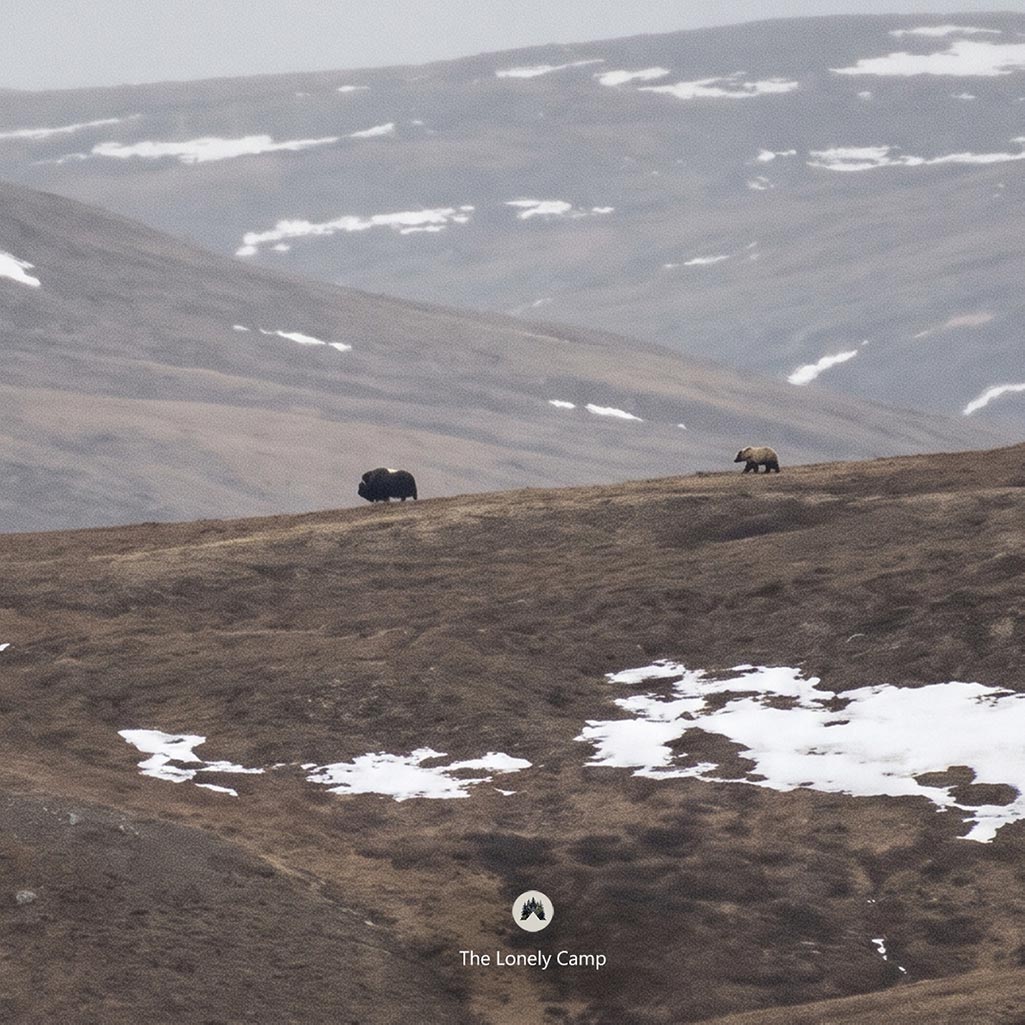
In 2012, Alaska wildlife managers tried to save an Arctic muskox herd without launching a broad war on predators. Instead of clearing grizzlies off the tundra, state biologists decided to target only the individual bears caught in the act of hunting muskoxen. Seven bears were killed, the state declared the five-year experiment a failure, and then the herd rebounded anyway.
Native muskoxen were wiped out across Alaska’s Arctic during the 1800s. Every wild muskox in the state today descends from a group of animals shipped over from Greenland in the 1930s. State biologists released some of those descendants onto the eastern North Slope in 1969 and 1970, and by the 1990s a thriving herd of roughly 300 animals lived along the Dalton Highway corridor in Game Management Unit 26B, the open tundra stretching between the Brooks Range and the Prudhoe Bay oilfields.
Around 2004, the numbers started dropping. Within two years the herd was down to roughly 200 animals, forcing the state to shut down the local muskox hunt. Just to the east, in Unit 26C, a neighboring herd had already collapsed to almost zero, and biologists with the Alaska Department of Fish and Game worried the Dalton Highway herd was headed for the same end.
To find out what was killing them, researchers fitted muskoxen with radio collars and tracked their fates across the tundra. Between 2007 and 2011, grizzly bears were responsible for 62 percent of documented adult deaths and 58 percent of calf deaths. Most of the dead adults were breeding-age cows. The herd was otherwise healthy and well-fed, and females were giving birth at rates high enough to grow the population. The animals simply were not surviving the spring.
Older bear-tracking records from the same stretch of tundra pointed to a specific culprit. Between 1991 and 2007, a small number of radio-collared male grizzlies had killed multiple muskoxen, returning to hunt the herds spring after spring. Most of the attacks happened during a narrow window around calving season, while female bears were still asleep in their winter dens.
When threatened by wolves, muskoxen bunch together in a tight defensive ring with their horns facing out and their calves tucked in the center. That wall of horns stops a wolf pack cold. If a heavy male grizzly figures out how to bull through the formation or trigger a stampede that leaves calves behind, however, he can live off the same herd for the rest of his life. Biologists suspected they did not have a general bear problem. They had a specialist problem.
In 2012, the Alaska Board of Game approved a targeted removal plan. Flying over the tundra during spring calving season, state wildlife crews watched the muskox groups from the air and shot only the individual grizzlies seen actively stalking or killing them. The rest of the estimated 333 brown bears living in the unit were left untouched.
Over five springs between 2012 and 2016, aerial crews removed just seven bears: three in 2012, three in 2013, and one in 2016. Every single one of them was a male. Almost immediately, bear kills among the radio-collared muskoxen dropped.
Then bad luck muddied the math. During the very first winter of the program, a group of 20 muskoxen broke through thin river ice and drowned together, wiping out roughly 11 percent of the entire herd in a single afternoon. Because of that freak loss, total herd numbers stayed flat, hovering between 181 and 228 animals. When state biologists wrote up their final evaluation in 2018, they recommended shutting the program down, concluding they could not prove that shooting the seven bears had grown the herd.
Right after the flights stopped, the herd took off. By 2020, the population had climbed past the state’s recovery goal of 300 muskoxen, allowing managers to reopen a limited hunting season. Throughout that entire growth spurt, field crews recorded almost no bear kills. Looking back at the data in 2026, state biologists noted that taking out those seven male specialists had likely worked all along, and that the river drowning had simply hidden the recovery while the clock was running.
In nature, the peace only lasts until the next bear figures out the trick. Starting in 2023, a new generation of grizzlies began working the herds, and muskox numbers started sliding backward again. By April 2026, the count was back down to 220 animals, with bear kills matching the worst years before the original experiment. On July 22, 2026, the Alaska Board of Game voted 7 to 0 to put spotter planes back over the calving grounds through 2034, looking for the few boars that have learned how to break the ring.
Image is for illustration purposes only.
Source: Alaska Department of Fish and Game, Unit 26B Muskoxen Recovery Annual Report (2018) / ADFG Proposal 1, Alaska Board of Game Special Meeting (July 2026) / Unit 26B Muskox Recovery Update (2014).
Alaska Targets Grizzlies Hunting Muskoxen as Herd Recovers