Bush camps and safari lodges across sub-Saharan Africa operate on an understanding most guests don’t fully absorb before arrival. The fence, if there is one, is psychological more than physical. The wildlife does not recognize it.
When the lobby is not off limits
In June 2018, staff at a luxury safari camp in Zimbabwe reviewed their CCTV footage and found something that required a significant cleanup effort. 14 hyenas had gathered in the reception area overnight and killed a kudu bull there, feasting on it through the night while guests slept nearby. The lodge staff arrived in the morning to find the evidence.
This is not an isolated incident. It is a category of event that happens with enough regularity across southern and eastern Africa that lodge protocols exist specifically to address it. After-dark movement rules, escort policies between accommodation and dining areas, curfews for unaccompanied guests. These are not theater. They are responses to documented history.
The most recent fatal incident
In May 2025, a 59-year-old businessman named Bernd Kebbel was staying at a tented resort near Hoanib Skeleton Coast Camp in the remote northwest of Namibia. He stepped out of his tent at night to use the toilet. A lion attacked him. Other campers managed to scare the animal off but Kebbel was already dead.
He was a philanthropist who supported wildlife conservation in Namibia. He understood the environment he was in. The area is home to desert-adapted lions, a population estimated at around 60 adults, that range across terrain where tourist infrastructure sits directly within their territory. There are no walls between the two.
What lions actually think of lodges
A lion approaching a bush camp at night is not making an error in judgment. It is moving through its territory. The lodge sits within that territory regardless of what the booking confirmation says.
The common thread of predator attacks on campers in Africa is that they happen after dark. Lions, leopards, and hyenas are opportunistic hunters that will take whatever comes their way. The critical variable is whether the animal has learned to associate the lodge with food or with threat. A lion that has had negative experiences near human structures will avoid them. A lion that has had neutral or positive experiences loses its wariness over time. That habituation process is what lodge management teams work to prevent, and why leaving food accessible is treated as a serious safety issue rather than a minor housekeeping concern.
The Rongai incident
In May 2024, CCTV cameras near Nairobi captured a lion climbing over a fence at 10 PM, prowling the perimeter of a private compound, and leaving with an animal in its jaws. This was not remote bush. This was a suburb of one of Africa’s largest cities, adjacent to Nairobi National Park, where the boundary between urban life and lion territory is measured in meters.
The park’s lions have been documented moving into residential areas with increasing frequency as human development presses against the park’s unfenced southern boundary. The CCTV footage is evidence of what happens when the buffer disappears.
What the protocols actually protect against
Every reputable bush camp and safari lodge in lion country operates with a set of after-dark rules that guests are briefed on at check-in. Do not walk between accommodation and common areas unaccompanied at night. Do not leave food in tents or on tent platforms. Do not approach wildlife regardless of how habituated it appears.
These rules exist because the incidents that generated them are documented. Lions entering dining areas. Leopards on tent platforms. Hyenas in reception. The incidents are not common enough to make safari lodges statistically dangerous — millions of people visit each year without incident. But they are common enough that the rules are not precautionary theater.
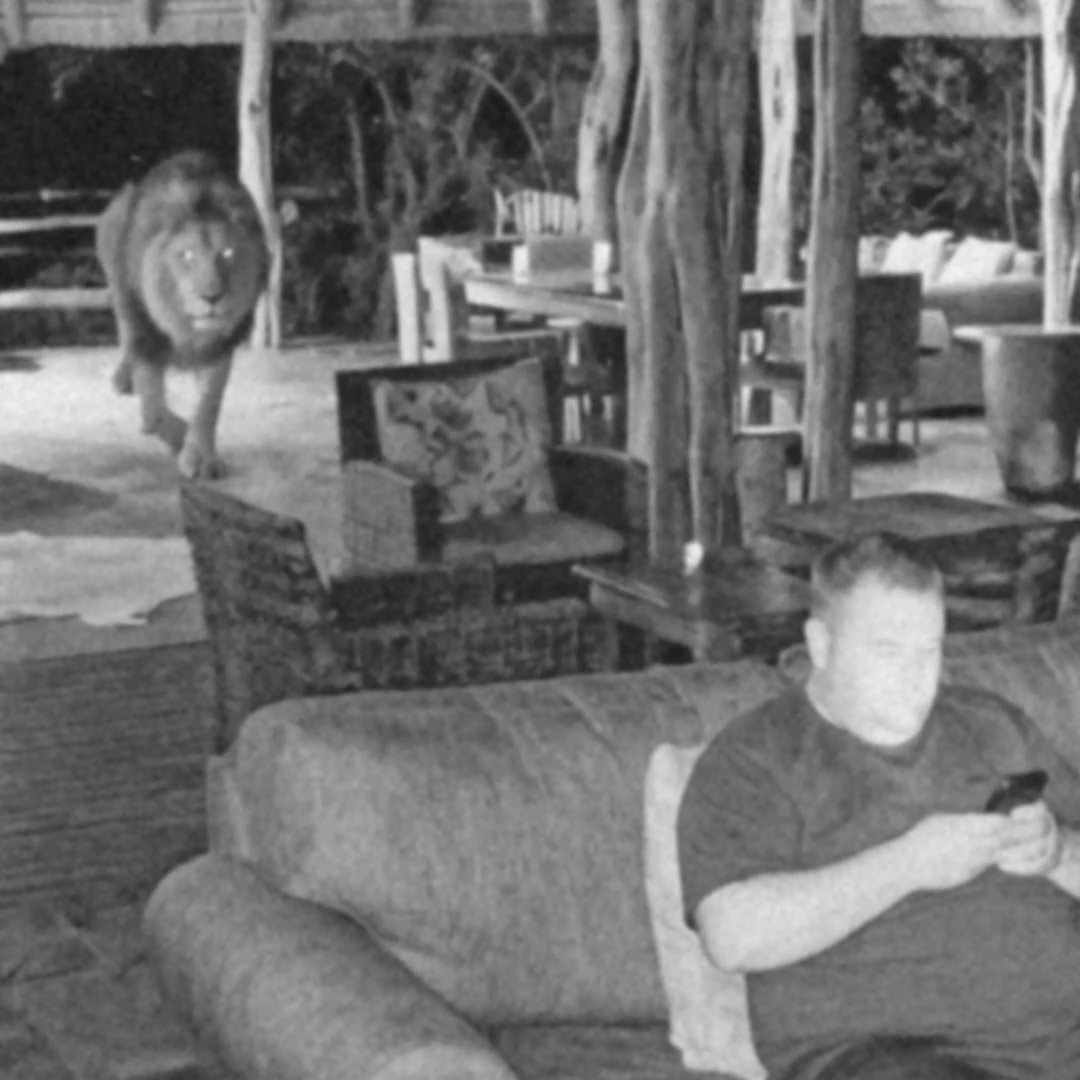
The guest sitting alone in a lodge lobby at night, having a beer, scrolling a phone, unaware of what the darkness outside the light pool contains — that is not a fictional scenario. It is a recurring one. The after-dark briefing that was half-listened to at check-in was written for exactly that moment.
The difference between a lodge and safety
The appeal of a bush camp is proximity to the wild. That proximity is real in both directions. The animals that make the experience extraordinary are the same animals that make the after-dark protocols necessary.
A lion that walks through a camp at night is doing what lions do. The CCTV reviewed in the morning is often the only record that the gap between the two worlds narrowed significantly while everyone sat inside thinking they were safe.