Most people who see a black wolf for the first time assume they’re looking at a different animal entirely. Something larger. Something older. Something that doesn’t quite fit the mental image of a wolf.
They’re not wrong to feel that way. The black wolf is not a separate species, but it carries a history that makes it genuinely unlike its gray counterparts in ways that go well beyond color.
Where the black coat comes from
The black wolf is a gray wolf. Same species, same behavior, same territory. The color difference comes from a single genetic mutation, and the origin of that mutation is one of the stranger stories in wildlife genetics.
Research from Stanford and UCLA confirmed that the black coat in North American wolves traces directly to ancient hybridization with domestic dogs. Thousands of years ago, wolves interbred with early domestic dogs carried by Native American populations, and the gene responsible for black pigmentation passed into the wild wolf population. It has been spreading ever since.
Researchers dated the origin of the black coat allele in Yukon wolves to between 1,598 and 7,248 years ago, with genetic evidence pointing to a single introgression event from Native American dogs as the source. One encounter between wolves and dogs, thousands of years ago, and the result is still visible in forests across North America today.
Why black wolves are concentrated in forests
This is the part that matters for anyone camping in the northern forests of the United States and Canada.
In Alberta, 55% of wolves are black, compared to just 33% in northern British Columbia and 32% in Alaska. The further into forested terrain you go, the more likely the wolf you encounter will be a black one.
Black coats occur in about 62% of wolves in forested areas of the Canadian Arctic, compared with about 7% in the open tundra. The math is straightforward. A wolf with a black coat is effectively invisible at night in dense forest. The gray wolf, visible against snow and open ground, loses that advantage the moment it moves into the trees.
There is still scientific debate about whether the black coat provides a direct hunting advantage or whether the selection pressure comes from somewhere else entirely, possibly enhanced immunity. What is not debated is that the trait is thriving in exactly the environments where campers tend to pitch their tents.
What wolves actually do around campsites
Wolves are not ambush predators of humans. There is no documented pattern of wolves stalking and attacking healthy adult humans in North America in modern times. That is worth stating clearly.
What wolves do is investigate. They are intensely curious, highly intelligent animals with an acute sense of smell that detects human presence from miles away. A wolf that wanders through a campsite at night is almost certainly following a scent trail, assessing a new element in its territory, and making decisions about whether any of it is relevant to its immediate interests.
Food smells are the primary draw. Garbage, cooking residue, anything protein-based left in the open. A wolf that finds an interesting scent will investigate it thoroughly before moving on.
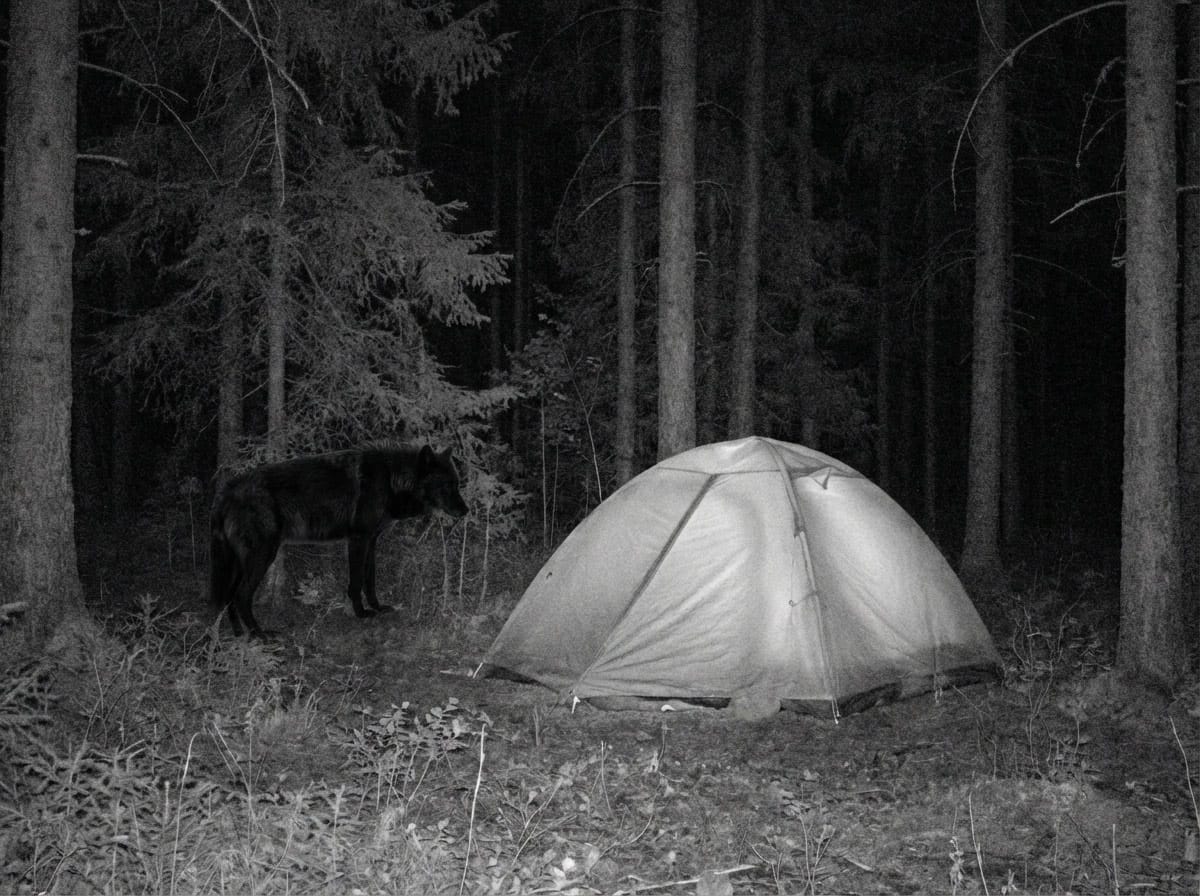
The camper in footage like this likely heard something because wolves are not always quiet when they move through unfamiliar territory. They pause. They shift weight. They occasionally disturb ground cover. And then they leave, usually within minutes, having determined that a sleeping human is neither a threat nor a meal.
The one exception worth knowing
Habituated wolves are a different calculation. A wolf that has learned to associate humans with food, through repeated exposure to unsecured camp garbage or direct feeding, loses its natural wariness over time. These animals become unpredictable in ways that wild wolves are not.
This is the reason backcountry rangers in wolf territory are consistent about food storage. Not because a wild wolf is likely to attack, but because the process of habituation that begins with a stolen granola bar ends with an animal that no longer treats humans as something to avoid.
Keep food secured. Store it in bear canisters or hang it at least 10 feet off the ground and 4 feet from the trunk. The wolf that walks through your campsite tonight will keep walking, as long as there is no reason to come back.
The animal you will not see coming
A gray wolf on a forest trail at night is difficult to spot. A black wolf is close to impossible. The coat that started as a genetic accident, passed from a domestic dog to a wild wolf somewhere in the Yukon thousands of years ago, has been refined by selection into something genuinely well suited for moving through darkness in forested terrain.
The camper who shines a flashlight and sees nothing was probably right. The wolf had already gone. It just saw them first.