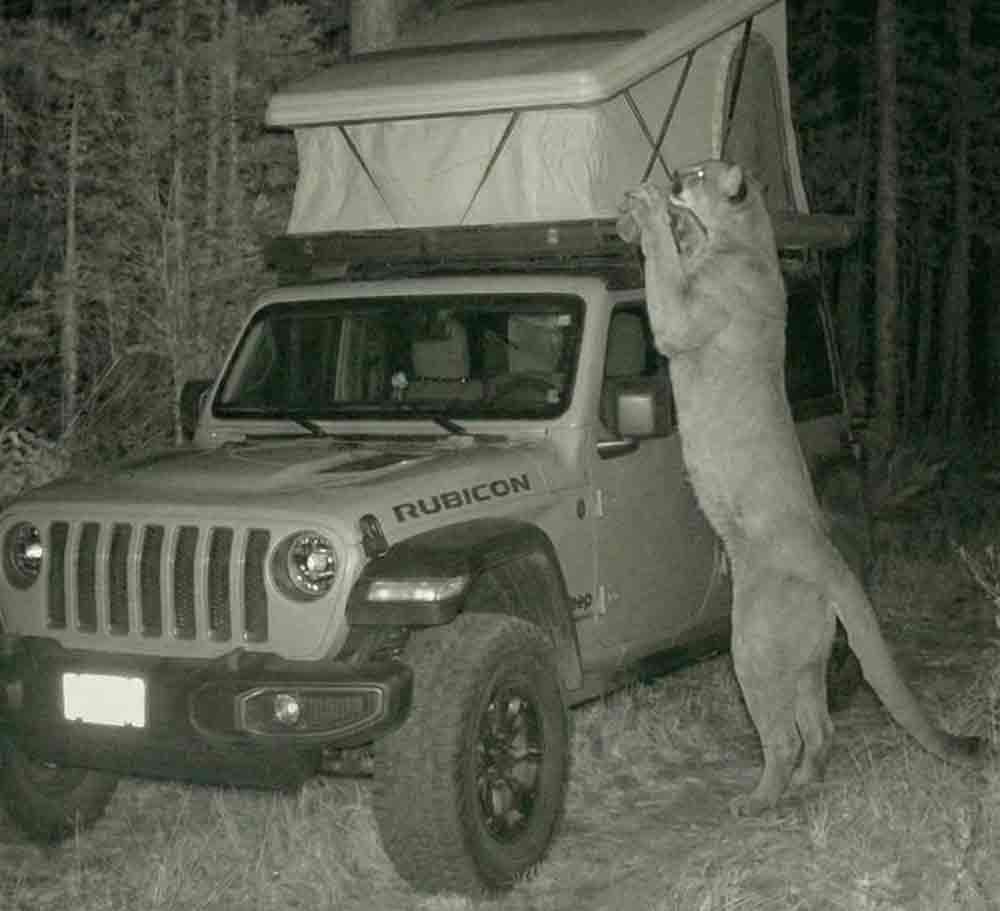
A mountain lion approaching a vehicle at night and standing up against the side is not a random event. It is a deliberate investigation. The animal has already detected something worth checking on. The question most people ask in these situations is whether the people inside were in danger. The more useful question is what drew the lion to the vehicle in the first place, and whether being in a rooftop tent changes anything.
Can a mountain lion smell people inside a vehicle
Yes. A mountain lion’s sense of smell is significantly more developed than a human’s, and a canvas rooftop tent is not a barrier to scent in any meaningful way. The fabric breathes. Human scent, body heat, and any food smell passes through it continuously.
The vehicle itself is a harder barrier. A locked hard-sided vehicle contains scent far better than a canvas tent, which is why many high-use national parks in bear and mountain lion country require hard-sided camping and explicitly prohibit rooftop tents and ground tents in certain zones. Yosemite, Glacier, and Yellowstone all have areas where this applies.
What draws a mountain lion to investigate a vehicle is almost never the vehicle itself. It is the scent profile around and on it. Cooking residue, food stored below in the cab, human scent on the ladder and exterior surfaces. A lion investigating a vehicle is not trying to get inside. It is investigating a concentrated source of unfamiliar scent at close range.
Is a rooftop tent safer than a ground tent
For most wildlife, elevation helps. Raccoons, snakes, rodents, most of the animals that cause problems at campsites are deterred by height. For mountain lions specifically, elevation is less relevant. A rooftop tent is still soft-sided, and the fabric offers no real physical barrier from a determined large predator. What it does offer is that the ladder creates a chokepoint. An animal has to make a deliberate choice to climb, rather than simply approaching horizontally.
The more meaningful safety factor is the vehicle itself. Being able to drop down into a locked hard-sided cab instantly is an option a ground tent does not give you. In any wildlife encounter from a rooftop tent, the vehicle below is your most significant safety resource.
What a mountain lion is actually doing when it investigates
The behavior documented by wildlife researchers — approach, stand up, sniff, withdraw — is investigative, not predatory. A mountain lion preparing to attack does not announce its presence by standing visibly against the side of a vehicle. It closes distance under cover and strikes from concealment.
Research from UC Santa Cruz found that mountain lions fled in 83% of cases the moment they heard a human voice. When a scent source is stationary, silent and not reacting, the investigation simply runs its course. The animal gathers enough information and moves on.
What actually reduces the risk
Food management is the single most effective variable. A mountain lion that finds nothing interesting at a campsite has no reason to return. One that finds cooking residue, unsecured food, or accessible trash has a reason to come back and to stay longer.
Cook at a distance from your sleeping setup. Store all food inside the locked cab overnight, not in the rooftop tent or in external bags. Clean cooking gear before dark. These are not precautions against a predator actively hunting you. They are precautions against creating a scent trail that draws investigation in the first place.
Light is also a deterrent. Flashing lights keep mountain lions and other nocturnal animals at distance. A motion-activated light on the vehicle changes the calculus for an animal deciding whether to approach.
The rooftop tent community is large and growing. People sleep in them in mountain lion territory across California, Colorado, Utah, Oregon and British Columbia regularly. The vast majority of nights produce nothing more than distant sounds and, occasionally, tracks in the morning that confirm something was there.