
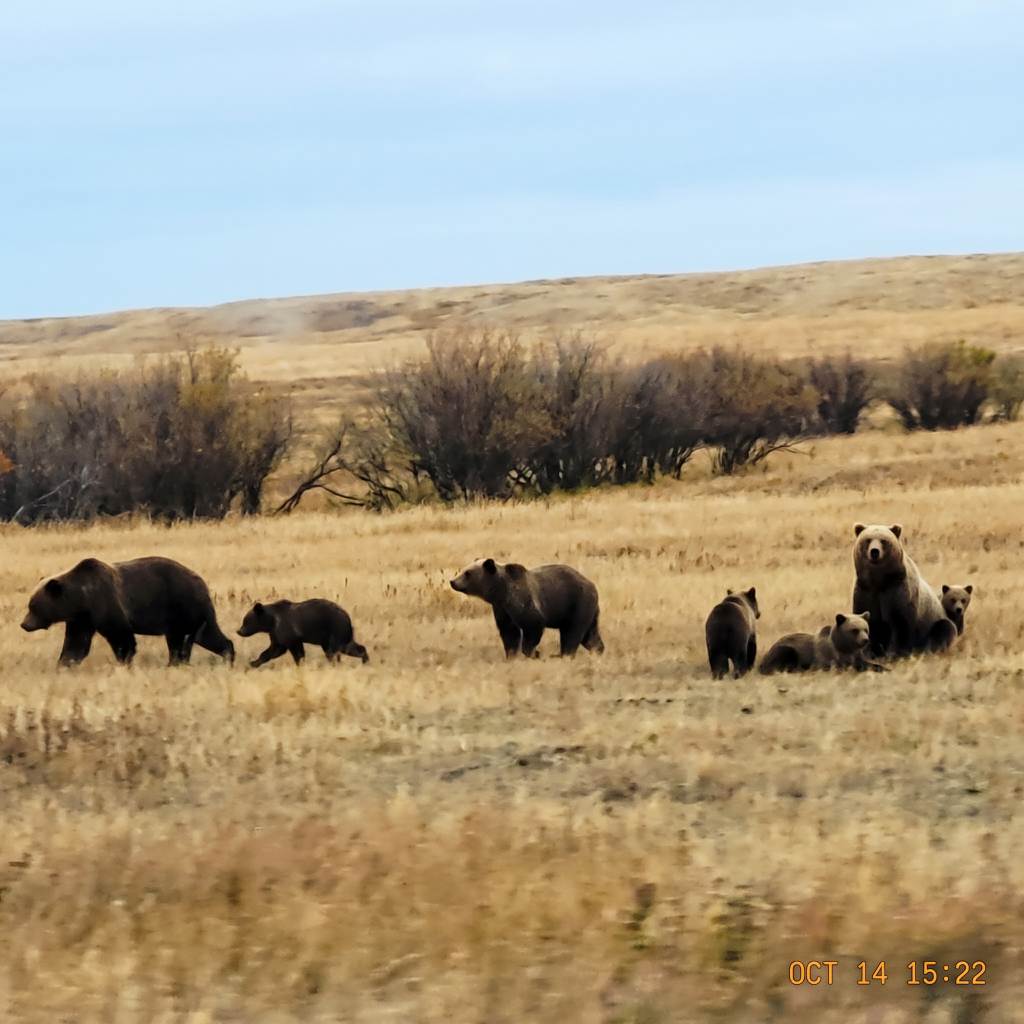
Seven grizzly bears were filmed walking across an open farm field just south of the Pendroy turnoff in Teton County, Montana, on October 3, 2026, far out on the flat prairie east of the Rocky Mountain Front.
A local resident was driving north toward Valier to check on an upcoming work site when he spotted the bears moving together across the plains a mile or two south of Pendroy. Earlier that summer, in July 2026, a ranch family near Pendroy checked their security cameras and found seven grizzlies strolling through their yard. Both sightings are part of a growing pattern of multi-bear sightings across the farmland around Choteau, Dupuyer and Valier.
Adult grizzlies spend most of their lives alone, apart from the breeding season and the years a mother spends raising her cubs. Seven of them traveling together across treeless farm country looks unusual at first glance, but wildlife biologists with Montana Fish, Wildlife and Parks have been tracking the shift behind these prairie gatherings for years.
The bears around Pendroy belong to the Northern Continental Divide Ecosystem, a recovery zone anchored by Glacier National Park and the Bob Marshall Wilderness to the west. In the 1980s, federal surveys counted fewer than 400 grizzlies across that entire mountain block. Over the past four decades, the population has climbed past 1,100 bears and filled up the best high-country territory.
With the mountain valleys crowded, young bears looking for their own ground, and mothers trying to keep their cubs away from dominant males, have pushed steadily east down the river bottoms. They are reclaiming the Great Plains, where grizzlies lived until market hunting and homesteading wiped them off the flatlands in the 1800s.
The prairies of Teton, Pondera and Chouteau counties look nothing like the dense timber of Glacier. Most of the plains are wide-open wheat stubble, cattle pasture and dry grassland. Grizzlies prefer cover during the day, so bears moving east funnel into the narrow strips of cottonwood, willow and chokecherry brush that line the Teton, Marias and Two Medicine rivers.
In autumn, grizzlies enter hyperphagia, a feeding frenzy in which they eat tens of thousands of calories a day to put on fat for winter. During those weeks, farm country offers concentrated food. Spilled grain around storage bins and thick stands of berries along the creeks draw several family groups and young independent bears into the same coulees and field edges at the same time.
When two mothers with older cubs, or groups of young siblings, overlap along a narrow prairie creek or flush out of a crop field together, they often tolerate each other and cross open ground as a single group until they reach the next patch of brush.
Image is for illustration purposes only
Source: Montana Fish, Wildlife & Parks (FWP) Region 4 Prairie Grizzly Distribution Reports / Costello, C. M., et al. (2016–2025), Northern Continental Divide Ecosystem Grizzly Bear Monitoring Team Annual Reports / Dylan Isakson Field Video (October 3, 2026, Pendroy, Montana)