
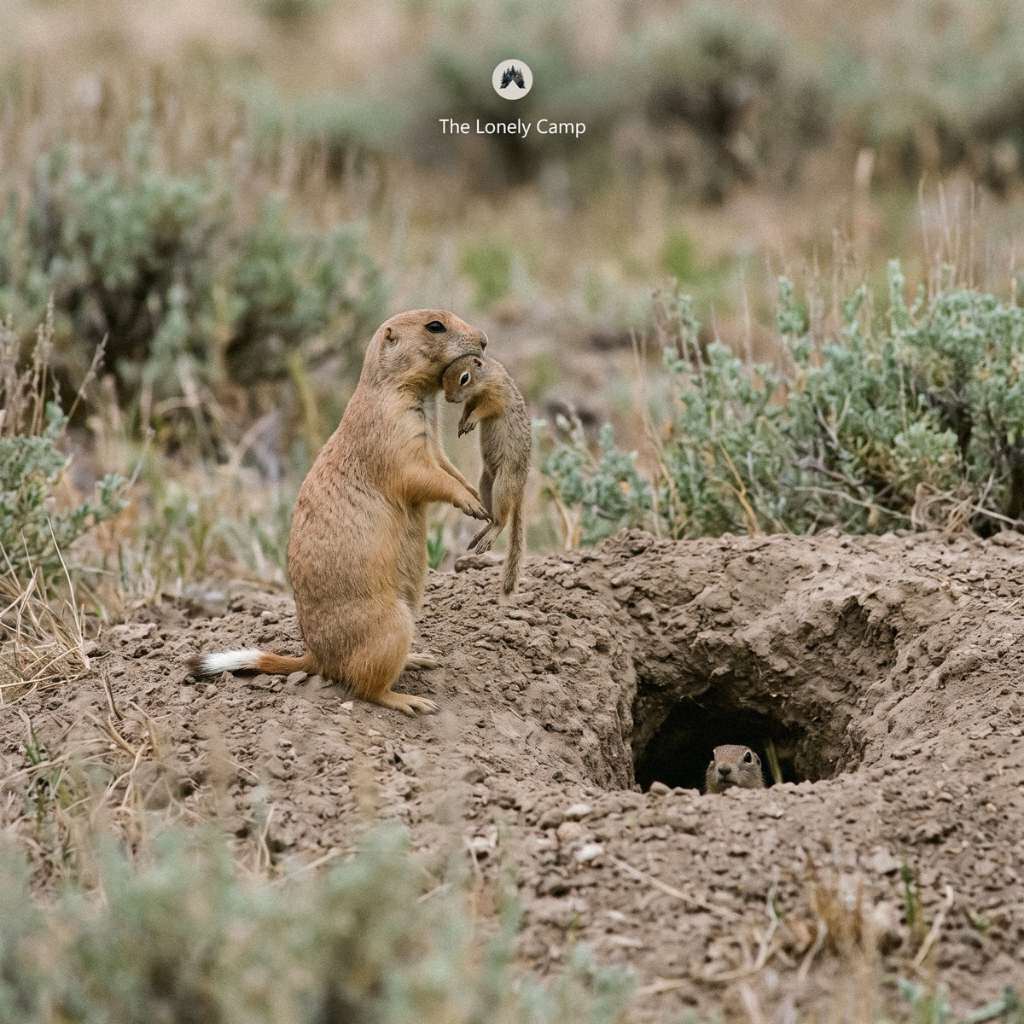
In western Colorado, a single female white-tailed prairie dog was documented killing seven young ground squirrels in one afternoon, catching each one as it stepped out of its burrow for the first time.
She did not eat them. Each time, she dropped the body in the dirt and went back to watching the grass.
Wildlife biologist John Hoogland had spent more than four decades studying prairie dogs before he ever saw it happen. He had already been observing white-tailed prairie dogs at the Arapaho National Wildlife Refuge for a full year when he watched a female leap onto something small, shake it hard, and walk away. Climbing down from his observation tower, he found the body of a baby Wyoming ground squirrel. He picked up his radio and told his students to start watching for more.
Between 2007 and 2012, Hoogland and his research team documented 101 confirmed kills and another 62 suspected cases from carcasses found in the field. In total, 47 individual prairie dogs were identified targeting ground squirrels. The routine rarely varied. A prairie dog would spot a squirrel, run it down, seize it by the head or neck, and shake it until the encounter ended a few minutes later.
Occasionally, a prairie dog chewed briefly at the chest or head afterward, but Hoogland determined they were not hunting for food. They never consumed more than five percent of a carcass. He concluded they were simply making sure the rival was dead before leaving the body in the dirt for scavenging birds.
Almost all of the attacks were carried out by mothers. Seventy-nine percent of the prairie dogs involved were lactating females with pups underground, and nearly every incident took place within 20 meters of the mother's own burrow entrance.
The timing centered on May, the exact stretch when juvenile ground squirrels emerge from their nests and start feeding on the same grasses and prickly pears that nursing prairie dogs depend on. One female, nicknamed Killer Supreme by the research team, eliminated nine ground squirrels over four years. Not once during the six-year study did researchers record a ground squirrel killing a prairie dog in return.
To figure out why a two-pound plant-eater would spend energy eliminating a neighbor it had no intention of eating, Hoogland and co-author Charles Brown of the University of Tulsa tracked reproductive success across the entire colony. The data, published in the Proceedings of the Royal Society B and covered by National Geographic, pointed straight to survival.
Females that eliminated ground squirrels raised litters three times larger than females that did not. The number of ground squirrels a female removed in a given year proved to be the single strongest predictor of her reproductive fitness, outranking body mass, age, territory quality, and number of neighbors.
After 43 years in the field, Hoogland called it the most provocative finding of his career. It was the first documented case of a plant-eating mammal routinely killing another plant-eating mammal without consuming it. On the Colorado sagebrush flats, where spring forage is limited and pups grow fast, removing every competing mouth within 20 meters of home turned out to be the surest way to keep a litter alive.
Image is for illustration purposes only
Source: Hoogland, J.L. and Brown, C.R. (2016), Proceedings of the Royal Society B / National Geographic