
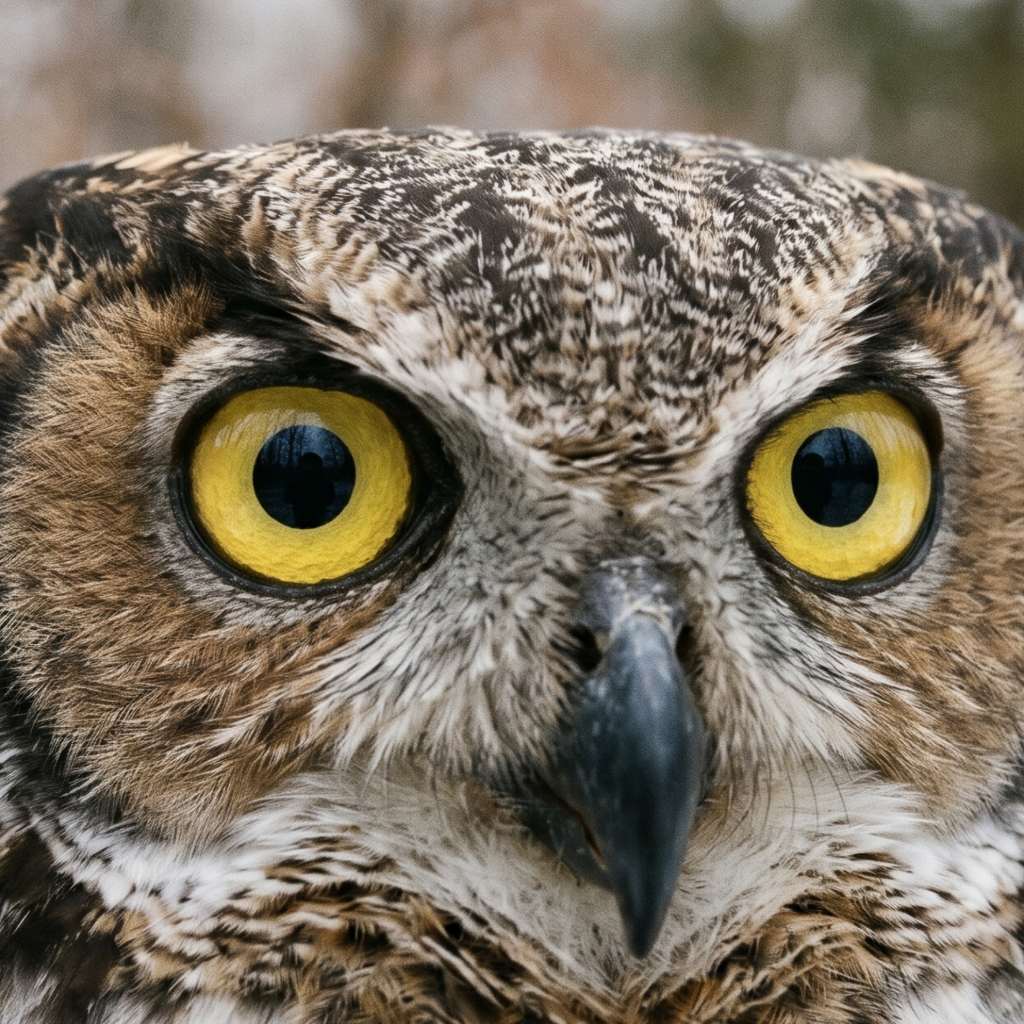
In 2004, a wild great horned owl went back into the Wisconsin woods wearing custom artificial lenses in both eyes.
Rescuers first found the bird on December 1, 2003, perched on a fence near Manitowoc, Wisconsin. She was severely emaciated. Dense cataracts had clouded both of her eyes, stripping away the sharp vision a raptor needs to hunt.
In almost every case like hers, a wild bird of prey faces two outcomes. Wildlife clinics either euthanize the animal or place it permanently in a captive teaching facility. Great horned owls rely heavily on binocular depth perception to intercept fast-moving prey in dim light. Simply removing a clouded lens leaves the bird too far out of focus to judge distance and make a clean strike from a perch.
Volunteers with Wildlife of Wisconsin, a Manitowoc-area rehabilitation group, brought the owl to the School of Veterinary Medicine at the University of Wisconsin-Madison. Staff named her Minerva and realized they had an unlikely stroke of luck sitting in storage.
Six years earlier, UW-Madison veterinary ophthalmologist Christopher Murphy and then-resident Chuck Stuhr had custom-designed and fabricated a pair of intraocular lenses for a different great horned owl. That earlier bird turned out not to be a suitable candidate for surgery, so the lenses had been saved.
On January 22, 2004, Murphy and ophthalmology residents Renee Carter and Katie Diehl removed Minerva's cataracts and implanted both lenses, marking the first time a great horned owl had received implants built specifically for its species.
Unlike a contact lens resting on the eye's surface, an intraocular lens sits inside the eyeball behind the pupil, held in place by tiny curved arms where the natural lens used to be. Once her eyes healed, the clear plastic discs were completely invisible from the outside. Minerva looked identical to any other sharp-eyed owl, only with the milky haze of her cataracts gone.
Surgery was only half the work. Back in the care of Wildlife of Wisconsin operators Jerry and Susan Theys, Minerva received antibiotic and steroid eye drops to control inflammation and prevent infection while she gained weight. Rehabilitators moved her into progressively larger flight cages and reintroduced her to live prey to confirm she could track and catch food on her own.
Her disposition suggested she was ready to leave. Jerry Theys later told CNN that out of all the raptors his group had handled, Minerva was "by far the orneriest great horned owl we've had."
On April 30, 2004, rescuers fitted Minerva with a radio transmitter and released her on the same property near Manitowoc where she had been found starving five months earlier. She became the first owl ever returned to the wild after cataract surgery and intraocular lens implantation.
Post-release tracking showed the procedure held up in the field, with UW-Madison reporting that Minerva was doing well back in the woods. The surgical team later published her case in the Journal of the American Veterinary Medical Association.
Source: University of Wisconsin-Madison News (April 28, 2004) / CNN (May 14, 2004) / Journal of the American Veterinary Medical Association (2007)