
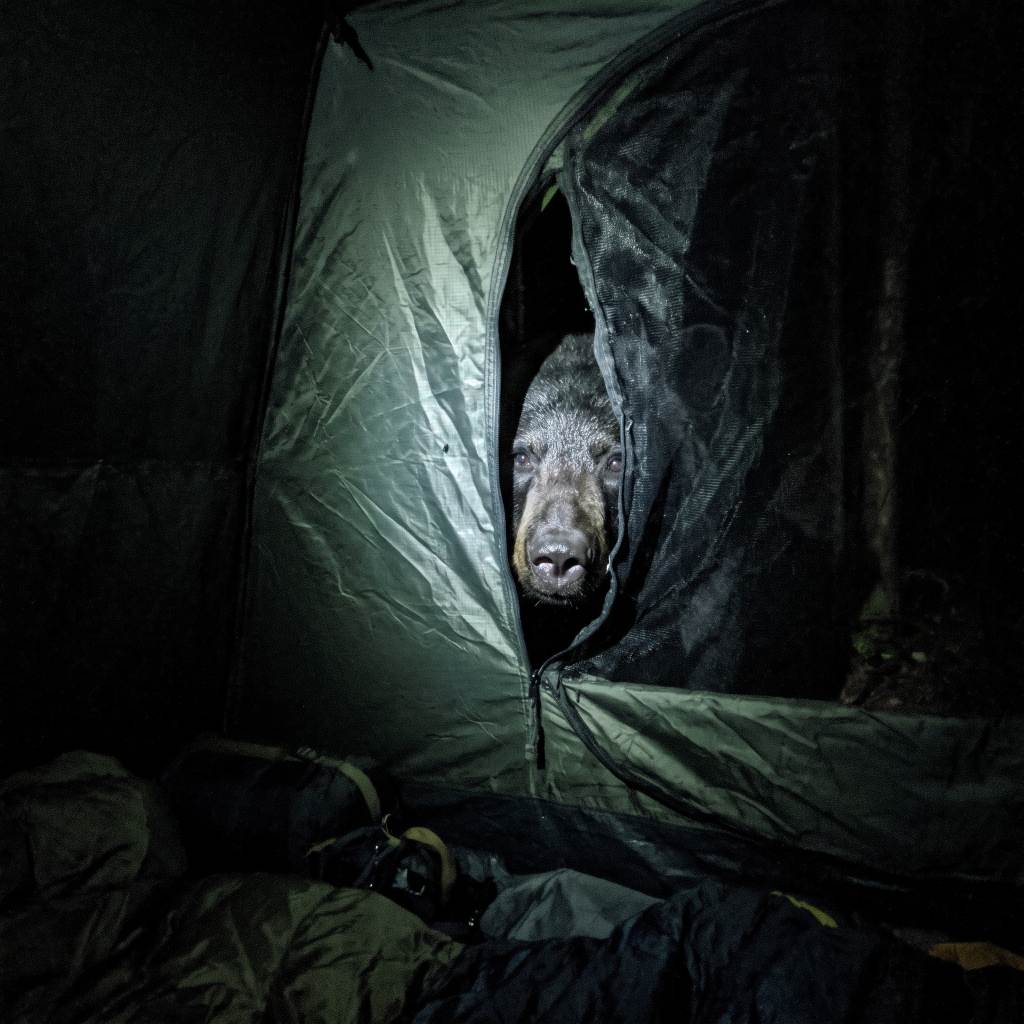
Around 1 a.m. in May 2018, a northern British Columbia camper woke up to a mature black bear sniffing his torso through a ripped tent window.
The encounter happened at Peace Island Park, roughly 20 kilometers southeast of Fort St. John. The bear had torn through the tent's mesh screen and pushed halfway inside. Startled awake, the man yelled and kicked at the animal until it backed out and fled into the dark.
Three hours later, around 4 a.m., the bear returned to the campsite and had to be chased off a second time. Later that morning, B.C. Conservation Officer Service personnel arrived and set snares around the site. By dusk, officers had trapped the animal, matched its paw prints to confirm they had the right bear, and euthanized it.
Conservation Sergeant Shawn Brinsky called the incident the kind of report wildlife officers dread. "You don't ever want to hear those stories," he told CBC News. "That's about a close of a call as you can have."
Spotting a black bear in northern British Columbia is routine. Having one rip into an occupied tent is not. "In my 30 years of doing this job, I can tell you that a bear entering a tent is an extremely rare occurrence," Brinsky told the Victoria Times Colonist.
Wild black bears are naturally cautious around unfamiliar, enclosed spaces where they cannot easily see a threat or an exit. When a bear ignores that instinct and pushes straight into a tent with a person inside, biologists look at its history with human food rather than simple aggression.
"What's uncommon is for a bear to be willing to go into a confined space," Brinsky said. "That's a bear that's become very bold. There's zero doubt in my mind: that's a garbage-conditioned bear."
May sits right in the middle of the highest-risk window for that behavior across northern bear country. Black bears emerging from winter dens face a lean stretch of weeks before spring green-up, insects, and summer berries take off. Running on an empty stomach after months of fasting, a bear that finds unsecured trash or camp food learns quickly that human spaces offer dense calories with almost no effort.
Once a bear becomes heavily food-conditioned, wildlife agencies have very few safe options left. Relocating a bold adult rarely works. Bears carry a strong homing instinct and will often travel long distances back to their original range, or simply seek out the next campground or dumpster wherever they are dropped off. Tearing through a tent wall while someone is sleeping inside crosses a public safety line that rules out release.
The Peace Island Park camper walked away without a scratch, and the bear never actually attacked. Still, the outcome was decided well before that night, the moment an unsecured human meal taught a wild bear to stop fearing the outline of a tent.
Image is for illustration purposes only
Source: CBC News (May 15, 2018) / Victoria Times Colonist (May 15, 2018) / B.C. Conservation Officer Service